EV Battery Boom STALLED? Chinese Tech Visa Woes Hit India's Green Push!

Overview
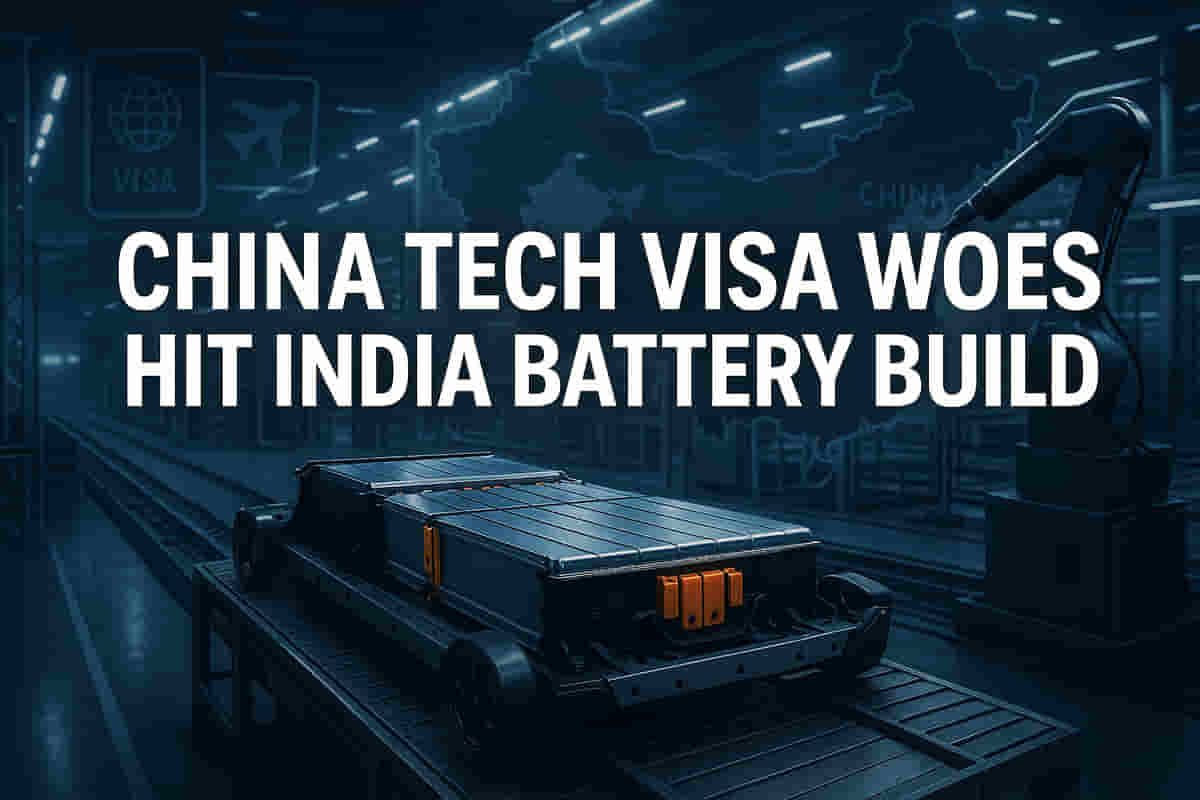
Delays in renewing visas for Chinese technicians are slowing the build-out of India's electric vehicle and energy storage battery manufacturing plants. This is impacting companies benefiting from the Production Linked Incentive (PLI) scheme, despite government efforts to expedite the process. The six-month visa validity is insufficient for project completion, requiring technicians to leave and reapply, causing significant project timeline extensions.
Stocks Mentioned
India's ambitious push for domestic lithium-ion battery manufacturing faces a significant hurdle as visa renewal issues for crucial Chinese technicians slow down project timelines for electric vehicles and energy storage.
Visa Hurdles
- Chinese technicians, essential for commissioning and maintaining advanced battery manufacturing machinery, are facing delays in visa renewals.
- Currently, these technicians receive only six-month visas, which require them to return to China and wait for several months before reapplying.
- This creates long gaps in project execution, pushing back construction and operational timelines.
- While business visas can be granted for up to five years as per Ministry of Home Affairs norms, the current short-term allocation for these specific technicians is proving inadequate.
PLI Scheme Impact
- The delays directly affect companies selected under the ₹18,100-crore Production Linked Incentive (PLI) scheme for Advanced Chemistry Cell (ACC) batteries.
- Beneficiaries include Reliance Industries, Ola Electric, and Rajesh Exports, whose progress on building 40 GWh manufacturing capacity has been described as "excruciatingly slow."
- The government is reportedly considering extending the PLI scheme's timelines due to this slow progress, as reported on December 1.
Technological Dependence
- China holds a dominant position globally in EV and battery technology, including essential raw material supplies.
- India currently relies heavily on Chinese technology and expertise for advanced battery manufacturing, with limited alternatives from Europe, Japan, and Taiwan.
- This dependence makes the physical presence of Chinese ground-level commissioning engineers critical, as stringent warranty clauses for the machinery may be voided if handled by local or non-authorised technicians.
- Companies are also forced to rely on video conferencing for technical assistance due to the lack of physical inspections.
Broader EV Push
- These challenges arise amidst India's strong drive to establish substantial domestic battery manufacturing capabilities for renewable energy and clean transportation.
- A projected surge in EV battery demand, potentially reaching 1,080 gigawatt-hours by 2050, underscores the urgency of building this capacity.
Government Response & Industry Views
- The government is reportedly aware of the visa challenges and is working to expedite applications, with renewal processes taking approximately six weeks.
- The Ministry of External Affairs stated in November 2024 that the visa regime for Chinese business travelers is "fully functional."
- However, industry bodies like the India Energy Storage Alliance (IESA) argue that six months is insufficient for completing large-scale battery projects and that the current process needs acceleration.
Impact
- These visa-related delays could significantly impact India's ability to meet its ambitious EV and renewable energy storage targets.
- It may lead to increased project costs, extended investment cycles, and a potential slowdown in the adoption of electric vehicles.
- The reliance on foreign expertise highlights the need for accelerated domestic skill development and technology transfer initiatives.
- Impact Rating: 8/10
Difficult Terms Explained
- PLI schemes: Production Linked Incentive schemes, designed by the government to boost domestic manufacturing by providing incentives based on incremental sales.
- Galwan clashes: A military confrontation between India and China in June 2020 along the Line of Actual Control.
- Business visas: Permits allowing foreign nationals to enter a country for business-related activities.
- Commissioning engineers: Specialists who oversee the installation, testing, and startup of new machinery or industrial plants.
- Gigawatt-hours (GWh): A unit of electrical energy, commonly used to measure the capacity of large battery systems or manufacturing plants.
- ACC batteries: Advanced Chemistry Cell batteries, referring to next-generation battery technologies that offer higher energy density and performance.
- EV: Electric Vehicle, a vehicle that uses one or more electric motors for propulsion.
Banking/Finance Sector

RBI Unleashes Free Banking Boost: Your Savings Account Just Got a Major Upgrade!

Bond Market Frenzy! Top Companies Rush to Raise Record Funds Ahead of RBI MPC Amid Yield Fears!
Other Sector