

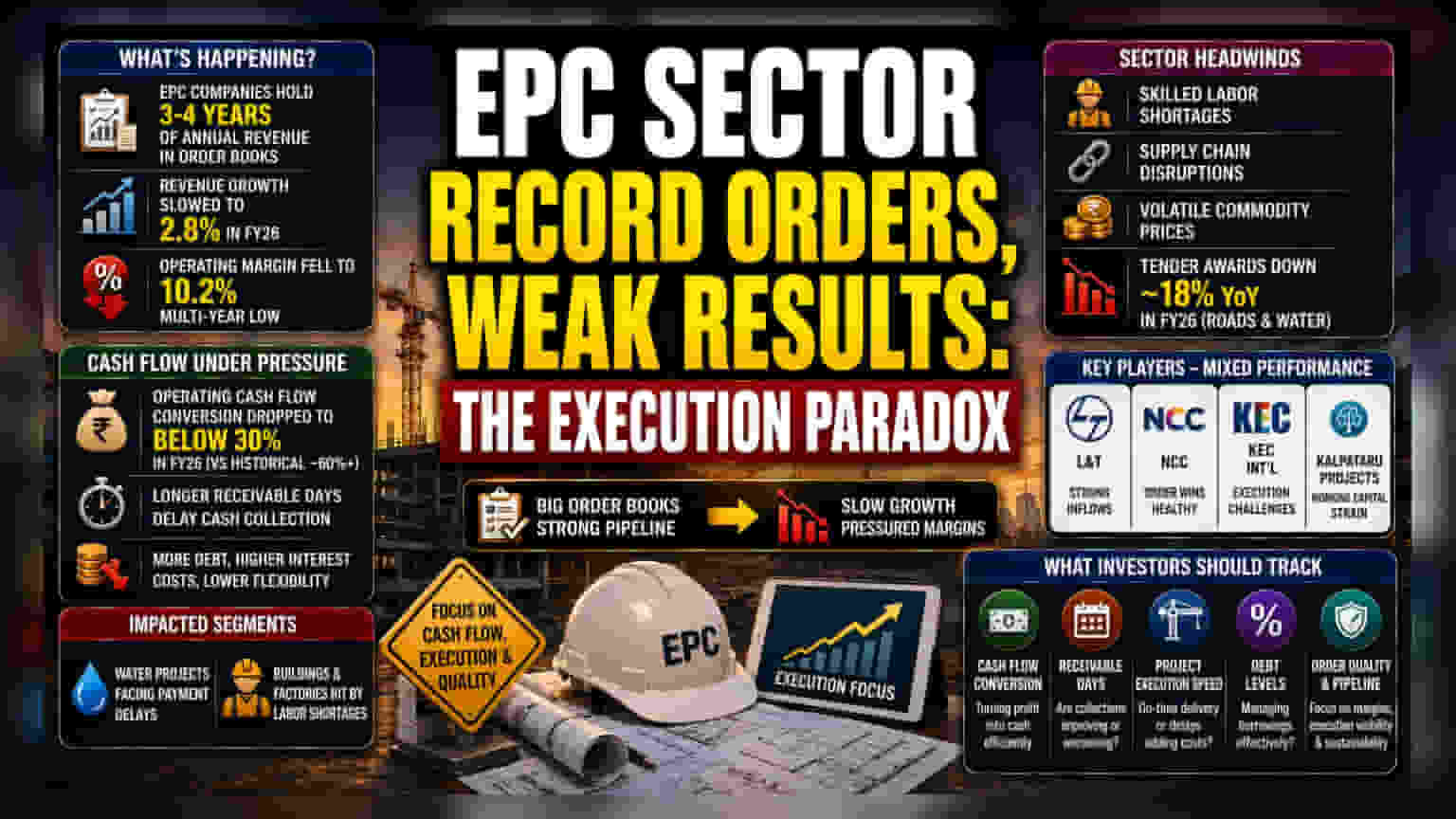
While India's EPC companies hold record-high order backlogs, they are struggling to convert these into actual profit and cash. Sector revenue growth slowed to 2.8% in FY26, with margins touching multi-year lows. Investors are shifting their focus from new contract wins to actual execution speed and cash flow management, as companies face payment delays and labor issues.
What Happened
India's Engineering, Procurement, and Construction (EPC) sector is facing a paradox. Companies currently hold record order books—some equivalent to three to four years of their annual revenue—yet they are struggling to translate this pipeline into actual financial performance. Recent data shows that the sector's revenue growth slowed to just 2.8% in the fiscal year ending March 2026 (FY26). Profitability is also under pressure, with operating profit margins falling to a multi-year low of 10.2%.
The Gap Between Orders And Results
For investors, an order book is usually a signal of future income. However, the current situation highlights that having orders does not always guarantee quick or profitable revenue. Companies are facing multiple hurdles in getting projects off the ground. These include a shortage of skilled labor, supply chain disruptions for raw materials, and volatile commodity prices that make budgeting for long-term projects difficult.
Because of these persistent problems, the FY27 revenue growth forecast for the sector has been lowered to mid-single digits, down from earlier expectations of 10%. This indicates that the market needs to adjust its growth expectations for several players in the industry.
Where The Cash Flow Is Stuck
One of the most critical issues currently is cash conversion. Simply put, companies are finding it harder to collect cash from their clients after completing work. Operating cash flow conversion—the measure of how much profit actually turns into cash—has dropped to below 30% in FY26. This is less than half of what the sector has historically achieved.
This cash flow strain creates a ripple effect. It often forces companies to rely on more debt to cover their day-to-day operations, which increases interest costs and reduces the money available for other business needs. Specific segments are also feeling the heat: water projects are seeing payment delays, and the buildings and factories segment is dealing with labor availability issues.
How The Sector Is Reacting
Large players like Larsen & Toubro (L&T), NCC, KEC International, and Kalpataru Projects International have different stories to tell within this challenging environment. For instance, while some firms report strong inflows, others are battling working capital strain. A notable trend is a slowdown in new tender awards, which dropped by nearly 18% year-on-year in FY26. This decline, particularly in roads and water projects, suggests that the pipeline for future work may not be as full as it was in the past.
What To Watch Next
Investors are shifting their focus away from just looking at the size of the order book. Instead, they are now watching the quality of the execution. Important metrics for the coming quarters include:
- Cash Flow Conversion: Can the company turn its profits into cash more efficiently?
- Receivable Days: Is the time taken to collect payments from clients improving or getting worse?
- Project Execution Speed: Are projects being completed within the planned timeline, or are they facing delays that increase costs?
- Debt Levels: Is the company managing its borrowings effectively despite the pressure on cash flow?
By tracking these, investors can better understand which companies are navigating the sector's current difficulties and which ones are still facing significant operational risks.