

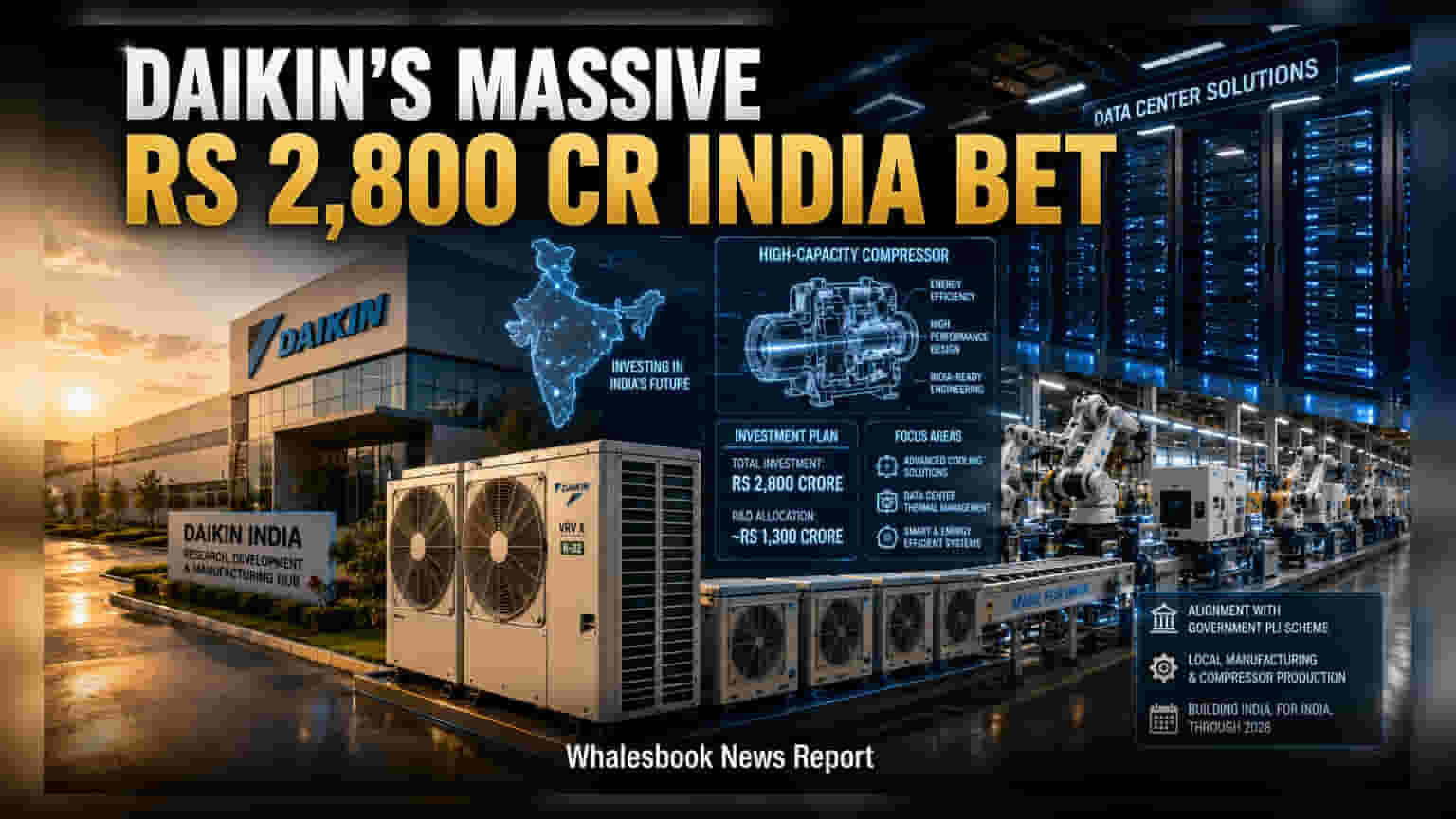
Japanese cooling major Daikin Industries has announced a Rs 2,800 crore investment to scale its Indian manufacturing and research capabilities. Focusing on high-capacity cooling for data centers and deeper localization under government incentives, the move signals a shift in the domestic HVAC landscape. While the company is not listed on Indian exchanges, the expansion increases competitive pressure within the country's appliance sector.
Daikin Industries, the Japan-based global leader in air conditioning, has announced a fresh investment of Rs 2,800 crore to strengthen its presence in India. This capital infusion is set to support the company's roadmap for domestic research, development, and manufacturing through 2028. For Indian investors, it is important to note that Daikin’s Indian arm operates as a private, wholly-owned subsidiary of the Japanese parent and is not directly listed on the National Stock Exchange (NSE) or the Bombay Stock Exchange (BSE).
Out of the total investment, approximately Rs 1,300 crore is specifically earmarked for research and development. The company plans to establish a dedicated innovation center that will focus on high-capacity cooling systems. A primary driver for this R&D push is the rapidly expanding data center market in India, which requires specialized, energy-efficient thermal management solutions to keep server infrastructure running optimally. By tailoring its technology to India's specific climate conditions, Daikin aims to move beyond standard residential air conditioning to capture demand from industrial and commercial infrastructure projects.
This investment is closely aligned with the Indian government's Production Linked Incentive (PLI) scheme for white goods. The government has been actively encouraging multinational companies to reduce their reliance on imports and increase the local manufacturing of critical components, such as compressors. By deepening its localization efforts, Daikin is attempting to improve its cost structure and supply chain reliability, effectively moving the company’s Indian operations from an assembly-focused model to an integrated manufacturing hub.
The broader implications for the Indian appliance and HVAC sector are significant. As Daikin deepens its local manufacturing and research capabilities, it adds to the competitive intensity faced by established listed players like Voltas, Blue Star, and Havells. While these domestic companies have their own distribution networks and strong market shares, the entry of more localized, high-tech manufacturing by global giants can impact pricing strategies and product innovation cycles across the industry.
Despite the growth potential, there are risks to consider. The company faces a highly competitive environment where profit margins are sensitive to fluctuations in the cost of raw materials and global supply chain stability. Furthermore, executing large-scale, multi-year projects such as the innovation center through 2028 involves operational risks, including potential cost overruns or delays in development. The sector’s revenue growth is also subject to seasonal variations in demand, often driven by extreme weather patterns, which can lead to volatility in sales performance.
Moving forward, the key factor for the sector will be how quickly Daikin can operationalize its new R&D capacity and whether this leads to a shift in market share. Investors may monitor updates regarding the company’s localization progress and its success in securing large-scale commercial contracts, as these developments will influence the competitive landscape for other cooling and appliance manufacturers operating in India.