 Whalesbook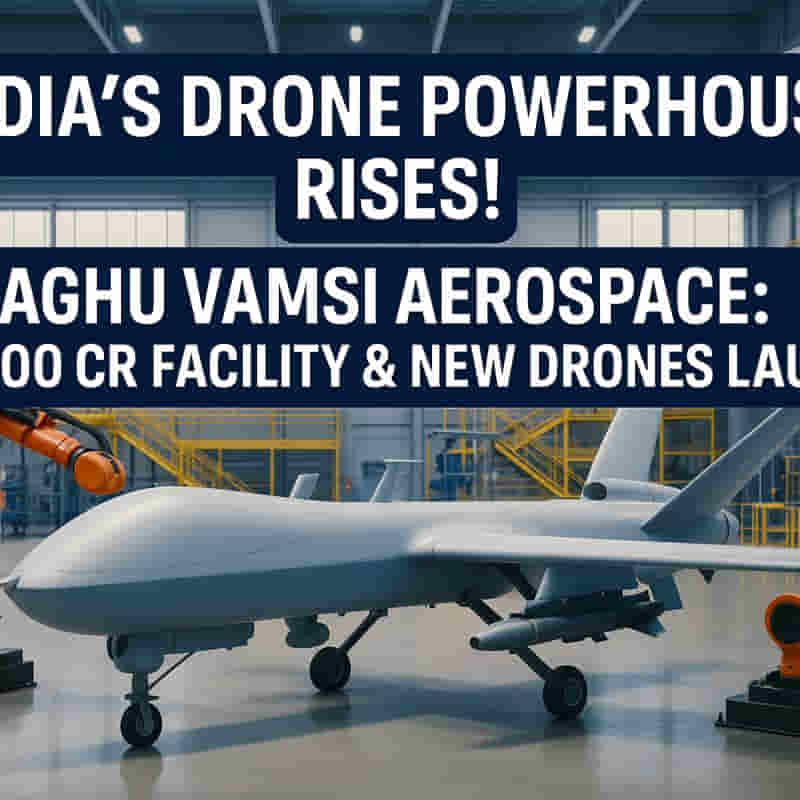
India's Defence Manufacturing Poised for Growth with New Raghu Vamsi Aerospace Facility
Raghu Vamsi Aerospace Group marked a significant milestone on Monday by inaugurating a new deep-tech design, production, and integration facility in Hyderabad. This launch underscores India's growing prowess in indigenous defence technology.
The state-of-the-art facility, located at the Citadel Campus in Hardware Park near the Rajiv Gandhi International Airport, represents an investment of ₹100 crore. This capital infusion highlights the company's commitment to advancing its manufacturing capabilities and technological development.
Indigenous Innovation Takes Flight
Alongside the new facility, the group proudly introduced six indigenous unmanned aerial vehicles (UAVs) and autonomous defence products. These new offerings are set to enhance India's strategic defence capabilities and position the nation as a key player in the global aerospace market.
The innovative product line includes jet-powered loitering munitions, decoy drones, target drones, tethered surveillance drones, air-based missile launchers, micro turbojet engines, long endurance UAVs, unmanned ground vehicles (UGVs), autonomous ground combat systems, and robotic aircraft maintenance solutions. These advanced systems are designed to operate over long ranges and at high speeds.
Strategic Expansion and Economic Impact
Raghu Vamsi Aerospace Group, already a significant player with a network of 10 manufacturing locations across three countries and over 1,000 employees, supplies critical aero engines and missile sub-systems. The company's current revenue stands at ₹500 crore.
Further demonstrating its growth ambitions, the group announced plans for another manufacturing facility within the same park, slated for investment by 2026. This future facility will require an additional ₹300 crore investment and will span 2.5 lakh square feet across eight acres. It is projected to generate employment for over 2,000 people within the next three years, significantly contributing to local employment and economic development.
Strengthening Strategic Capabilities
Vamsi Vikas, Founder and Managing Director of Raghu Vamsi Aerospace Group, emphasized the strategic importance of the new infrastructure. "We have added large-scale infrastructure for design, system integration, assembly, and testing. This new facility strengthens the Group’s ability to support Indian strategic programmes and global customers with faster turnaround times and scalable production," he stated.
A Shift in Technological Leadership
The newly launched products are engineered to exceed ranges of 300 km with speeds up to 650 kmph. Vamsi Vikas noted the broader implication of this development: "The new product line underscores the country’s shift from being a buyer of UAV and propulsion technologies, to a nation capable of designing and manufacturing unmanned systems at scale."
Impact Rating: 7/10
Difficult Terms Explained
- Deep-tech: Advanced technology requiring substantial research and development, often based on scientific discovery or engineering breakthroughs.
- Production: The process of manufacturing goods or products.
- Integration: The process of combining different components or systems into a unified whole.
- UAV (Unmanned Aerial Vehicle): An aircraft that operates without a human pilot onboard, controlled remotely or autonomously. Commonly known as a drone.
- Autonomous: Capable of operating and making decisions independently without direct human intervention.
- Defence products: Items or systems specifically designed for military or national security purposes.
- Citadel Campus: A specific, named site where the new facility is located.
- Hardware Park: An industrial zone designated for companies involved in hardware manufacturing and related technologies.
- OEM (Original Equipment Manufacturer): A company that manufactures parts or components that are incorporated into another company's final product.
- Aero engines: Engines used to power aircraft.
- Missile sub-systems: Components that are part of a larger missile system.
- Global OEMs: Original Equipment Manufacturers that operate and supply products worldwide.
- Defence public sector units: State-owned enterprises that are part of a country's defense industry.
- Revenue: The income generated from a company's normal business activities over a period.
- Loitering munitions: Weaponized drones that can stay airborne for extended periods, surveilling an area before attacking a target.
- Decoy drones: Drones designed to mislead enemy targeting systems by mimicking the signature of more valuable assets.
- Target drones: Drones used for training and testing purposes, simulating adversary aircraft or missiles.
- Tethered surveillance drones: Drones connected to a ground station via a cable for continuous power and communication, used for persistent surveillance.
- Air-based missile launchers: Devices mounted on aircraft or aerial platforms for deploying missiles.
- Micro turbojet engines: Small, compact jet engines suitable for powering small unmanned vehicles or missiles.
- Long endurance UAVs: Drones designed to fly for extended periods.
- UGVs (Unmanned Ground Vehicles): Vehicles that operate on land without a human driver, controlled remotely or autonomously.
- Autonomous ground combat systems: Robotic systems designed for warfare on the ground that can operate with a degree of independence.
- Robotic aircraft maintenance solutions: Automated systems or robots used for the servicing and repair of aircraft.