

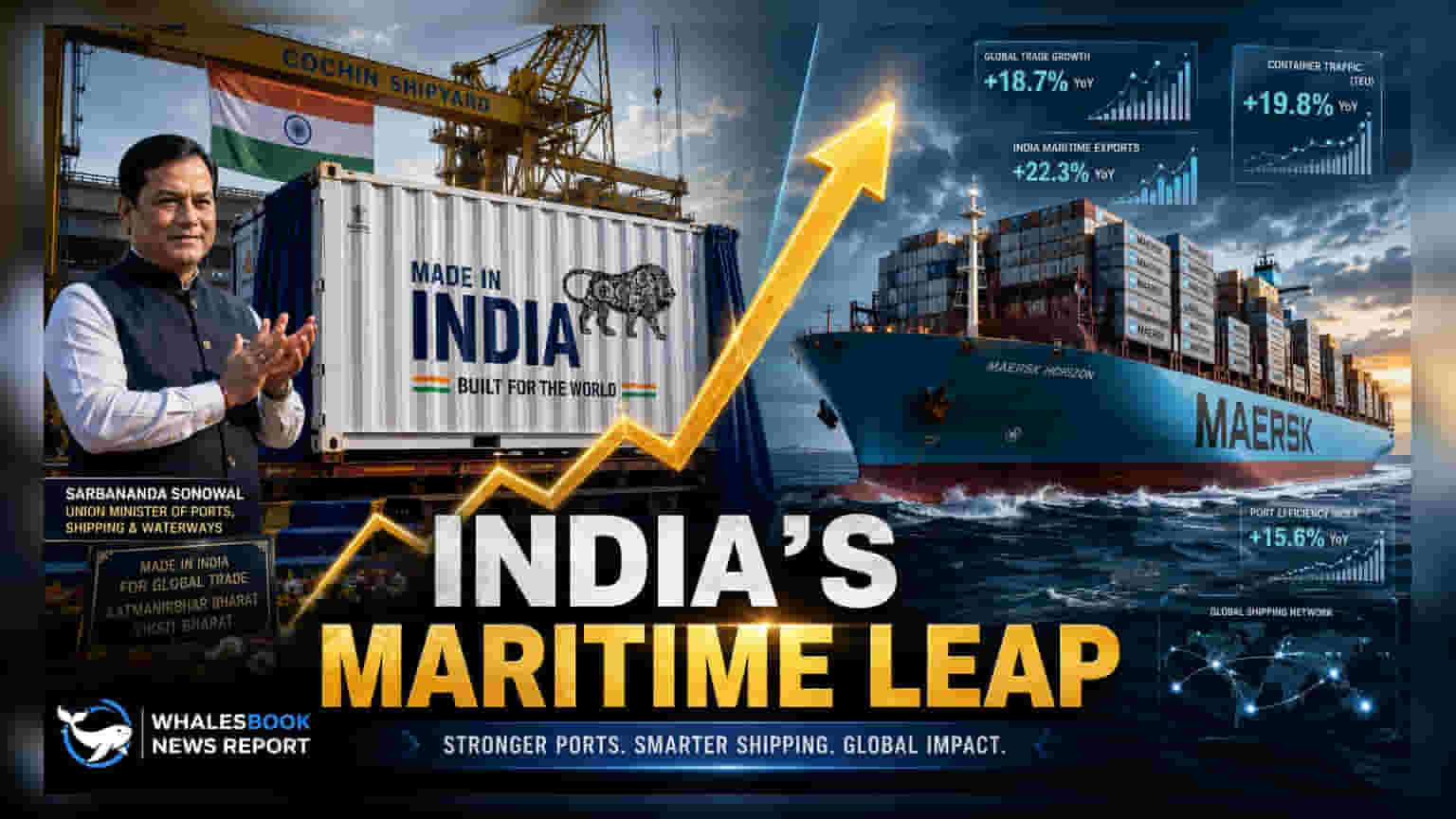
India has unveiled its first domestically manufactured EXIM shipping container, with DCM Shriram securing an order for 1,000 additional units from global giant Maersk. The project aligns with the new ₹10,000 crore Container Manufacturing Promotion Scheme aimed at reducing import reliance.
What Happened
India has officially launched its first domestically manufactured export-import (EXIM) shipping container, marking a significant step toward reducing reliance on imports for maritime logistics. The inauguration ceremony took place at the Maersk-CONCOR Inland Container Depot in Dadri, Uttar Pradesh, led by Union Minister for Ports, Shipping, and Waterways, Sarbananda Sonowal. During the event, the DCM Shriram Group secured a fresh order for 1,000 shipping containers from A.P. Moller-Maersk, a global leader in the shipping industry. This development follows a period of government-led efforts to boost domestic manufacturing capabilities for critical logistics infrastructure.
The Shift to Domestic Manufacturing
For years, India has relied heavily on imported containers to support its growing trade volume. The domestic production of these units, which must adhere to strict international ISO and International Convention for Safe Containers (CSC) standards, is designed to integrate India into the global maritime value chain. The government has framed this as a key success of the 'Make in India' initiative, with the project moving from policy discussions to manufacturing reality in roughly sixteen months.
Impact of the Container Manufacturing Promotion Scheme
This manufacturing effort is closely tied to the Union Budget 2026’s ₹10,000 crore Container Manufacturing Promotion Scheme (CMPS). The scheme is designed to provide financial support for both capital and operational expenses to companies establishing or scaling container production facilities in India. By offering incentives for research, testing, and skill development, the government aims to increase annual manufacturing capacity to 7.5 lakh TEUs (Twenty-foot Equivalent Units). For investors, the success of companies like DCM Shriram in this space will likely depend on their ability to maintain cost-competitive production while scaling capacity to meet the targets set under the CMPS.
Challenges and Execution Risks
While the order book for container manufacturers may see an uptick due to government incentives, the sector faces inherent risks. Scaling production to meet international quality standards requires consistent technological upgrades and skilled labour. Furthermore, the global shipping industry is highly sensitive to trade cycles. If global demand for goods slows, shipping lines may reduce their container procurement, which could impact the order inflow for local manufacturers. Additionally, while the government provides incentives, manufacturers remain exposed to fluctuations in raw material prices, particularly steel, which is a primary input for container production.
What Investors Should Track
The most important monitorable for investors is the successful scaling of manufacturing units beyond initial prototypes. Investors should keep an eye on:
- The timeline for the delivery of the 1,000 containers ordered by Maersk.
- Further announcements regarding the disbursement of incentives under the CMPS.
- Updates on the Merchant Shipping Act, 2025, and how it influences port infrastructure projects like the upcoming Vadhavan Port.
- Any future order wins or capacity expansion plans announced by the DCM Shriram Group in the container segment.