 Whalesbook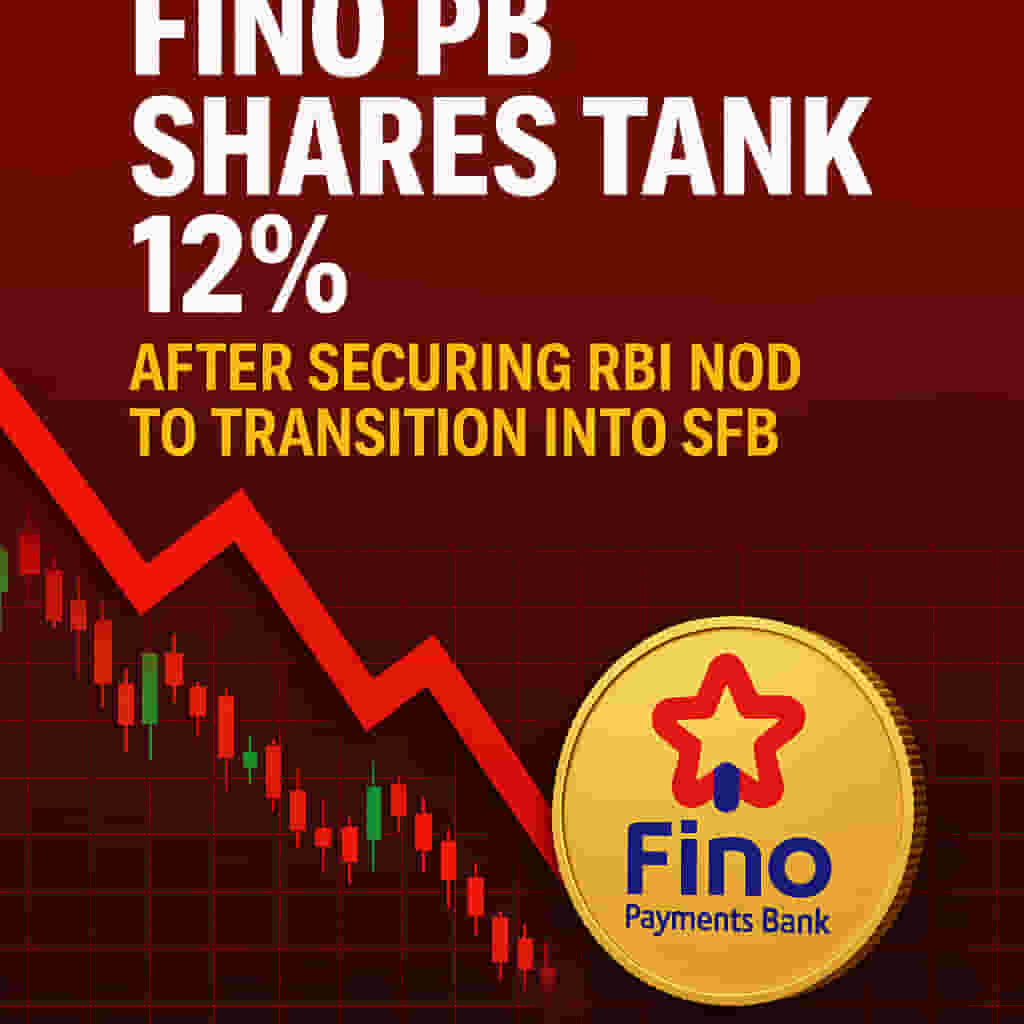
Fino Payments Bank Faces Steepest Ever Stock Drop
Fino Payments Bank Limited experienced its most significant single-day share price decline on Monday, with its stock tumbling over 12 percent to close at Rs 275 on the National Stock Exchange (NSE). This record fall occurred shortly after the company announced it had secured approval from the Reserve Bank of India (RBI) to transition into a small finance bank.
RBI Grants Approval for Small Finance Bank Transition
The approval from the RBI marks a significant milestone for Fino Payments Bank, making it the first payments bank to receive the nod for such a transformation. The bank had initially applied for this conversion two years ago. The regulator has granted Fino Payments Bank a period of 18 months to complete the transition into a fully-fledged small finance bank.
Analysis: Why the Stock Fell Despite Positive News
While the RBI approval is fundamentally positive for Fino Payments Bank's long-term growth prospects, market experts attribute the sharp stock price drop to several factors. A primary reason cited is profit-taking by investors following a considerable rally of approximately 15 percent in the stock over the preceding two weeks. Furthermore, the broader market sentiment played a role, with the Nifty Smallcap 100 index itself declining by 2.6 percent on Monday, indicating a general sell-off in small-cap stocks.
Emkay's Outlook: Strategy for Lending Growth
According to a report by Emkay Global Financial Services, Fino Payments Bank is expected to remain predominantly a payment-focused entity in the initial years of its transition. The bank plans to gradually build its lending business by leveraging its existing customer base to ensure portfolio quality and profitability. Emkay projects that the bank aims to build a loan asset under management (AUM) of Rs 5,000 crore between FY28-30. This AUM is anticipated to comprise 65-70 percent MSME loans and 30-35 percent loan against property and mortgages, contributing 20-25 percent of total revenue by the end of three years of SFB operations. The initial loan portfolio is expected to carry a higher blended yield due to MSME loans, with a strategic shift towards secured lending potentially moderating yields, partly offset by reduced funding costs.
Regulatory Compliance and Shareholding
As a small finance bank, Fino Payments Bank will need to adhere to specific regulatory requirements. These include maintaining promoter (Holdco) shareholding of at least 40 percent for the first five years of its SFB operations. This stake will need to be reduced to 26 percent within 15 years, in line with regulatory caps on individual voting rights.
CEO's Vision for Cautious Lending
Rishi Gupta, Managing Director and Chief Executive Officer of Fino Payments Bank, stated in a recent interview that the bank intends to adopt a cautious approach to its lending strategy. The focus will be on specific geographies and points of contact rather than immediate nationwide expansion of lending operations. He emphasized that the bank would continue to grow and build its deposit base.
Impact
- The transition to a small finance bank allows Fino Payments Bank to offer a wider range of lending products, potentially boosting revenue and profitability.
- The stock price volatility highlights investor caution regarding the execution risks and timeline of this transformation.
- The broader market conditions and profit-taking sentiment are currently overshadowing the positive regulatory development for the stock.
- Impact Rating: 7/10
Difficult Terms Explained
- Payments Bank: A differentiated bank tier that can accept deposits but has restrictions on lending and issuing credit cards. They focus on small deposits and payment services.
- Small Finance Bank (SFB): A type of bank that aims to provide financial services to unserved and underserved sections of the population, including MSMEs, small farmers, and individuals. SFBs can accept deposits and offer lending.
- Asset Under Management (AUM): The total market value of all the financial assets that a financial institution manages on behalf of its clients. In this context, it refers to the total value of loans the bank has disbursed.
- MSME: Micro, Small and Medium Enterprises, a crucial sector for economic growth that requires access to credit.
- Holdco: Holding Company, which owns a controlling stake in another company (in this case, Fino Payments Bank).