 Whalesbook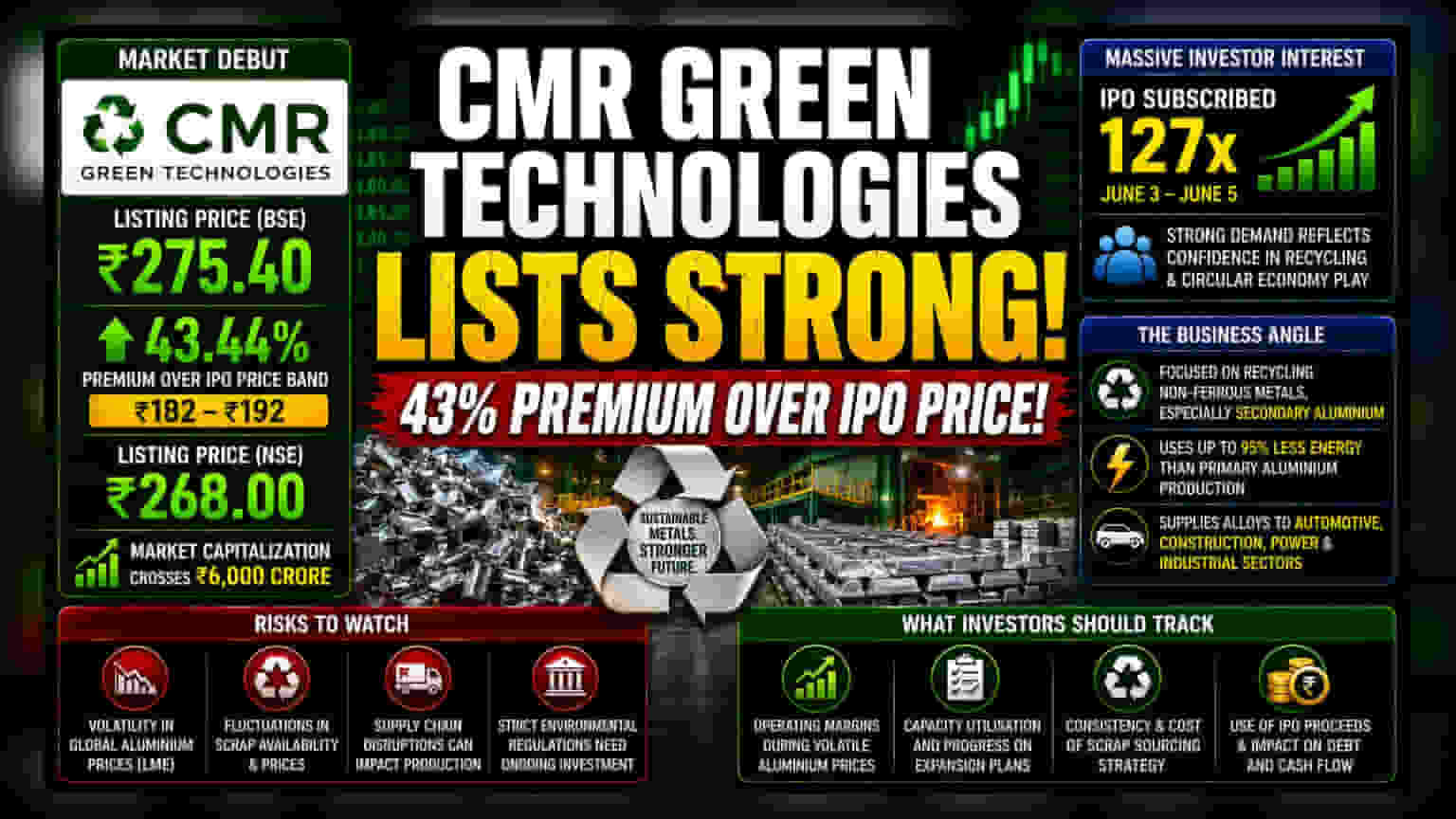


CMR Green Technologies listed at Rs 275.40, a 43% jump over its IPO price. The strong market entry follows a 127x subscription, signaling high interest in the company's secondary aluminium recycling business. Investors are now evaluating the stock's long-term sustainability amid raw material price volatility.
What Happened
CMR Green Technologies, a company focused on recycling non-ferrous metals, made a strong entry into the stock market on Wednesday. The shares began trading at Rs 275.40 on the BSE, marking a significant premium of 43.44% over its initial public offering (IPO) price band of Rs 182-192. On the National Stock Exchange (NSE), the stock opened at Rs 268, reflecting a similar trend. The market capitalization of the company crossed Rs 6,000 crore following the listing, a valuation that exceeded many analyst expectations ahead of the debut.
Why Investors Were Interested
The robust listing follows an IPO process that saw massive interest from investors. The issue was subscribed 127 times between June 3 and June 5, which indicated high demand for the company's business model. Investors often look at metal recycling as a play on the circular economy and industrial growth, particularly in the automotive sector where secondary aluminium is widely used to manufacture lighter and more fuel-efficient vehicles.
The Business Angle
CMR Green Technologies operates in the secondary aluminium space, which involves collecting scrap metal and processing it into alloys. Unlike primary aluminium producers who mine bauxite, secondary producers rely on scrap. This business model offers a unique advantage because it consumes significantly less energy than primary production. However, it also makes the company sensitive to the availability and price of scrap metal. The company’s growth strategy is tied closely to the industrial demand for these alloys in sectors like automotive, construction, and power, where light-weighting is increasingly important.
Risks and Industry Challenges
While the market reaction has been positive, investors should remain aware of specific sector risks. Companies in the recycling space are highly sensitive to price fluctuations in the global aluminium market. Since the cost of scrap metal changes frequently based on global trends, profit margins can be volatile. If the cost of raw materials rises quickly, the company may find it difficult to pass those costs on to customers immediately. Furthermore, the industry relies on a consistent and high-quality supply of scrap. Any disruption in the collection or supply chain of scrap metal could impact the company's production capacity. Environmental regulations regarding recycling plants are also becoming stricter, which necessitates ongoing capital investment in compliance and technology.
What Investors Should Track
The most important monitorable for shareholders is the stability of the company's operating margins. Since the business is a processor of raw materials, investors should look at whether it can maintain its profitability when aluminium prices on the London Metal Exchange (LME) are volatile. Additionally, management commentary on capacity utilisation and the ability to source scrap consistently will be key. As the company uses the capital raised from the IPO, watching the progress of any announced expansion or efficiency projects will also be important to understand how the company plans to scale its operations while managing its debt and cash flow effectively.