 Whalesbook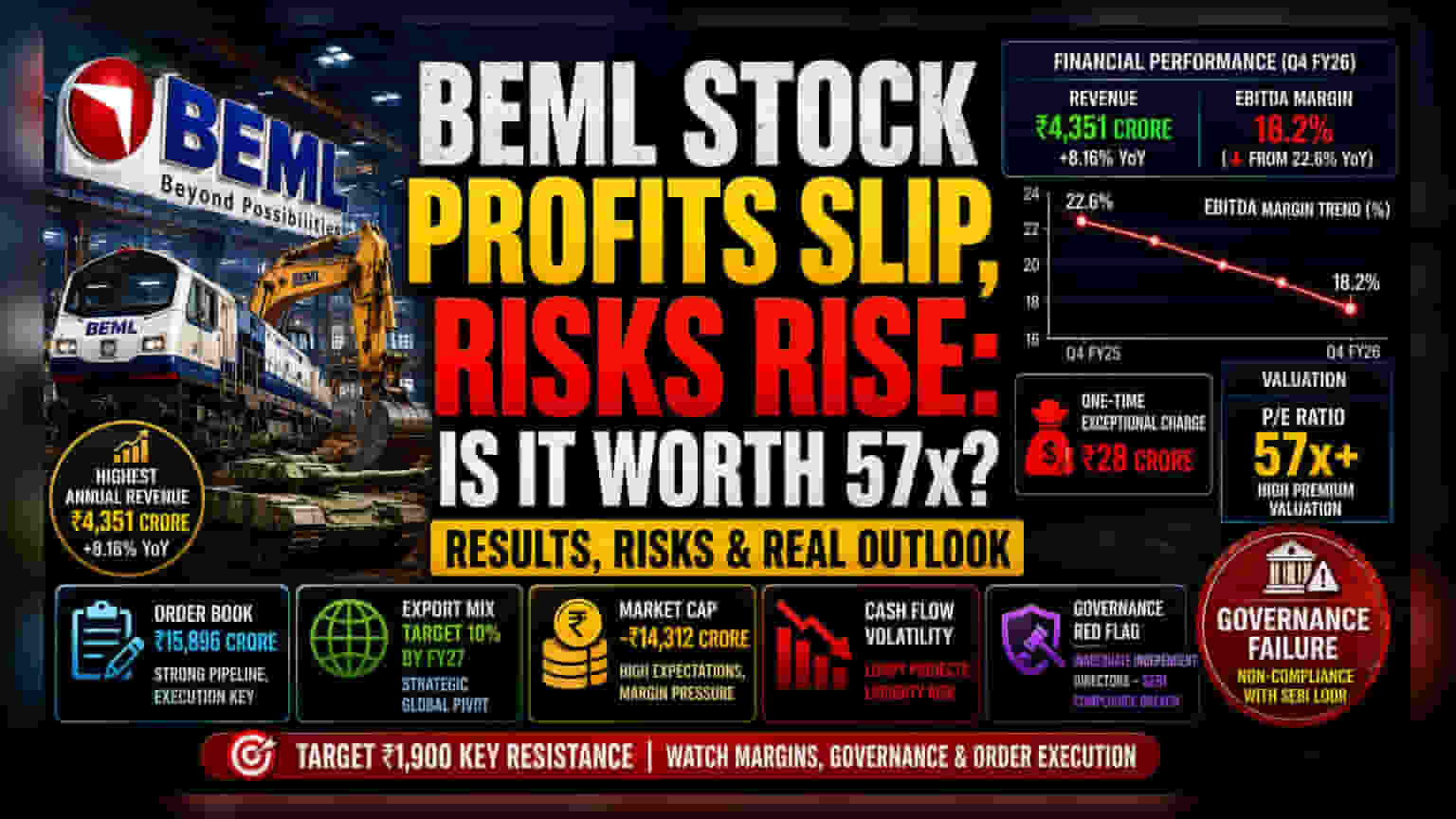


The Valuation Gap
BEML’s recent financial results illustrate a classic divergence between top-line expansion and operational efficiency. Although the company clocked its highest-ever annual revenue—an 8.16% increase to ₹4,351 crore—the market has reacted with skepticism. The core issue lies in the quality of earnings. EBITDA margins for the fourth quarter dropped to 18.2%, down significantly from the 22.6% reported in the same period last year. This compression, compounded by a ₹28 crore one-time exceptional charge, has triggered a re-evaluation of the company’s ability to protect its profitability amidst inflationary pressures and execution delays.
The Analytical Deep Dive
While the market cap currently sits near ₹14,312 crore, the stock is trading at a premium valuation with a P/E ratio exceeding 57x. This high multiple assumes a rapid conversion of its ₹15,896 crore order book into high-margin revenue. However, competitors in the heavy engineering and defence space are facing similar headwinds, including rising input costs and competitive pricing pressure. Unlike some of its private-sector peers that have successfully optimized working capital, BEML’s reliance on large, long-gestation railway and defence projects subjects its cash flows to lumpy, unpredictable cycles. The transition toward a 10% export mix by FY27 is a necessary strategic pivot, but until this manifests in consistent quarterly margin expansion, the stock remains vulnerable to sector-wide volatility.
Structural Weaknesses and Governance Risks
Beyond the financials, the company has hit a critical regulatory roadblock. Statutory auditors recently flagged a significant governance failure: the board of directors currently lacks the required number of independent directors, a direct breach of SEBI’s Listing Obligations and Disclosure Requirements (LODR) regulations. In an era where institutional investors demand high standards of corporate governance, this compliance lapse acts as an unnecessary discount on the stock. Furthermore, historical reliance on government orders creates a concentration risk. Any delay in the finalization of major metro rolling stock or defence contracts directly impacts the firm's liquidity, as evidenced by the recent fluctuation in its operating cash flow metrics.
The Future Outlook
Management’s guidance for sustained inflow in FY27 hinges on a 50% success rate from a ₹100 billion pipeline. While the dividend declaration of ₹2.85 per share offers some consolation to shareholders, the overarching sentiment remains cautious. Future price action will likely be determined by the timely appointment of independent board members and the ability to demonstrate margin stabilization in upcoming quarters. Until the operational drag from legacy issues is fully cleared and the board composition is normalized, the stock is expected to face resistance around the ₹1,900 level.