 Whalesbook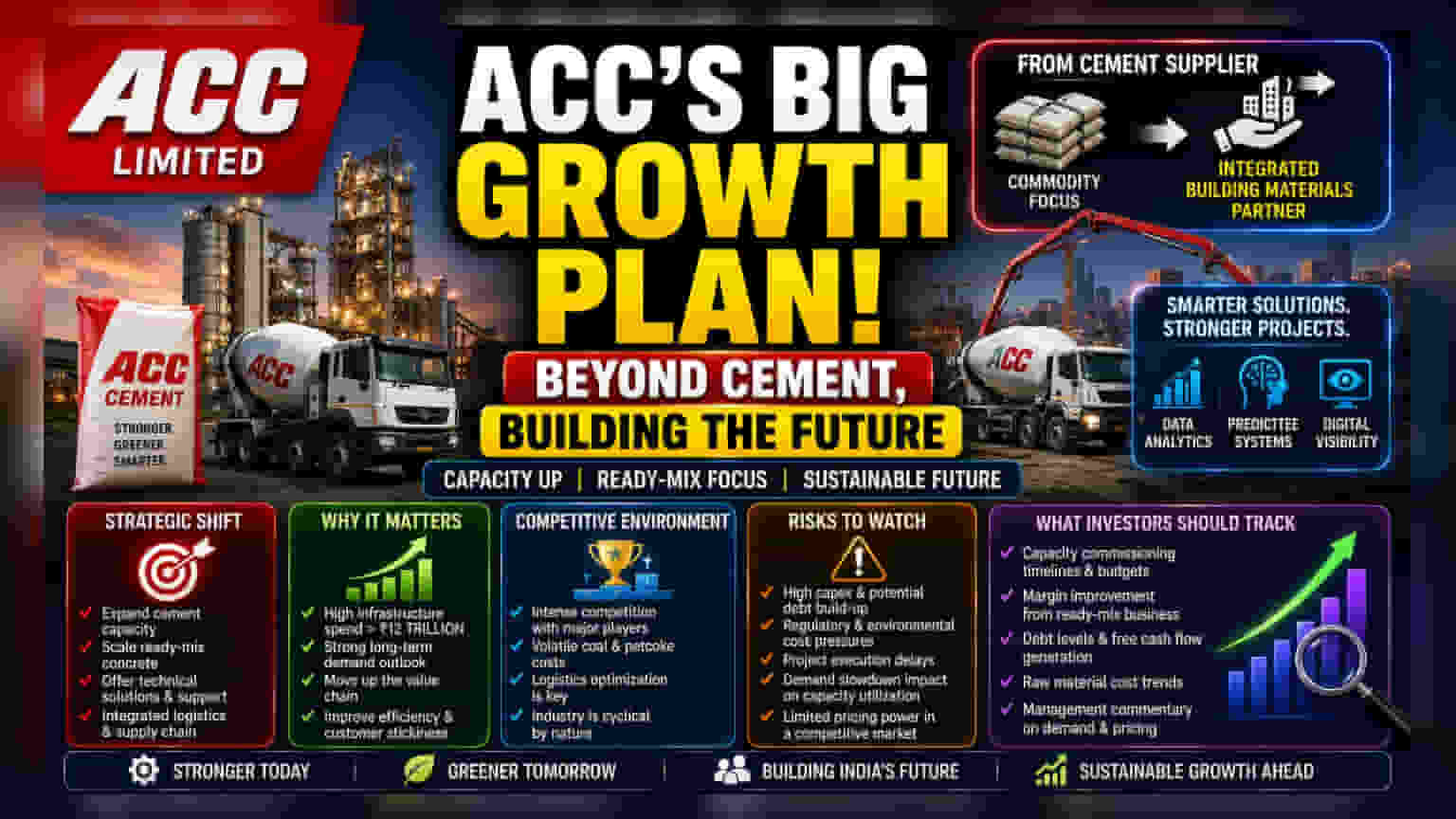


ACC Ltd has announced plans to expand its cement production capacity and ready-mix concrete footprint while focusing on low-carbon technology and logistics. Chairman Karan Adani noted the company's strategy to navigate moderate near-term demand while leveraging India's long-term infrastructure potential. Investors may monitor how this capital-intensive growth plan balances against debt levels and competitive pressures in the cement industry.
What Happened
ACC Ltd has announced a strategic plan to grow its cement production capacity and expand its presence in the ready-mix concrete market. During a recent address, Chairman Karan Adani confirmed that the company will take a balanced approach to this growth. The plan involves deeper integration across logistics networks, the adoption of low-carbon technologies, and the use of data analytics to improve operational efficiency. The company aims to move beyond supplying cement as a raw material, positioning itself instead as an integrated building materials provider that offers technical support and project-specific solutions.
The Strategic Shift
The shift in strategy reflects a broader goal within the Adani cement business to transform from a commodity-focused model to one that offers comprehensive construction solutions. By focusing on ready-mix concrete and offering services like mix optimization, the company intends to become an active partner in project execution. This is supported by investments in digital visibility and predictive systems across manufacturing and logistics, which the company claims will reduce waste and improve project timelines. This approach is designed to differentiate ACC in a crowded market where performance and reliability are becoming as important as the product itself.
Financial and Industry Context
India's cement sector is currently witnessing high activity, driven by significant government spending on infrastructure, which is estimated to be over ₹12 trillion. While this creates a strong long-term outlook, the industry is capital intensive, requiring large investments to build and maintain plants. Companies in this space typically manage high costs related to energy, fuel, and logistics. For ACC, the challenge lies in scaling its capacity efficiently without straining its balance sheet. Investors often look at how effectively a company manages these large investments, as excessive spending during periods of moderate demand can put pressure on profit margins and cash flow.
Peer and Sector Check
The Indian cement industry is highly competitive, with major players like UltraTech Cement leading in capacity and market reach. Like its peers, ACC faces challenges such as volatile raw material costs—specifically coal and petcoke—and the need for constant logistical optimization to keep distribution costs low. The cement sector is also cyclical, meaning demand often fluctuates based on the pace of construction, government infrastructure releases, and monsoon patterns, which can impact regional sales volume. Staying competitive requires continuous investment in capacity, but also necessitates careful control over debt and operational costs to maintain profitability.
Risks and Concerns
While the expansion plan focuses on growth, it brings inherent risks that shareholders should consider. Large-scale capacity additions require substantial capital, which can lead to increased debt if cash flows do not match the pace of investment. Additionally, the cement industry is sensitive to regulatory changes and environmental standards, which could increase operational costs. Any delay in project execution or a slowdown in the expected demand for infrastructure projects could impact the company's ability to utilize its new capacity effectively. Furthermore, intense competition means that companies have limited power to pass on cost increases to customers if demand remains moderate.
What Investors Should Track
Moving forward, investors may want to track several key areas to gauge the company's progress. First, watch for updates on the specific timelines for capacity commissioning to see if projects remain on schedule and within budget. Second, monitor the company’s profit margins in quarterly results to see if the focus on higher-value products like ready-mix concrete is actually improving profitability. Third, keep an eye on debt levels and free cash flow to understand how the company is funding its expansion. Finally, pay attention to management commentary regarding raw material cost trends and their ability to navigate competitive pricing in the market.