

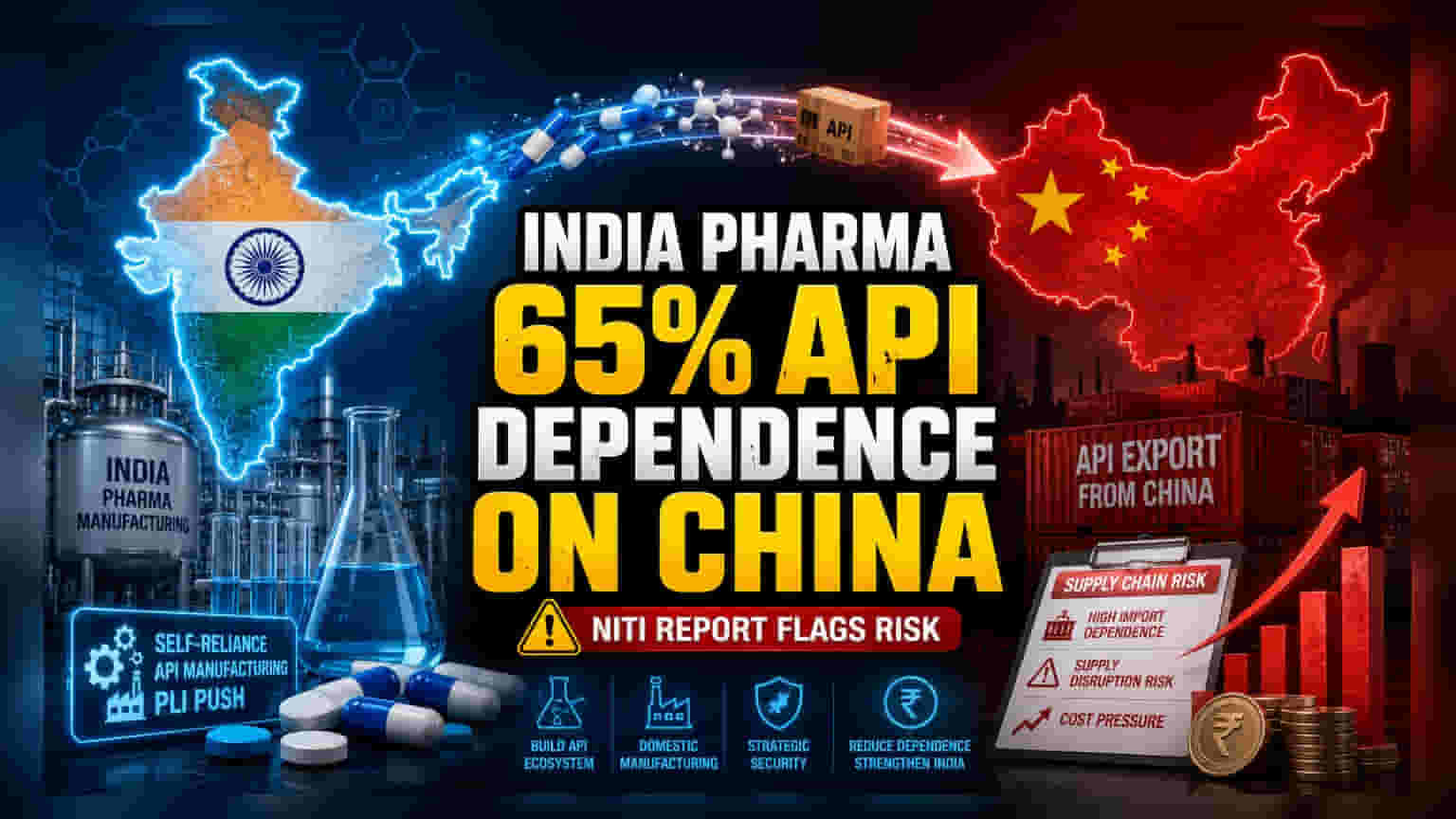
A new NITI Aayog report highlights that India relies on China for 65% of its essential active pharmaceutical ingredients (APIs). This dependency creates supply chain risks, while rising environmental compliance costs further challenge domestic manufacturers. Investors are watching how companies use government incentives to localize production and move toward higher-value products.
What Happened
NITI Aayog has released its latest 'Trade Watch Quarterly' report, which brings attention to a significant vulnerability in the Indian pharmaceutical industry. The report confirms that India continues to rely on China for 65% of its active pharmaceutical ingredients (APIs) and key starting materials. These ingredients are the core building blocks for manufacturing medicines. The reliance is particularly high for fermentation-based products, creating a risk that any supply chain disruption could directly impact drug availability and pricing within India.
Why Dependency Matters for Business
For investors, this reliance represents more than just a logistical concern. When Indian manufacturers depend heavily on a single country for raw materials, they are exposed to sudden price fluctuations, trade restrictions, and global geopolitical tensions. The report emphasizes that this dependence hinders the stability of the local supply chain. If Chinese suppliers face delays or raise prices, Indian pharmaceutical companies—especially those involved in generic medicine production—may see their profit margins come under pressure.
The Cost of Compliance
Beyond raw material imports, the report identifies rising environmental compliance costs as a major hurdle for domestic production. As Indian companies work to meet stricter pollution and safety standards, the money spent on upgrading facilities and waste management increases. These costs make domestically produced APIs more expensive compared to imports, making it harder for Indian firms to compete on price in the global market. The report suggests that this creates a difficult environment for innovation and discourages long-term investment in local manufacturing.
The Strategic Shift
To counter these challenges, NITI Aayog has called for a shift toward high-value pharmaceutical segments. The government has already introduced Production Linked Incentive (PLI) schemes to encourage companies to set up local manufacturing plants for these critical ingredients. The goal is to reduce import dependency and help Indian companies move up the value chain by focusing on specialty chemicals and complex generics rather than just high-volume, low-margin products.
The Innovation Gap
The report also points out that the current ecosystem for research and commercialization is weak. It suggests that stronger collaboration between the industry and academic institutions is necessary to speed up technology transfer. By improving the ability to innovate and commercialize patents, the sector hopes to build a more resilient business model that is less vulnerable to external supply shocks.
What Investors Should Track
Investors may monitor a few key areas following this report. First, track the progress of companies participating in the PLI schemes for API manufacturing and how much they are able to reduce their import dependence over time. Second, keep an eye on how companies manage their operational costs amid strict environmental regulations. Finally, observe if there is a noticeable shift in product portfolios toward higher-margin, specialty segments, as this will determine the long-term profitability and resilience of Indian pharmaceutical firms.