

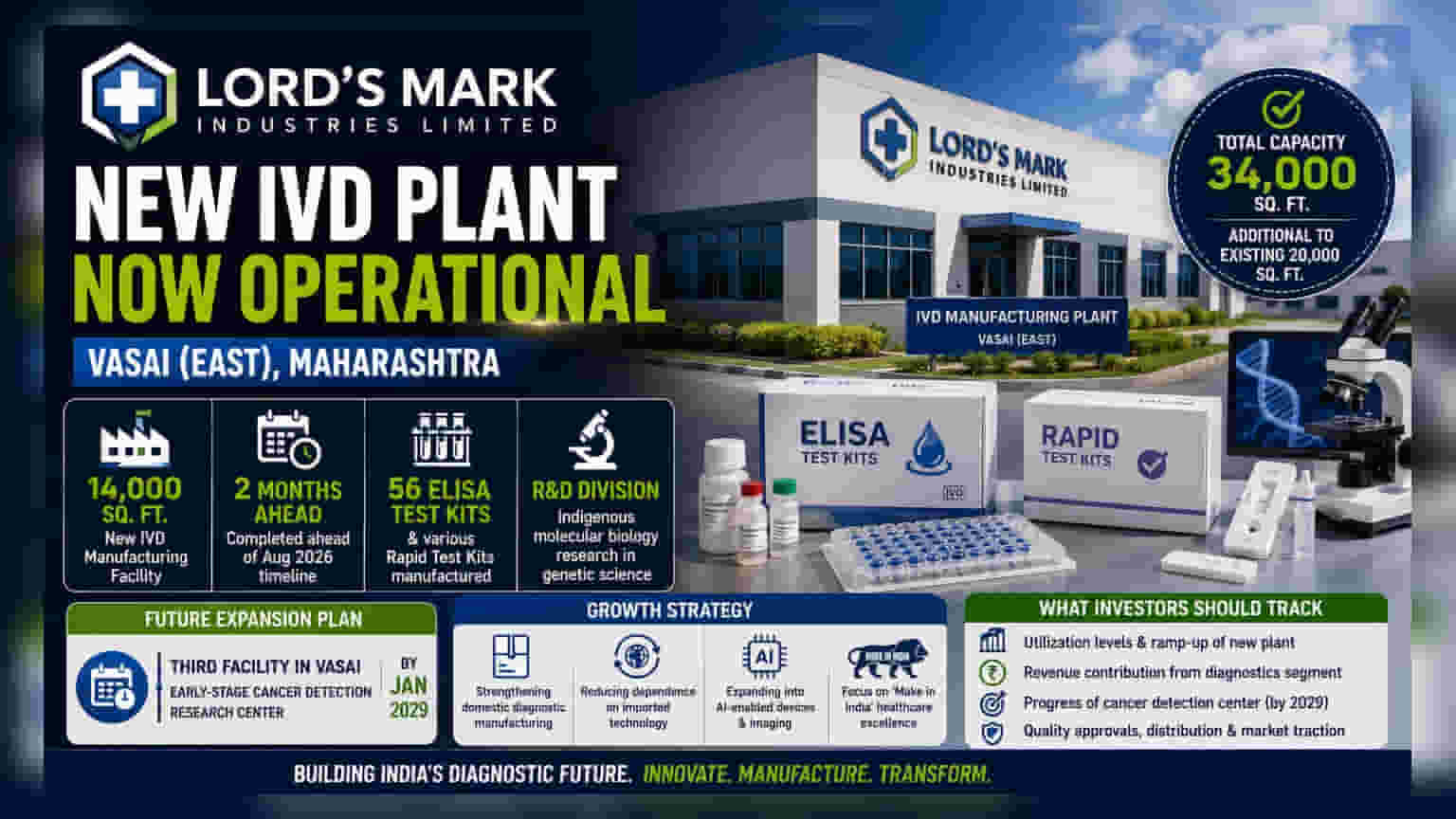
Lord’s Mark Industries has launched a 14,000 sq. ft. In Vitro Diagnostics (IVD) manufacturing unit in Vasai, Maharashtra, completing the project two months ahead of its August 2026 target. This expansion increases the company's total manufacturing footprint to 34,000 sq. ft., enabling the production of ELISA and rapid test kits. The facility also includes a dedicated molecular biology research center.
What Happened
Lord’s Mark Industries Limited has officially operationalized its new In Vitro Diagnostics (IVD) manufacturing plant in Vasai (East), Maharashtra. The facility covers 14,000 sq. ft. and was completed two months ahead of its planned August 2026 timeline. This project brings the company’s total manufacturing capacity to 34,000 sq. ft., adding to its existing 20,000 sq. ft. infrastructure. The new site is designed to manufacture a range of diagnostic products, including 56 types of ELISA test kits and various rapid test kits.
Beyond production, the facility houses a Research & Development (R&D) division dedicated to indigenous molecular biology research in genetic science. The company has also announced long-term expansion plans, including a third facility in Vasai, which is slated to become an early-stage cancer detection research center by January 2029.
The Growth Strategy
For Lord’s Mark Industries, this facility is part of a broader shift in its business model. Following its corporate restructuring and recent listing on the BSE, the company has increasingly focused on the healthcare and diagnostic space, moving away from its legacy business operations. The expansion into ELISA and rapid test kits is intended to capture a larger share of the domestic diagnostic market by lowering dependence on imported diagnostic technology.
By building its own R&D capabilities and manufacturing infrastructure, the company is attempting to position itself as a serious player in the 'Make in India' healthcare segment. The focus on AI-enabled medical devices and imaging technology, as outlined in its future plans, suggests an ambition to move into higher-value diagnostic equipment over the next few years.
Why Operational Execution Matters
In the manufacturing and diagnostic sectors, completing projects ahead of schedule is a key performance indicator that investors watch closely. Early commissioning of the Vasai unit may allow the company to start revenue generation from this capacity sooner than the market initially expected. In an industry where speed-to-market and compliance are critical, demonstrating the ability to execute infrastructure projects efficiently can be a positive sign for operational discipline.
However, expanding manufacturing capacity is only the first step. The long-term success of this facility will depend on the company's ability to maintain high quality standards, secure necessary product approvals, and effectively distribute these kits to hospitals, laboratories, and other healthcare providers in a highly competitive market.
What Investors Should Track
As the company integrates this new facility into its operations, investors may watch for several key developments. First, it will be important to see how quickly the company can achieve high utilization levels at the new plant. Second, management commentary regarding the revenue contribution from this new diagnostic segment in upcoming quarterly results will be vital to assess the business's growth trajectory.
Finally, investors may monitor the progress of the company's future projects, including the planned cancer detection center in 2029, to understand the long-term capital spending required and whether the company can maintain a healthy balance sheet while funding these major investments.