

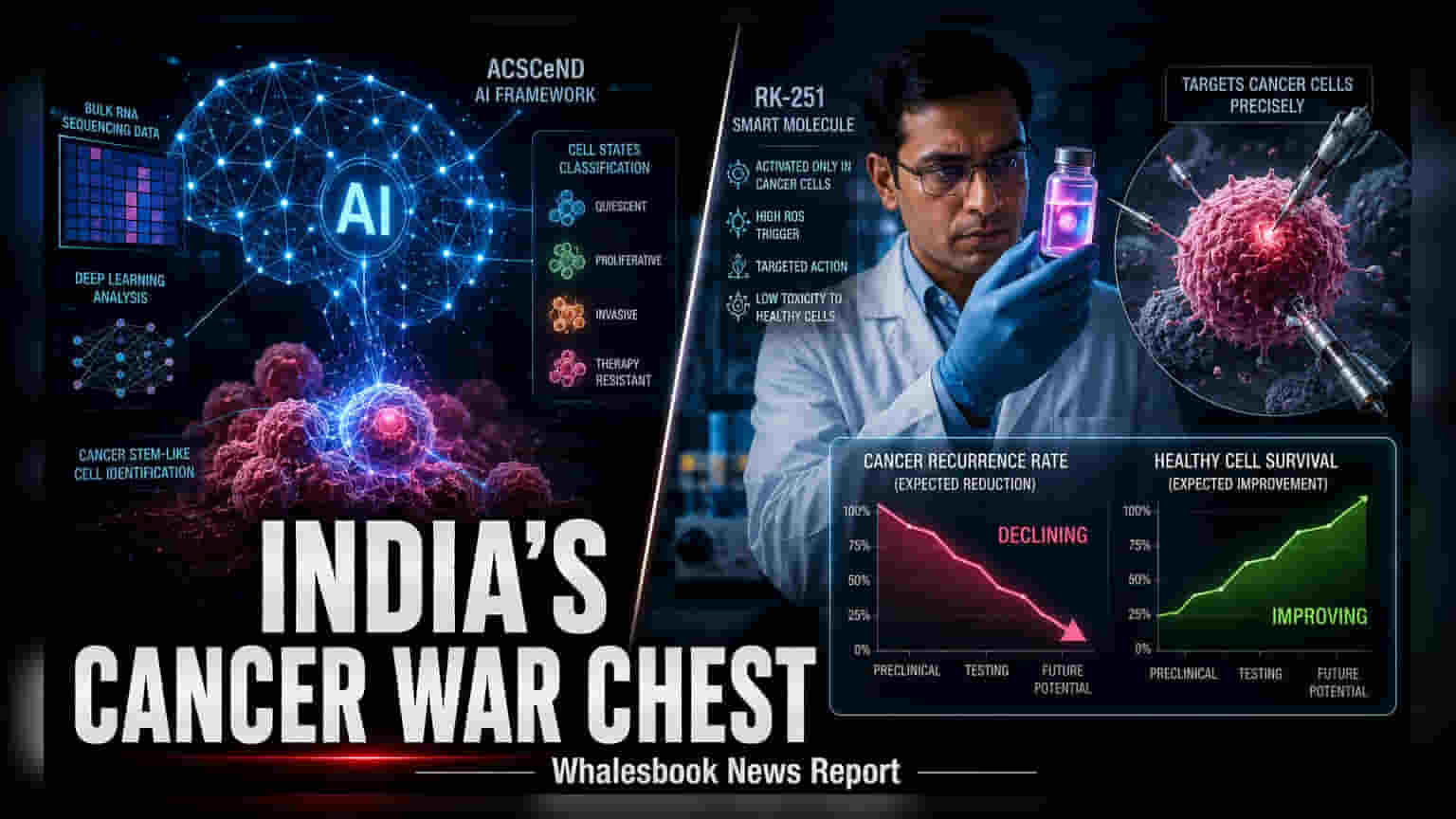
Indian academic institutions have introduced a new AI framework to track cancer relapse and a smart experimental drug designed to reduce chemotherapy side effects. These scientific innovations are currently in the early research stage and focus on improving treatment precision.
Researchers at leading Indian institutions have announced two significant developments in cancer research that aim to improve how doctors detect relapse and treat malignant cells. These projects, developed by academic and autonomous research bodies, are currently in the early, preclinical stages of scientific study.
The first development is an artificial intelligence framework called ACSCeND. Created by the S.N. Bose National Centre for Basic Sciences in collaboration with Ashoka University, this tool is designed to analyze complex genetic data. Its primary function is to identify cancer stem-like cells, which are often the hidden drivers behind tumor recurrence. By using deep learning to interpret bulk RNA sequencing data, the tool helps researchers classify these cells into different states, providing a clearer picture of how cancer might return.
Simultaneously, scientists from the Institute of Advanced Study in Science and Technology (IASST) and IIT-Guwahati have developed an experimental small-molecule compound named RK-251. Traditional chemotherapy often affects healthy cells alongside cancerous ones, leading to harsh side effects for patients. RK-251 acts as a "smart" drug that remains inactive while circulating in the body. It is designed to trigger and release its cancer-killing agent only when it enters the specific environment of a malignant cell, which typically has high levels of reactive oxygen species. Laboratory tests on cancer cells and trials in zebrafish embryos have shown that the compound can effectively target tumors while causing significantly less toxicity to non-cancerous tissue.
It is important for readers to understand that these advancements are currently academic research projects. They are not commercial products or technologies owned by publicly traded companies. Because these developments are in the preclinical research phase, they have not yet undergone human clinical trials. Success in laboratory models or animal testing is a positive early sign, but it does not guarantee that the technology will be safe or effective for human patients in the future.
Investors and the public should view these as significant contributions to scientific knowledge rather than immediate commercial or market events. The next steps for these technologies typically involve further validation, rigorous clinical research, and the potential for eventual licensing or development, which can take many years to progress from a research paper to a viable medical treatment.