

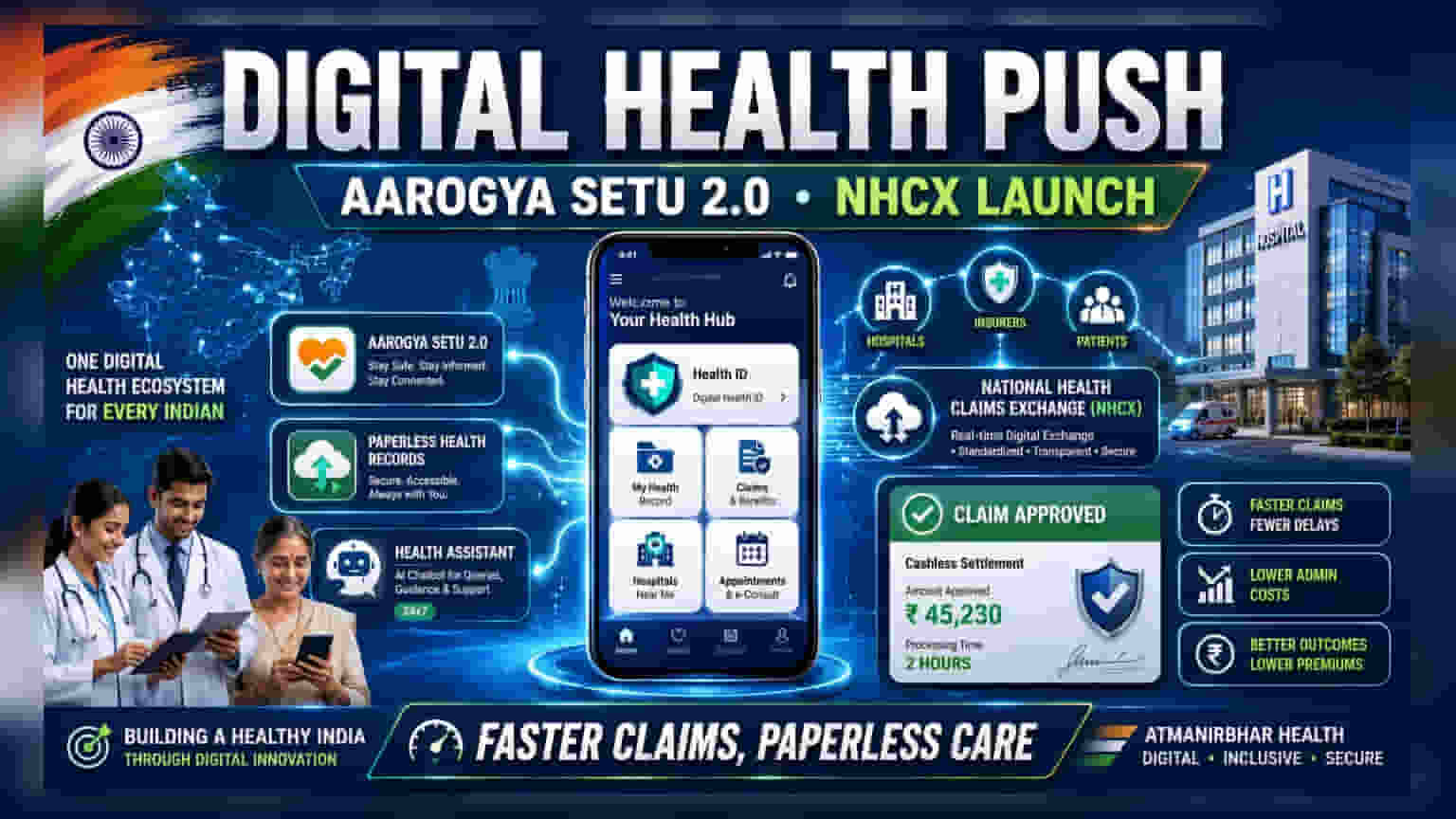
India is set to launch the revamped Aarogya Setu 2.0 and the National Health Claims Exchange on June 29, 2026. These digital platforms aim to standardize healthcare records, medicine data, and insurance claims processing. For investors, the initiative represents a significant push toward digitizing India's healthcare sector, which may eventually reduce administrative costs for hospitals and insurance companies.
What Happened
On June 29, 2026, the Ministry of Health is scheduled to launch a suite of new digital health platforms. The centerpiece is the revamped Aarogya Setu 2.0, which transitions from its original purpose as a pandemic-era contact tracing tool into a full-scale national digital health gateway. Alongside this, the government is introducing the National Health Claims Exchange (NHCX), an updated Ayushman App, and the Ayushman Sarathi WhatsApp chatbot. These tools are designed to integrate with the Ayushman Bharat Digital Mission (ABDM) to create a more unified, paperless, and efficient healthcare ecosystem across both public and private institutions.
Why It Matters For Investors
The launch of the National Health Claims Exchange (NHCX) is the most critical update for the financial sector. Currently, the health insurance industry faces high administrative costs and processing delays due to fragmented systems between hospitals, third-party administrators (TPAs), and insurers. The NHCX is designed to standardize this data flow, potentially allowing for faster claim settlements. If successfully adopted, this infrastructure could help health insurance companies improve their operating margins by lowering the cost of processing each claim and reducing manual errors.
The Move Toward Data Standardization
The government is also introducing a national Drug Registry and Common LOINC Codes for India (CLCI). These standards are intended to ensure that medical records and pharmaceutical data are consistent across all digital platforms. For healthcare providers, such as listed hospital chains, this data standardization may eventually lead to better operational insights, improved supply chain management for medicines, and more accurate diagnostic reporting. The efficiency gain depends on how quickly private sector hospitals and diagnostic chains integrate their internal systems with these government-mandated standards.
The Efficiency Trade-Off
While these digital platforms offer potential for long-term cost reduction, the immediate investor focus should be on the transition phase. Building a digital public infrastructure (DPI) in healthcare is a complex task. The success of these platforms relies entirely on the rate of adoption by doctors, private clinics, diagnostic centers, and insurance companies. If the integration process is slow or technically difficult for private players, the expected benefits in efficiency and cost reduction may take years to materialize. Investors should be aware that the rollout is just the first step in a multi-year effort to reorganize data in the health sector.
What Investors Should Track
Moving forward, the key monitorables are the pace of private sector adoption and the functional integration of the NHCX. Investors should watch for management commentary from leading health insurance companies and large hospital chains regarding their participation in these digital frameworks. Additionally, updates on whether these platforms genuinely reduce the time taken for insurance payouts or hospital billing will provide the first real evidence of the initiative's impact on business profitability.