

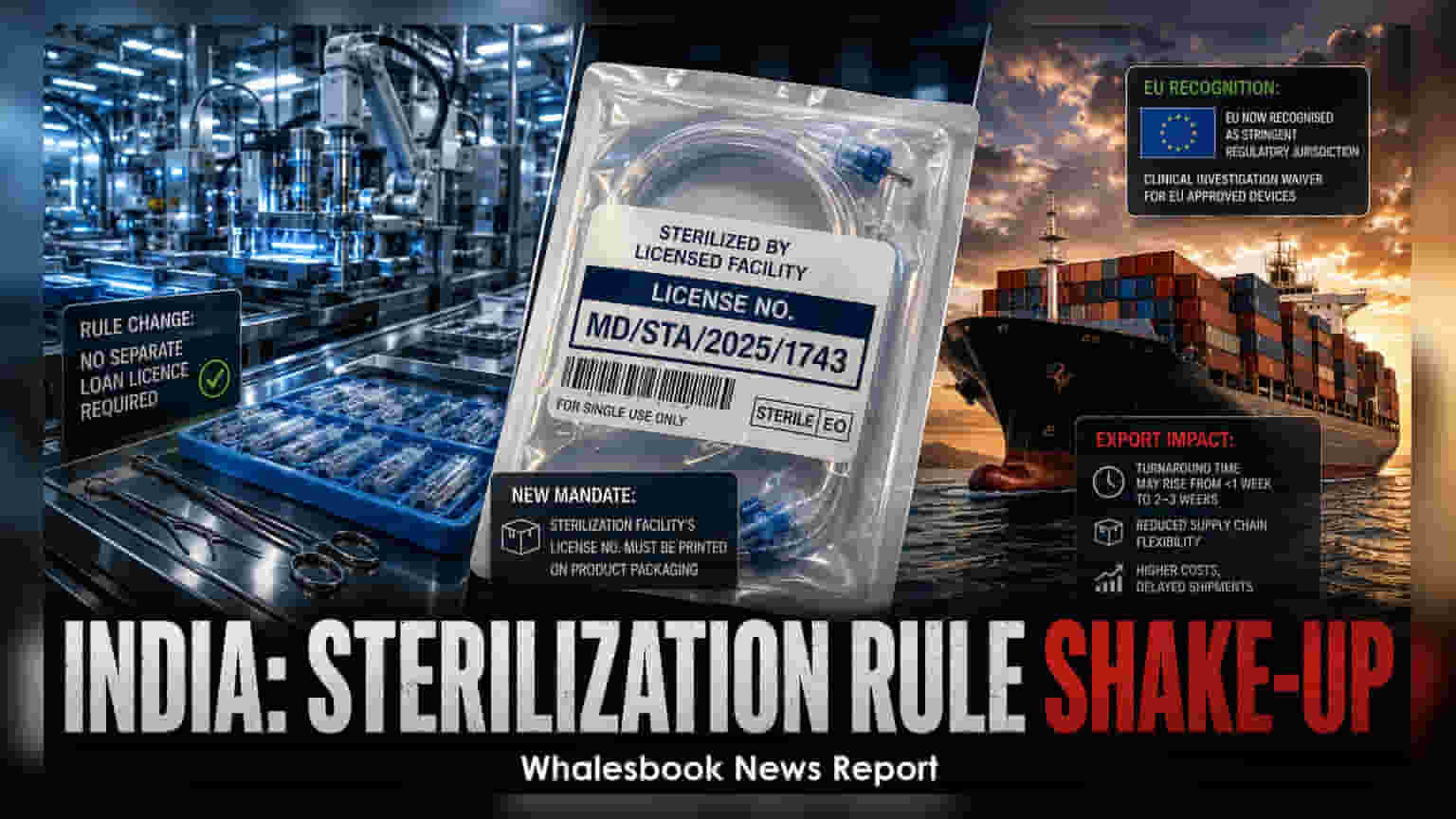
The government has removed the 'loan licence' requirement for outsourced sterilization of medical devices, aiming to simplify business operations. However, a new mandate requiring the sterilization facility's license number on product packaging is raising concerns about supply chain flexibility. Investors may track potential impacts on export timelines and operational costs for manufacturers relying on third-party facilities.
The Ministry of Health and Family Welfare has introduced an amendment to the Medical Devices Rules, 2017, aimed at streamlining manufacturing processes. The update removes the mandatory requirement for a separate 'loan licence' when medical device manufacturers outsource sterilization to a third-party facility that already holds a valid license. This change, which became effective in August 2026, was intended to reduce administrative paperwork and lower the compliance burden for domestic companies.
However, the update includes a new labelling mandate that has sparked pushback from the industry. Manufacturers are now required to print the sterilization facility’s specific license number directly on their product packaging. While this is designed to improve traceability, it has created a significant operational bottleneck for many companies.
The Association of Indian Medical Device Industry (AiMeD) has raised concerns that this rule reduces supply chain flexibility. Manufacturers often switch between different sterilization providers to manage volume or speed, but printing a specific license number on the packaging effectively locks a manufacturer into using one provider for that batch. If that facility is busy or faces technical issues, the manufacturer cannot easily switch to a faster provider without changing the packaging, which is a costly and time-consuming process.
This constraint could prove challenging for exporters. Industry feedback suggests that the turnaround time for sterilization could increase from under a week to two or three weeks due to the inability to use alternative service providers. For companies operating in competitive global markets, these potential delays in shipping and production could impact order fulfilment and increase inventory costs.
On a positive note, the government has simultaneously amended Rule 63 to recognize the European Union as a stringent regulatory jurisdiction. This change is beneficial for the sector as it allows for clinical investigation waivers for medical devices that are already approved within the EU. This regulatory alignment is expected to accelerate the entry of advanced medical technologies into the Indian market, potentially reducing development timelines and costs for certain imported products.
For investors, the key monitorable will be how the government addresses these industry concerns during the six-month transition period granted for the new labelling rule. Any clarifications or modifications to the mandate could ease the operational pressure. Investors may also watch whether larger players, who might have in-house sterilization or the scale to manage these requirements, gain a relative operational advantage compared to smaller manufacturers who rely heavily on outsourced services.