 Whalesbook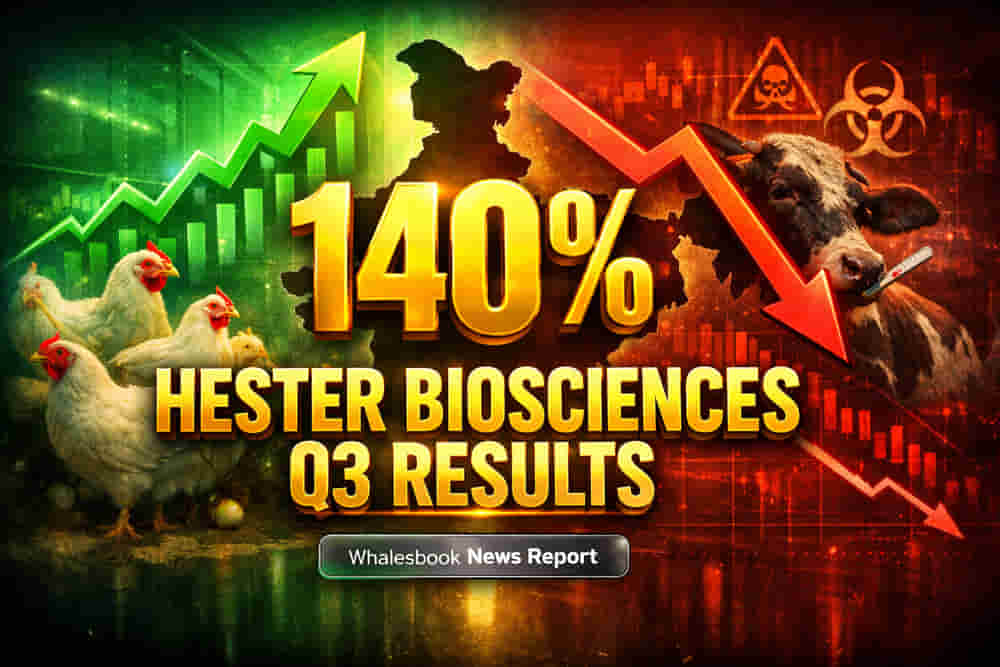
📉 The Financial Deep Dive
The Numbers:
Hester Biosciences presented a bifurcated financial picture for Q3 FY26. Standalone revenue saw a healthy 12% year-on-year (YoY) increase to ₹135.5 crore. However, the star performer was the Profit After Tax (PAT), which surged by an impressive 140% YoY to ₹24.1 crore. For the nine-month period (9M FY26), standalone revenue dipped by 5% YoY to ₹369.3 crore, though PAT grew 16% YoY to ₹53.3 crore.
Consolidated revenue for Q3 FY26 expanded by 22% YoY to ₹170.1 crore, while the 9-month consolidated revenue remained broadly stable at ₹452.4 crore YoY.
The driving force behind the robust PAT growth was a favourable product mix and stringent cost discipline, alongside operational efficiencies.
Segment Performance:
The Poultry Healthcare division continued its strong trajectory, recording 32% YoY growth in Q3 FY26 and 17% YoY growth for the 9-month period. This performance is attributed to deeper market penetration and consistent demand for core vaccines. A significant development includes receiving marketing and manufacturing licenses for the H9N2 Avian Influenza vaccine, with manufacturing slated for India.
Conversely, the Animal Healthcare division (ruminant and pet health) experienced a sharp 38% decline in Q3 and a 40% decline over 9 months. This downturn is primarily due to timing delays in government-led immunization programs for PPR and goat pox vaccines. Seasonal factors and elevated feed costs also impacted the ruminant business.
The Petcare segment, while a strategic focus, is nascent and contributes less than 5% to Animal Healthcare revenue.
The Quality:
Management highlighted consistent margin performance in the Poultry segment over the last four quarters, stemming from a deliberate product mix strategy. They expressed confidence in sustaining and improving profitability on a year-on-year basis through continued product mix optimization and operational efficiency.
In terms of capital expenditure, Hester Biosciences capitalized its fill/finish facility during the quarter, effectively doubling its drug product capacity. The company has INR 182 crore of Capital Work-in-Progress (CWIP) remaining, expected to be capitalized in the coming months. Evaluation is also underway to repurpose its BSL-3 facility for veterinary vaccines.
The Grill:
Management articulated a clear strategic intent to reduce dependence on tender-driven revenues, aiming instead to deepen presence in commercial and export markets. While Q3 EBITDA stood at approximately ₹20 crore, the focus remains on year-on-year profitability improvement and operational leverage. The company acknowledged the need for revival in Animal Health momentum from Q4 FY26, contingent on government program timelines.
🚩 Risks & Outlook
Specific Risks: The primary risk lies in the timing and execution of government immunization programs for the Animal Healthcare segment. Seasonal volatility and feed cost fluctuations remain concerns for ruminant business. The nascent Petcare segment's growth trajectory is yet to be proven at scale.
The Forward View: Investors should monitor the anticipated revival in the Animal Healthcare division from Q4 FY26, the successful rollout and market uptake of the H9N2 Avian Influenza vaccine, and progress on capitalizing the substantial remaining CWIP. The shift towards commercial and export markets will be critical to watch for sustained revenue diversification and profitability enhancement.