

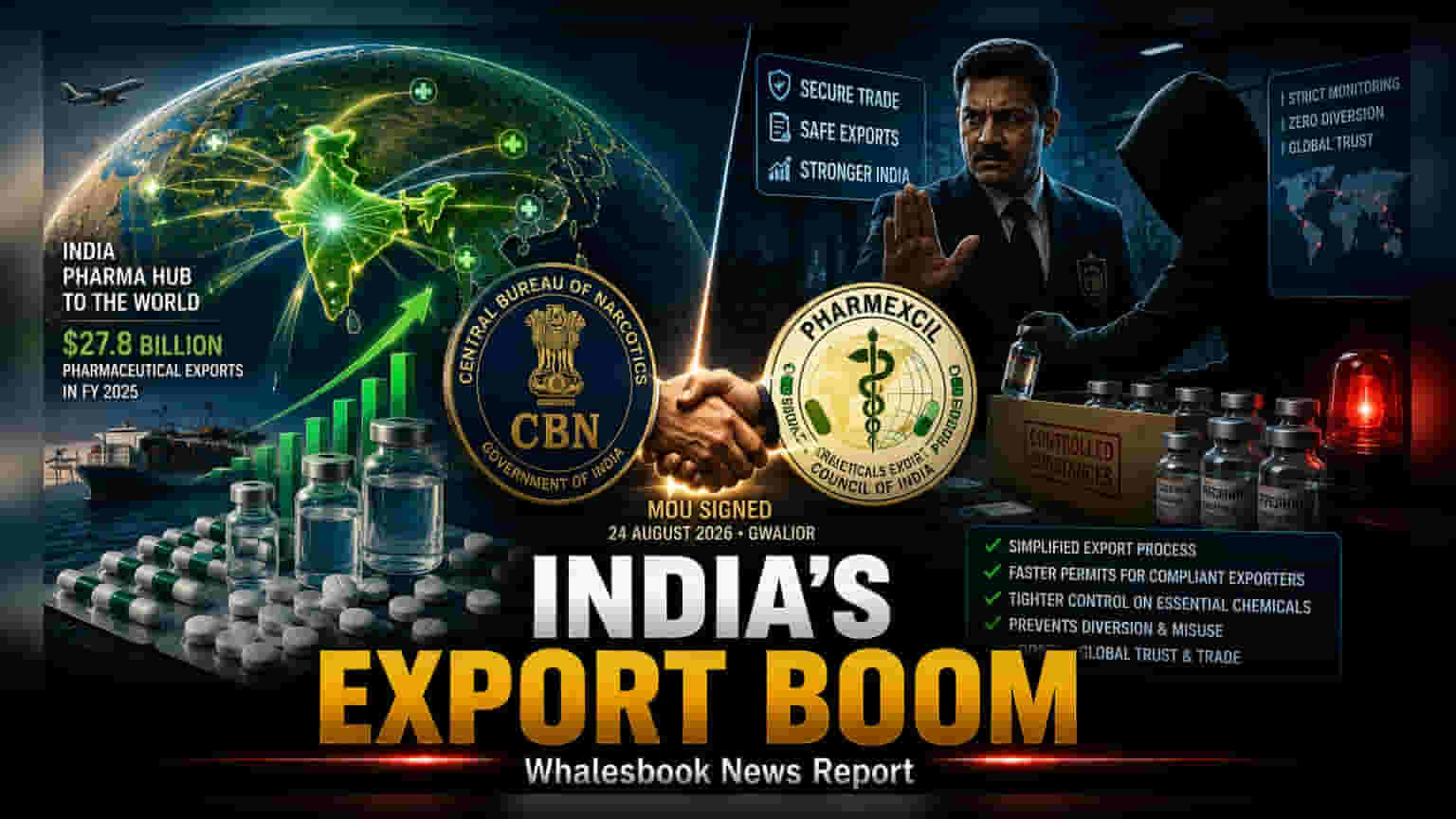
The Central Bureau of Narcotics and the Pharmaceuticals Export Promotion Council of India have signed an agreement to simplify export processes for pharmaceutical companies. This move balances the need for faster trade with strict regulatory compliance to prevent the diversion of essential chemicals. Investors may monitor how this impacts the operational speed and compliance costs of listed pharma exporters.
The Central Bureau of Narcotics (CBN) and the Pharmaceuticals Export Promotion Council of India (PHARMEXCIL) formalized a partnership on August 24, 2026, aimed at accelerating India's pharmaceutical exports. The Memorandum of Understanding, signed in Gwalior, establishes a framework to simplify international trade processes for legitimate exporters while simultaneously tightening the monitoring of controlled substances and essential chemical inputs.
For investors, this development is significant because of India’s position as a global hub for active pharmaceutical ingredients and formulations. The pharmaceutical sector often faces complex regulatory requirements when dealing with the import and export of chemicals that fall under the Narcotic Drugs and Psychotropic Substances Act of 1985. The government is attempting to improve the ease of doing business while ensuring that Indian companies meet global and local regulatory standards.
Under the new agreement, the two bodies will develop a voluntary code of conduct for the industry. Member companies will be required to designate specific contact persons who will manage communication and compliance regarding these new guidelines. This setup is designed to identify and remove operational bottlenecks that companies often encounter when processing export permits, which could potentially improve efficiency for firms that maintain strong internal controls.
The regulatory shift carries specific implications for company operations. While the aim is to streamline the movement of goods, the increased focus on oversight means that companies with weaker internal compliance systems may face higher scrutiny. Operational delays could occur if firms fail to adhere to the voluntary code or if their documentation regarding essential chemicals does not meet the revised expectations of the CBN.
Investors may monitor how individual companies adapt their supply chain management to these new standards. The effectiveness of this pact will depend on how quickly the industry adopts the code of conduct and how the CBN adjusts its processing times for compliant exporters. The key monitorable in upcoming quarters will be whether companies report smoother turnaround times for export permits or if the tighter oversight leads to increased administrative requirements.