 Whalesbook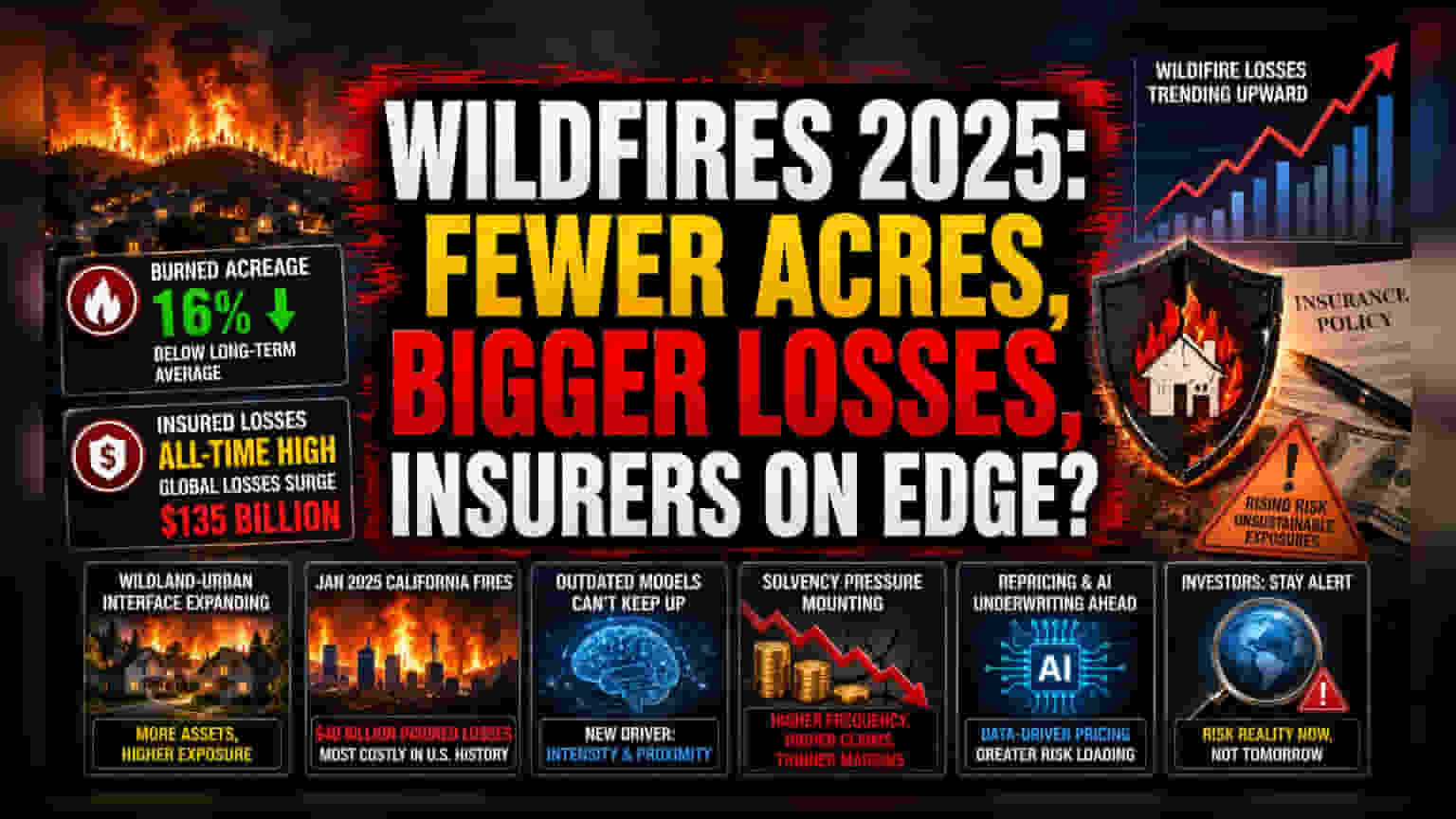


The Valuation Decoupling
The 2025 wildfire season presented a paradox for global markets: while aggregate burned acreage fell 16% below the long-term average, insured losses reached an all-time peak. This divergence marks the end of traditional actuarial models that rely heavily on historical burn-area metrics to forecast capital reserves. The financial reality is no longer driven by the total extent of a fire, but by the density of high-value assets situated in the expanding wildland-urban interface. As developers continue to build in historically high-risk zones, the exposure profile of the insurance sector has fundamentally shifted, turning relatively small, localized fires into multi-billion-dollar liabilities.
The Structural Shift in Risk Pricing
Historically, the P&C sector benchmarked fire risk against remote wilderness incineration. However, current data illustrates that intensity and proximity are the new primary drivers of loss. The $40 billion in insured damages from California’s January 2025 incidents—the most costly in U.S. history—demonstrates that even off-peak season events can trigger massive capital outflows. When comparing this to the industry's historical volatility, the 2025 figures suggest that catastrophe bond pricing and reinsurance premiums are likely lagging behind the actual frequency of these high-intensity events. Large insurers are finding that standard fire-suppression models fail when simultaneous, multi-continental outbreaks occur, effectively draining the liquidity of international emergency response networks.
The Forensic Bear Case: Insolvency Risks
For investors monitoring the insurance landscape, the 2025 data points toward a mounting solvency pressure. The sector faces a triple threat: increasing frequency of "megafires," the devaluation of properties in fire-prone regions, and the potential for a massive regulatory repricing. If insurers continue to struggle with accurate loss estimation, they risk significant margin compression through elevated loss ratios. Furthermore, the reliance on carbon-heavy boreal forests, which act as net carbon sources rather than sinks when they burn, poses a systemic risk to companies that have integrated environmental, social, and governance (ESG) metrics into their balance sheets. Unlike sectors with diversified revenue streams, regional insurers operating heavily in Western North America and the Mediterranean face existential threats from a single bad season, a fragility not currently fully reflected in broad market valuation multiples.
Forward-Looking Market Implications
Market participants should expect a transition toward more aggressive risk-loading on premiums throughout 2026 and 2027. Anticipated shifts include the adoption of predictive AI-driven underwriting that prioritizes topographical data over historical frequency. Analysts suggest that until infrastructure management begins to align with climate reality, the disconnect between asset value and fire resilience will remain a critical variable for investors tracking global property insurance conglomerates and large-scale real estate investment trusts.