

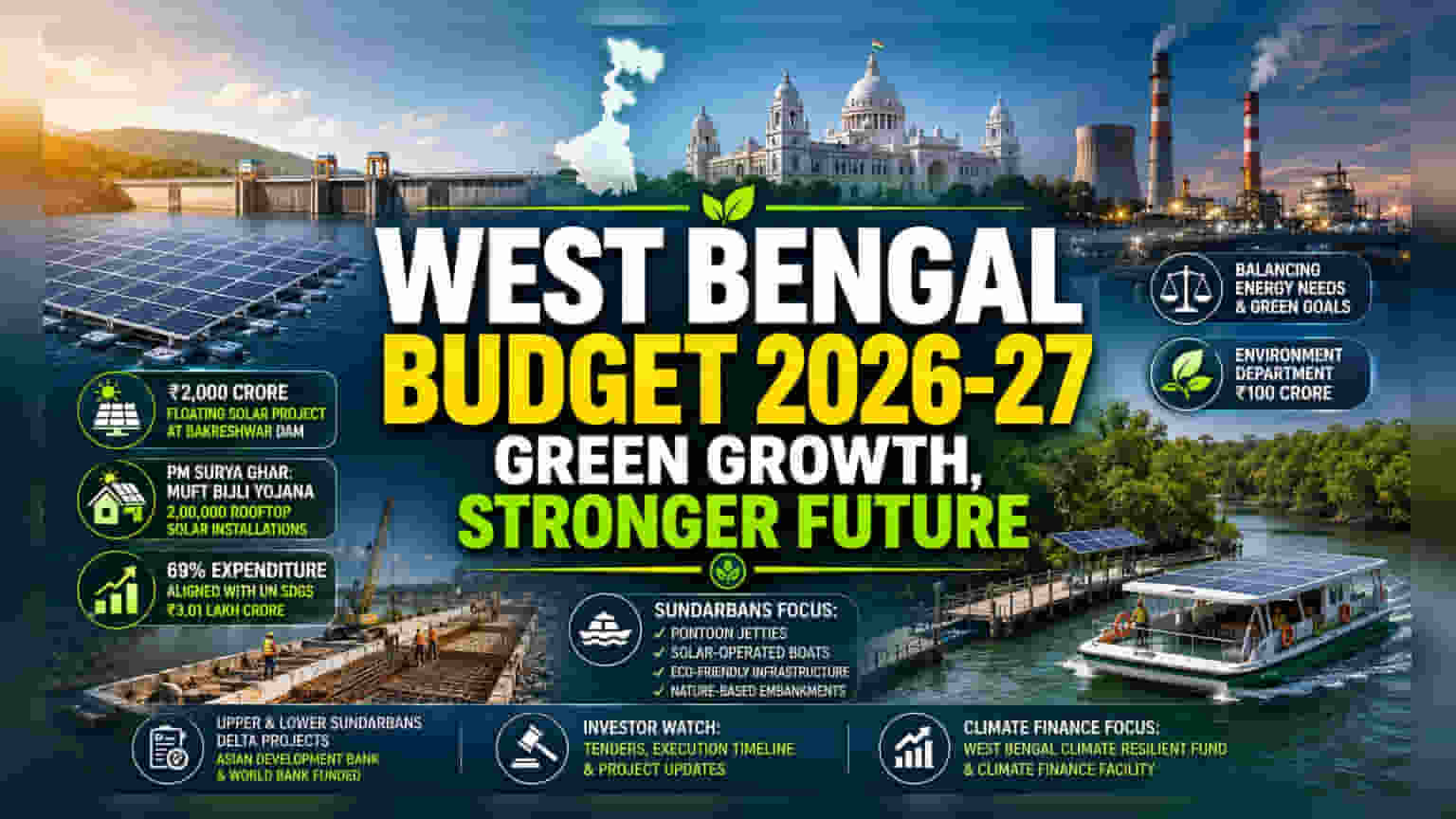
West Bengal’s Rs 4.38 lakh crore budget for 2026-27 aligns 69% of spending with sustainable development goals. The state plans major investments in solar energy and climate resilience projects in the Sundarbans, though continued thermal power expansion draws environmental concern. These shifts open potential opportunities for renewable energy, EPC, and infrastructure companies.
What Happened
The West Bengal government has presented its budget for the 2026-27 fiscal year, totalling Rs 4.38 lakh crore. A defining feature of this year’s financial plan is the alignment of 69% of total expenditure—amounting to Rs 3.01 lakh crore—with the United Nations' Sustainable Development Goals (SDGs). This initiative is part of a broader push to integrate global climate targets into state fiscal policy, with support from the UN Development Programme.
The Renewable Energy and EPC Opportunity
A significant portion of the budget focuses on energy transition. The state has identified a growing power demand, projected to hit 27 GW by 2035. To address this, the government is focusing on a shift toward solar energy. A notable project is the floating solar photovoltaic initiative planned for Bakreshwar Dam, with an estimated cost of Rs 2,000 crore.
For investors, this signals potential activity for companies in the engineering, procurement, and construction (EPC) space, as well as renewable energy equipment manufacturers. Additionally, the state’s involvement in the PM Surya Ghar: Muft Bijli Yojana, which aims for 200,000 rooftop solar installations, creates potential demand for solar installers and component suppliers operating in the region.
Sundarbans Infrastructure Spending
The budget earmarks specific funds for the Sundarbans, prioritizing ecological stability over traditional bridge connectivity. Plans include the development of pontoon jetties and the adoption of solar-operated boats to reduce the carbon footprint in the region.
This infrastructure shift, combined with the implementation of the Upper and Lower Sundarbans Delta projects—funded by international bodies like the Asian Development Bank and the World Bank—suggests a steady flow of government contracts for civil engineering and specialized infrastructure firms. The focus on embankment reconstruction using nature-based technologies will also likely involve specialized contracting work.
Thermal Power vs Green Goals
While the budget emphasizes green initiatives, it also includes provisions for new thermal power plants to meet base-load electricity demand. This duality has prompted discussion among environmental experts.
Some critics have pointed out that the allocation for the state’s environment department remains limited at Rs 100 crore, raising questions about the adequacy of funding for air and river pollution management. For investors, this creates an ESG (Environmental, Social, and Governance) context to watch. Companies involved in the power sector in West Bengal, such as CESC, may face evolving regulatory demands as the state balances its traditional thermal power dependency with its new climate-resilient mandate.
What Investors Should Track
Investors looking at the sector should monitor the specific release of tenders related to the Bakreshwar Dam solar project and the Sundarbans infrastructure works. The execution timeline of these projects will be a key monitorable to gauge the actual inflow of orders for private sector participants. Furthermore, any updates regarding the West Bengal Climate Resilient Fund and the West Bengal Climate Finance Facility will indicate how effectively the state can mobilize private capital to support these ambitious sustainability targets.