 Whalesbook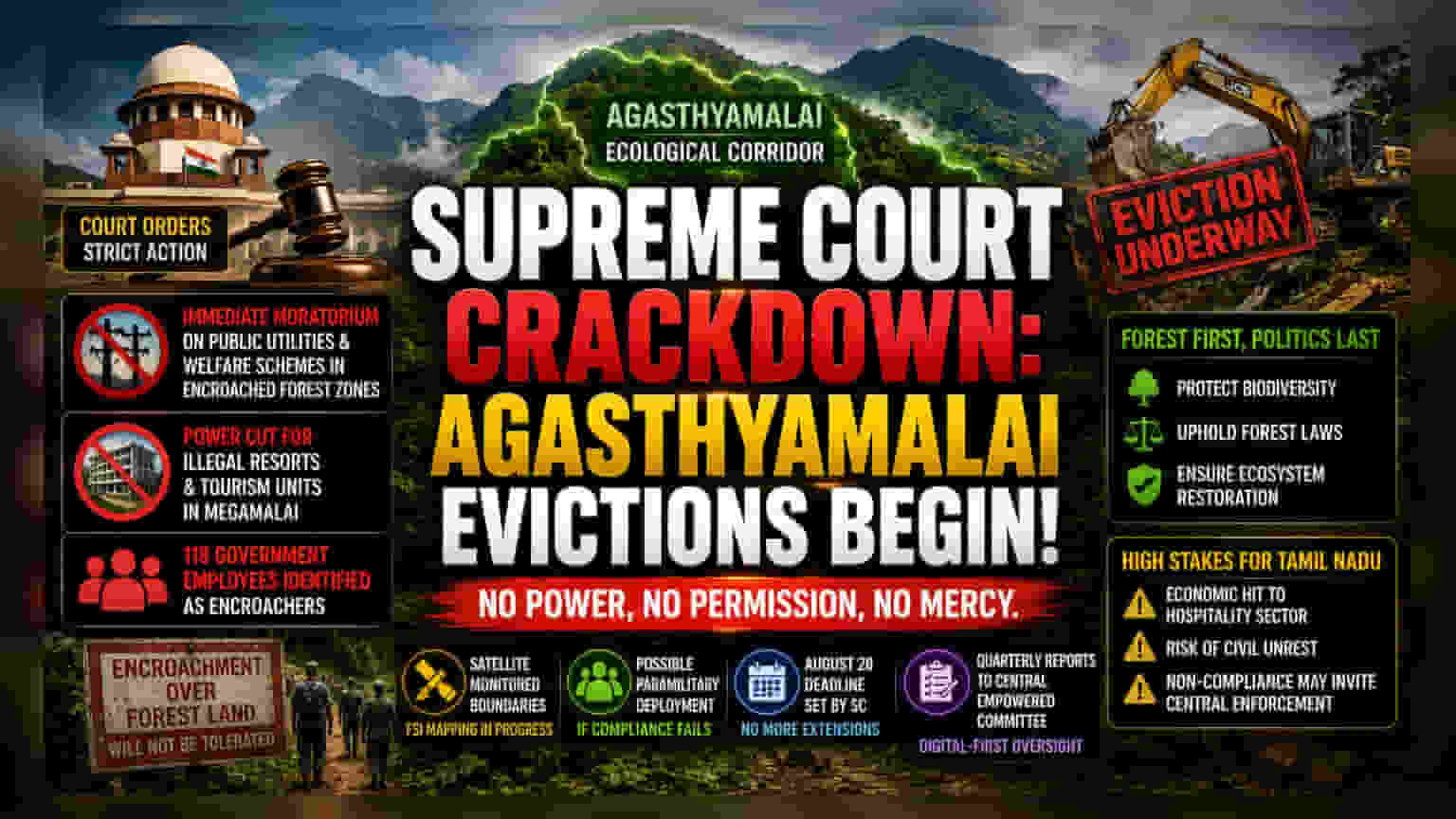


The Shift from Litigation to Enforcement
The judiciary has moved beyond traditional deliberation, transitioning into active oversight regarding the Agasthyamalai ecological corridor. By imposing an immediate moratorium on public utility provision and welfare schemes within occupied forest zones, the court has effectively strangled the economic sustainability of illegal settlements. This maneuver forces the Tamil Nadu administration to prioritize forest integrity over political expediency, moving away from previous cycles of stalled eviction notices.
Economic and Institutional Repercussions
The directive mandates the immediate termination of electricity and infrastructure support for unauthorized resorts and commercial tourism units. This will trigger a notable contraction in the local hospitality sector, particularly within the Megamalai area, which has historically thrived on gray-market operations. Beyond the commercial sector, the identification of 118 government employees as encroachers represents a significant institutional purge. The state must now navigate potential civil service friction while simultaneously preparing for the potential deployment of paramilitary oversight, should compliance targets remain unmet. This intervention indicates a broader judicial intent to standardize the enforcement of forest conservation laws across India, moving toward a digital-first, satellite-verified governance model.
The Structural Risk Factor
While the mandate aims for restoration, the implementation path faces significant execution risk. The history of the Agasthyamalai region is marked by entrenched socio-political resistance and complex land-tenure litigation. Attempting to forcibly remove long-term occupants without robust rehabilitation protocols risks civil unrest, which could lead to further delays in the court-ordered timeline. Furthermore, the state government now faces the dual burden of managing environmental remediation costs and the legal defense of those employees targeted by the bench. If the administration fails to hit the August 28 benchmark, the intervention of federal enforcement mechanisms will heighten the regional political stakes, potentially stalling other developmental projects in the state under the scrutiny of the Central Empowered Committee.
Future Trajectory
The integration of the Forest Survey of India to digitize boundaries marks a transition toward absolute technical accountability. With quarterly status reporting becoming the new standard for the Tamil Nadu administration, the state is effectively under federal probation regarding its land management practices. Future developmental activities in the region remain frozen, ensuring that any subsequent economic shifts in the area will be restricted to ecologically compatible endeavors, should the state successfully navigate the current eviction crisis.