 Whalesbook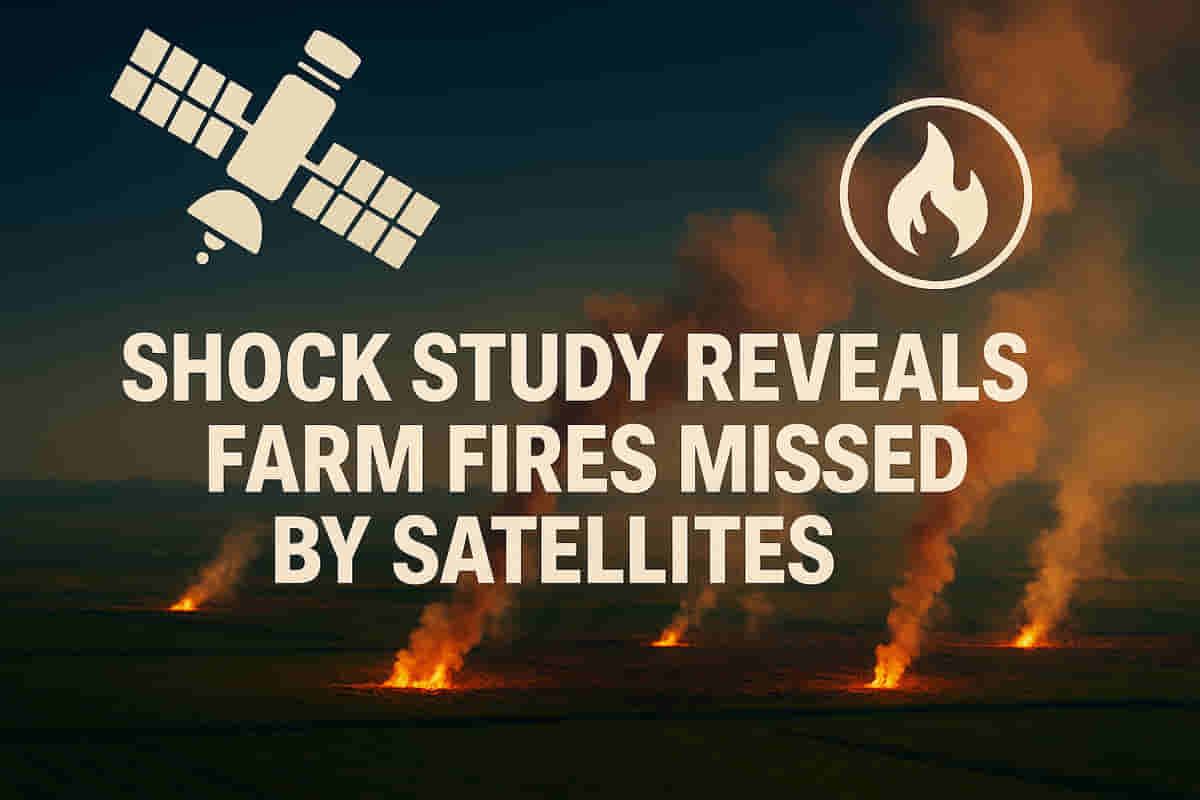
A recent study by the International Forum for Environment, Sustainability and Technology (iForest) has cast doubt on the accuracy of official data regarding farm fires in North India, particularly in Punjab and Haryana. The think tank's findings, released on December 8, suggest that farmers are burning paddy stubble late in the day, often after monitoring satellites have completed their passes over the region.
New Study Challenges Official Data
Official figures from the Indian Agricultural Research Institute (IARI), which rely on active fire-count data from satellite sensors like MODIS and VIIRS, indicated a significant drop of over 90% in active fire counts in Punjab and Haryana since their peak in 2021. However, the iForest study, using data from geostationary satellites, found that the majority of farm fires were ignited after 3 PM. This timing is well after the typical satellite observation window between 10:30 AM and 1:30 PM.
iForest Methodology
The iForest analysis determined burnt areas using geostationary satellite data. It estimated that approximately 20,000 sq. km of crop area was burnt in Punjab and 8,800 sq. km in Haryana in 2025. While the study did confirm a reduction in farm fires ranging from 25-35% since 2020, it contrasted sharply with the 95% decline suggested by active fire-count analyses.
Implications for Air Quality Management
These discrepancies have significant implications for air quality management in the National Capital Region. The study advises that the Decision Support System (DSS) for air-quality management in New Delhi, operated by the Indian Institute of Tropical Meteorology, should revise its methodology to accurately quantify stubble burning's contribution to air pollution. Farm fires are now estimated to contribute between 5-10% to the winter air pollution load, a factor that cannot be overlooked despite its episodic nature.
Broader Pollution Landscape
Furthermore, even the active-fire-count data indicates that crop burning has spread to states like Uttar Pradesh, Rajasthan, and Madhya Pradesh due to increased planting of Kharif paddy. The study highlights that without accurate data on stubble burning's impact, policymakers might be addressing the wrong causes of pollution. Stubble burning is not the sole contributor; vehicular pollution, coal-based power plants, industries, brick kilns, and the use of solid fuels for cooking and heating also play significant roles. The pollution intensity from burning stubble is considerably high due to the lack of filtering mechanisms.
Why Farmers Plant More Rice
The area under Kharif rice production has seen a nearly 9% increase between 2022-23 and 2025-26. Farmers prefer planting rice due to lower risks, sturdier growth, and assured government purchases offering competitive per-acre earnings. After harvesting, stubble is often burnt quickly to allow for the timely planting of the next wheat crop, as delays can lead to yield losses.
Impact
This news highlights a critical gap in environmental monitoring and policy-making related to air pollution. It could lead to revised strategies for pollution control, better farmer engagement, and potentially increased investment in alternative stubble management techniques. For Indian investors, it underscores the ongoing environmental challenges that could affect public health and policy directions. The direct impact on specific listed companies is minimal, but it raises awareness for environmental, social, and governance (ESG) considerations. Impact rating: 4/10
Difficult Terms Explained
- Paddy stubble: The leftover stalks of rice plants after the grain has been harvested.
- MODIS & VIIRS: Sensors aboard polar-orbiting satellites that capture data about Earth's surface, including active fires.
- Geostationary satellites: Satellites that orbit the Earth at the same rate the Earth rotates, appearing stationary over a particular point.
- Active fire-count: Data derived from satellite sensors that detect heat signatures indicating fires.
- Decision Support System (DSS): A system designed to help decision-makers by analyzing data and providing recommendations.
- Kharif paddy: Rice crops planted during the monsoon season (Kharif) in India.
- Episodic: Occurring only occasionally or at irregular intervals.