

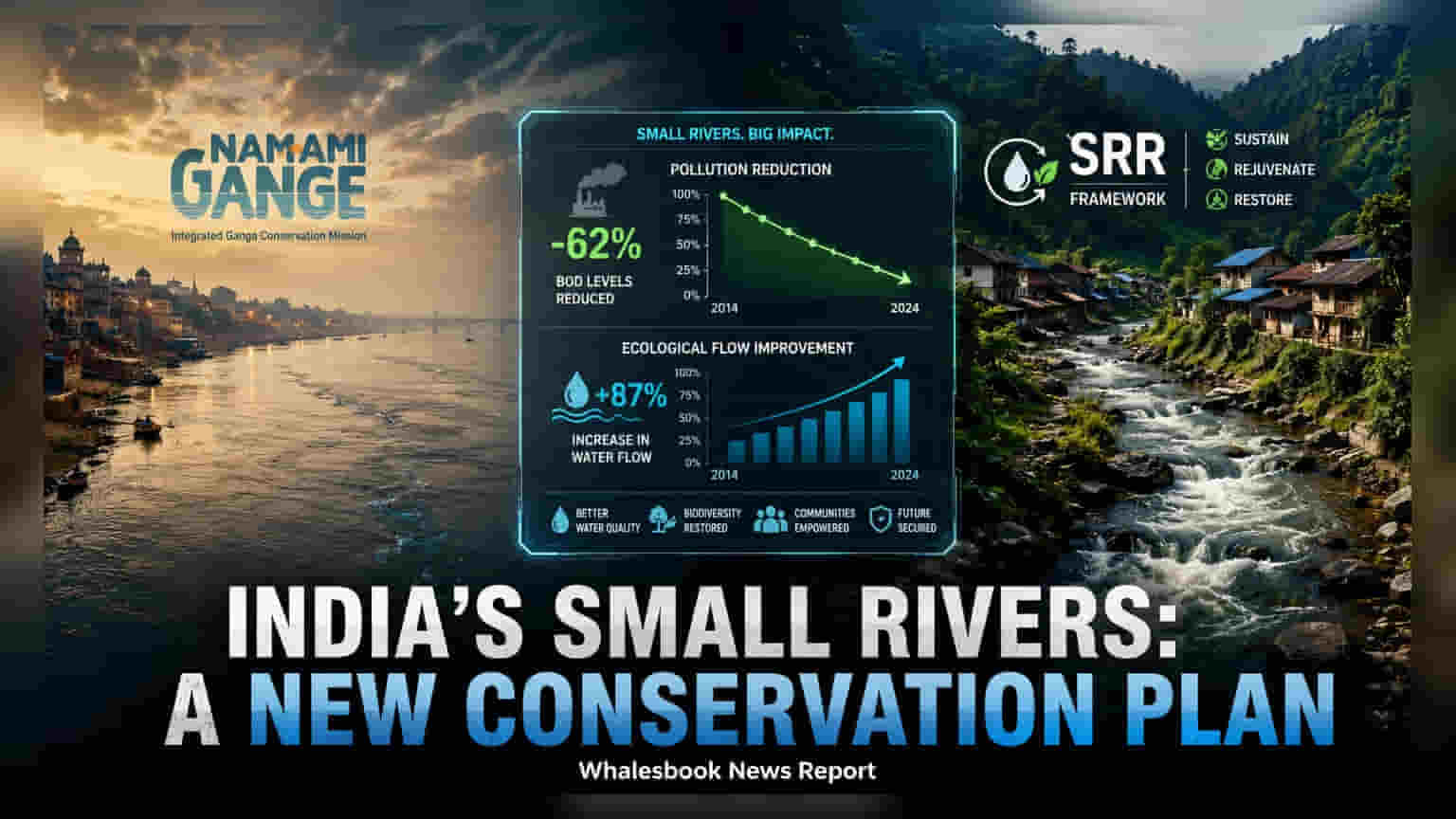
The National Mission for Clean Ganga has introduced a draft framework specifically to restore India’s smaller rivers. Unlike large-scale projects, this plan focuses on community-led local water storage and nature-based solutions to boost cost-effectiveness. The initiative aims to integrate conservation with existing government schemes, impacting regional water security and the agrarian economy.
The National Mission for Clean Ganga (NMCG) has launched a specialized draft framework aimed at the rejuvenation of India’s smaller rivers. This initiative, known as the Small River Rejuvenation (SRR) Framework, marks a strategic shift in how the government approaches water conservation, moving away from the large-scale engineering models used for major systems like the Ganga to more localized, nature-based solutions.
Moving Toward Localized Water Management
NMCG Director General Rajeev Kumar Mital clarified that the management of smaller waterways requires methods distinct from the "Nirmal Ganga" and "Aviral Ganga" principles applied to the main river system. For rivers in rural settings, the framework prioritizes the restoration of natural connectivity and the enhancement of local water storage, which is vital for supporting rural livelihoods and the agrarian sector. In contrast, urban small rivers often face different pressures, where the primary focus remains on maintaining continuous flow and managing urban runoff.
Sustainable Financing and Community Role
One of the central challenges identified by the NMCG is the long-term sustainability of restoration projects. The draft framework emphasizes that communities living along these rivers must move beyond awareness to take active responsibility for maintenance. From a financial perspective, the mission intends to avoid creating standalone, high-cost infrastructure. Instead, it proposes the convergence of funds from existing central and state government schemes. By utilizing nature-based solutions—such as wetland restoration and catchment area management—the project aims to keep capital spending low while achieving measurable environmental outcomes.
Developing the National Strategy
The draft is the result of 18 months of research and collaboration with academic and environmental institutions, including the Council on Energy, Environment and Water (CEEW), Delhi University, Wetlands International, and the IUCN. This collaborative approach is designed to balance geomorphological, pollution-related, and climate-based challenges.
The NMCG is now moving into a phase of regional consultations to refine the framework. Following a national workshop, upcoming sessions in Pune and Guwahati are planned to address the specific geographical and ecological needs of the western, southern, eastern, and northeastern regions. Investors and stakeholders in the water management, infrastructure, and rural development sectors should monitor the final policy details, as the implementation of this framework may shift government spending toward smaller-scale, decentralized water projects in the coming years. The primary focus for future updates will be the finalization of the policy and the subsequent allocation of funds through existing state and central water conservation programs.