

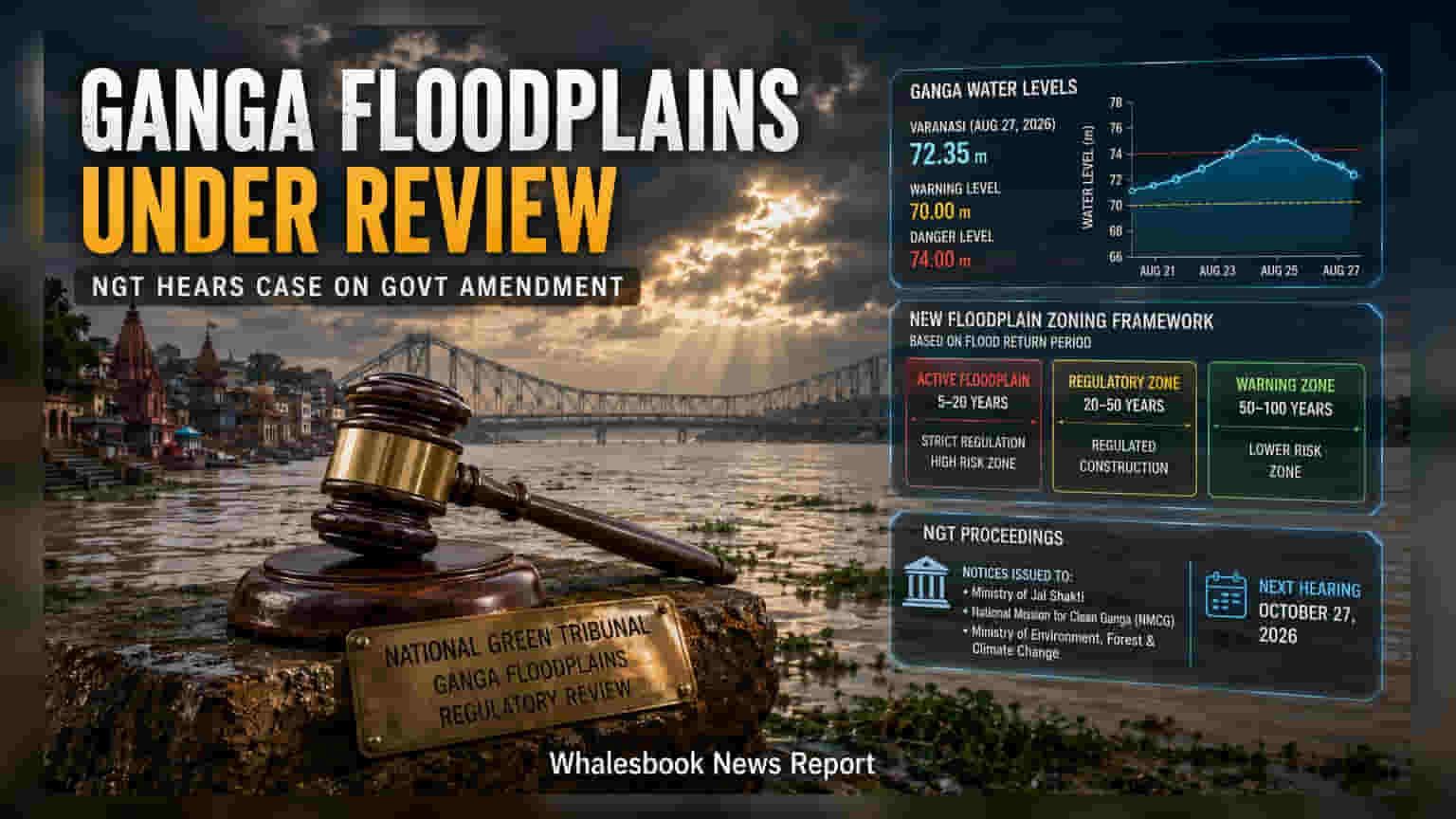
The National Green Tribunal is reviewing the August 2026 government amendment that replaced “construction-free zones” along the Ganga with a new three-tiered zoning system. While construction remains permitted for now, the legal challenge creates regulatory uncertainty for infrastructure and real estate projects in the river basin. Investors should track the next hearing scheduled for October 27, 2026.
The National Green Tribunal (NGT) has initiated proceedings regarding a government amendment to the River Ganga (Rejuvenation, Protection and Management) Authorities Order, 2016. The amendment, notified on August 10, 2026, by the Ministry of Jal Shakti, introduced a significant change in how construction is managed along the Ganga floodplains. The government replaced the previous “construction-free zone” designation with a new three-tiered zoning system.
Under the new framework, the floodplains are categorized into an “active floodplain,” a “regulatory zone,” and a “warning zone,” based on flood return periods ranging from 5 to 100 years. The Ministry has stated that this framework is intended to better manage pollution and preserve groundwater recharge functions. However, the change has faced legal pushback from petitioners who argue that the new system dilutes environmental protections established by previous orders and the Environment (Protection) Act, 1986.
For investors and companies involved in infrastructure development—such as road, bridge, and real estate construction along the Ganga basin—this regulatory shift introduces a period of uncertainty. The NGT has issued notices to the Ministry of Jal Shakti, the National Mission for Clean Ganga (NMCG), and the Ministry of Environment, Forest and Climate Change.
Importantly, the Tribunal has not issued an interim stay on the notification, meaning the current rules remain operational and active construction activities are not immediately halted by this legal challenge. However, the ongoing judicial review poses a risk for project developers. If the court eventually rules that the new zoning definitions are insufficient or incompatible with existing environmental standards, it could lead to stricter regulations, potential project delays, or higher compliance costs for firms operating in these zones.
The next hearing is scheduled for October 27, 2026. Until then, the primary monitorable for investors is the progress of this legal review, as the final outcome will clarify whether the new zoning system will be upheld or if the government will be required to modify its approach to floodplain protection. Market observers will watch for any official responses from the ministries regarding the scientific efficacy of the new zoning definitions, as this will determine the long-term regulatory environment for projects along the river.