

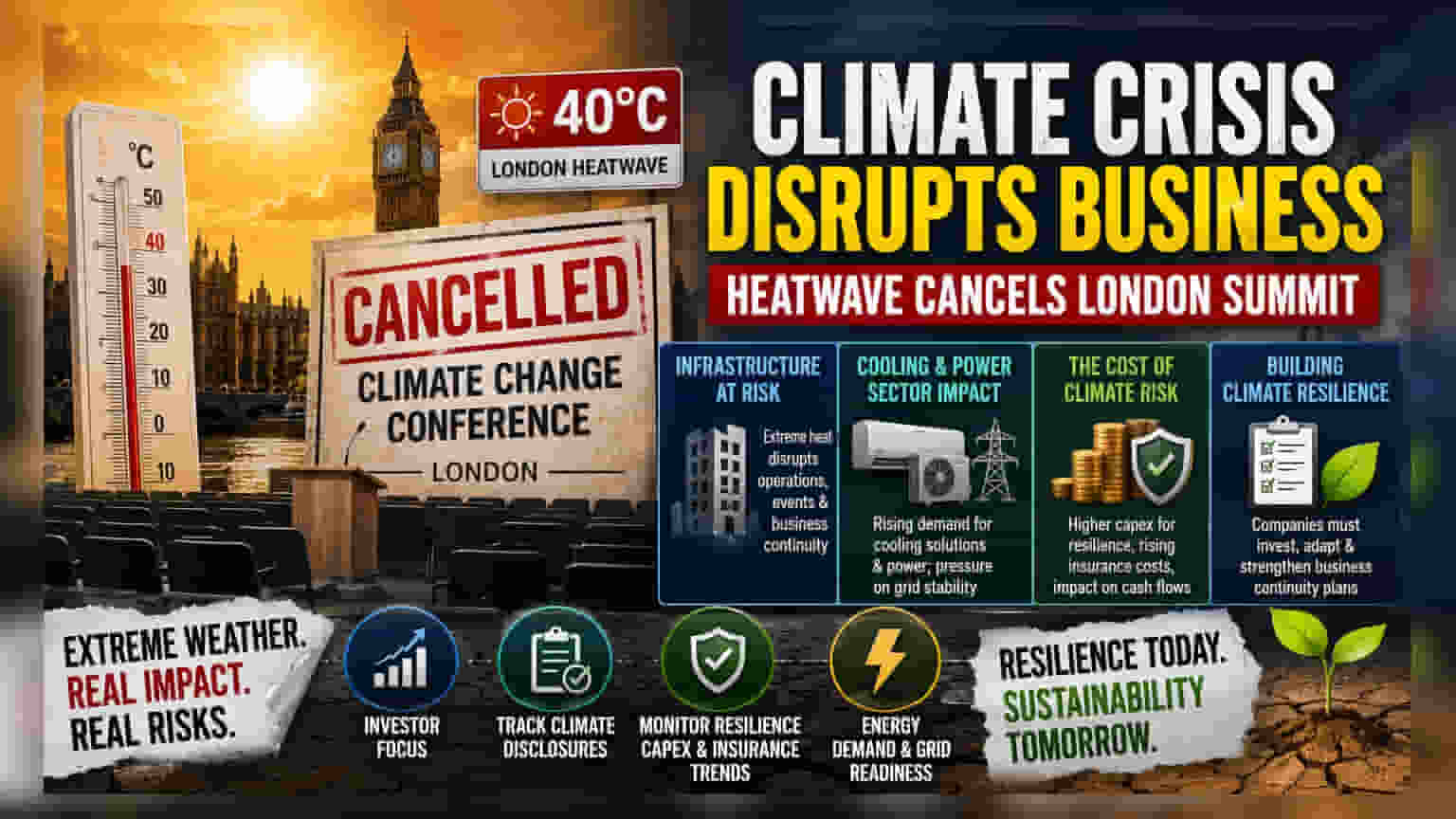
A climate change summit in London was cancelled after temperatures soared past 40°C, highlighting critical infrastructure vulnerabilities. The incident underscores rising operational risks from extreme weather, prompting investors to assess how companies in power, cooling, and infrastructure are adapting to a warmer climate.
What Happened
A climate change conference scheduled in London was officially cancelled this week after local temperatures surged above 40 degrees Celsius. The event, which ironically aimed to address climate change, could not proceed because the venue lacked the necessary cooling infrastructure to handle the extreme heat. While the cancellation is a localized event, it serves as a stark reminder of how quickly extreme weather patterns can disrupt standard business operations in regions historically unaccustomed to such heat.
Why This Matters For Investors
For the investment community, this incident highlights a broader trend: the vulnerability of physical infrastructure to climate change. As heatwaves become more frequent and severe, the ability of companies to maintain operations—or hold events—becomes a tangible operational risk. Investors are increasingly looking at business continuity plans, not just for manufacturing plants, but for all physical assets. When infrastructure fails to cope with weather, it leads to downtime, lost productivity, and potential reputational damage, even for entities advocating for environmental sustainability.
The Cooling And Power Sector Context
This trend has significant implications for sectors directly related to temperature management. In India, for instance, the cooling solutions market, dominated by players like Voltas and Blue Star, has seen sustained demand growth driven by both consumer needs and the industrial necessity for climate-controlled environments. As global temperatures rise, the reliance on HVAC (Heating, Ventilation, and Air Conditioning) systems is no longer a luxury but a critical requirement for business continuity.
Similarly, the power sector faces a dual challenge. Extreme heat drives a massive spike in electricity demand, putting pressure on grid stability. Investors often track this as a factor influencing short-term revenue spikes for power generation and distribution companies, though it also raises concerns about long-term grid resilience.
The Shift Toward Climate Resilience
Beyond immediate operational disruptions, there is a financial angle regarding 'resilience capital expenditure.' Companies across manufacturing, logistics, and real estate are now forced to allocate capital to upgrade facilities to withstand extreme weather. While this spending (capex) ensures business continuity, it also impacts cash flows in the short term.
Insurance companies are also factoring these risks into their pricing models. As incidents of weather-related business disruption rise, coverage costs for physical assets may increase, creating a drag on margins for capital-intensive industries.
What To Watch Next
Investors may monitor how companies report on climate risk in their annual disclosures. The key monitorable is not just the environmental impact of a company, but the company's own resilience to environmental changes. Tracking capital allocation toward infrastructure upgrades, insurance premium trends, and energy efficiency solutions provides a clearer picture of how businesses are preparing for a changing climate. The ability to maintain operations during extreme weather is becoming a qualitative metric that impacts long-term valuation.