 Whalesbook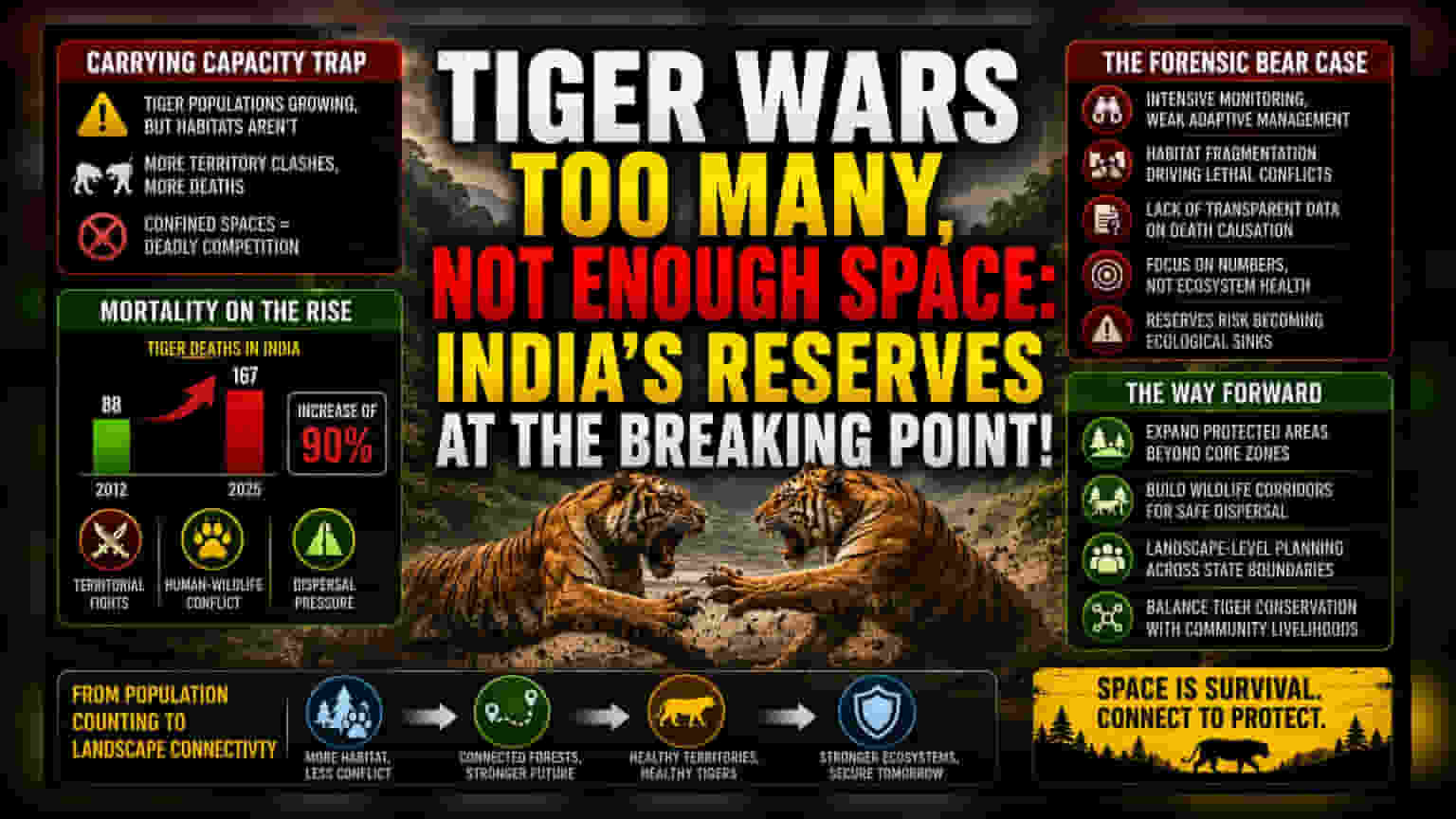


The Carrying Capacity Trap
The rising frequency of fatal territorial clashes within flagship reserves like Kanha and Ranthambore represents a transition from a conservation success story to a management crisis. While the National Tiger Conservation Authority maintains that elevated mortality figures reflect a burgeoning population, this perspective ignores the biological reality of density-dependent competition. When apex predators are confined to static geographical boundaries, the natural impulse for dispersal and territory acquisition creates a zero-sum environment where space is the ultimate limiting factor.
Quantitative Mortality Trends
Data indicates that the trajectory of tiger deaths is outpacing simple population growth. With mortality figures rising from 88 in 2012 to 167 in 2025, the narrative of success is becoming increasingly difficult to justify without accounting for the quality of the habitat. This is not merely an issue of total numbers but one of spatial distribution. Current management strategies heavily prioritize core zone protection but often fail to create the functional biological corridors necessary for sub-adults to establish new ranges. Consequently, these animals are forced into lethal contact with dominant males or pushed toward human-dominated fringe areas, which inherently increases the risk of both infighting and human-wildlife conflict.
The Forensic Bear Case: Failure of Adaptive Management
From a resource allocation standpoint, the reliance on intensive monitoring without concurrent land-use policy reform suggests a structural weakness in long-term conservation strategy. The lack of granular reporting on death causation on public dashboards obscures the severity of habitat fragmentation. Unlike previous decades where the primary threat was poaching, the modern threat is internal pressure caused by successful breeding programs that have not been met with corresponding increases in protected territory. Unless the state facilitates large-scale habitat expansion or establishes effective migration pathways, the reserves risk becoming ecological sinks rather than thriving ecosystems, where the gains of the last decade are eroded by preventable density-driven attrition.
Future Outlook and Policy Implications
Forward-looking projections suggest that without a shift toward broader landscape-level planning, the mortality rate will likely remain elevated or increase as younger cohorts reach maturity. The focus must pivot from population counting to habitat connectivity. Future effectiveness will be measured not by the density of tigers within a single reserve, but by the successful integration of these animals into a wider, connected, and sufficiently expansive network of forest lands that can absorb the natural dispersal patterns of the species.