 Whalesbook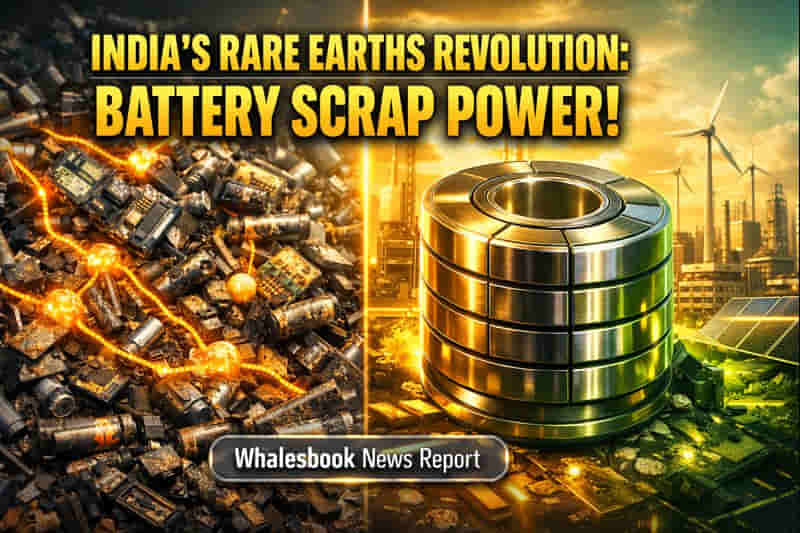
India Targets Self-Reliance with 'Urban Mines'
India's quest for self-reliance in critical minerals has taken a significant turn. A parliamentary standing committee has strongly recommended the promotion of 'urban mines' – recovering valuable minerals from waste streams like used batteries and discarded electronics. This move aims to bolster India's capacity for producing rare earth magnets, essential components for defence, electronics, renewable energy, and electric vehicles. The recommendation comes at a critical juncture, as global supply chains face increasing geopolitical uncertainties.
The Strategic Imperative
Mineral security has become a national imperative for India. Geopolitical tensions and trade wars have demonstrated the power of nations leveraging resource dominance to disrupt global supply chains. China's control over 60% of rare earth mining and 90% of processing capacity highlights this vulnerability. The threat of export bans, such as China's proposed April 2025 restrictions on rare earth magnets in response to US tariffs, underscores the need for countries like India to secure their own critical mineral supplies. Reports from UNCTAD and the International Energy Agency further emphasize the growing importance of minerals for the energy transition and the increasing trend of export restrictions.
Leveraging Secondary Sources
For nations heavily reliant on imports, 'urban mines' offer a viable and potentially less capital-intensive pathway to critical mineral supplies. The parliamentary committee advocates for scaling up scrapping and shredding centres to reduce dependence on new extraction projects. This approach not only curtails import needs but also strengthens supply chains and promotes sustainability by transforming waste into a valuable resource.
Industry Investments
Private players are already stepping up. Companies like Attero Recycling and Lohum Cleantech are making substantial investments in recycling used batteries to recover critical minerals, including lithium and rare earths. Attero CEO Nitin Gupta announced plans to invest ₹2,000 crore over three years to significantly scale up rare earth recovery from used magnets. Lohum Cleantech is establishing a new ₹500 crore facility in Uttar Pradesh for rare earth magnet production, expected to be operational by FY28, catering to sectors like EVs and defence.
India's Ambitious Plan
India's strategy involves a dual approach: developing domestic production capabilities for rare earth magnets while simultaneously investing in research and development to eventually move away from rare earth dependency. Union minister Ashwini Vaishnaw has highlighted India's domestic rare earth deposits, estimated at 6.9 million tons, and announced a ₹7,280 crore incentive package to encourage magnet manufacturers. This initiative will work in tandem with the National Critical Minerals Mission and the India Semiconductor Mission, signalling a comprehensive effort to move up the value chain from raw material sourcing to advanced component manufacturing. The demand for these magnets is projected to surge, with annual consumption expected to reach 15,400 tons by 2032, up from about 1,700 tons in 2022.
Impact
This strategic push towards mineral self-reliance, particularly in rare earth magnets derived from recycled sources, is poised to significantly impact India's industrial landscape. It promises enhanced security for vital sectors like defence, renewable energy, electric vehicles, and electronics, reducing vulnerability to global supply chain disruptions and geopolitical pressures. Increased domestic production of these critical components could foster innovation, create new job opportunities, and bolster India's position in the global manufacturing economy. The focus on recycling also aligns with sustainability goals by managing electronic and battery waste effectively.
- Impact rating: 8
Difficult Terms Explained
- Urban mines: Valuable minerals and metals recovered from waste products like discarded electronics, batteries, and construction debris, rather than from traditional geological deposits.
- Rare earth elements (REEs): A group of 17 chemical elements with unique magnetic, catalytic, and phosphorescent properties, crucial for many modern technologies.
- Rare earth magnets: The strongest type of permanent magnets, made using rare earth elements, essential for electric vehicles, wind turbines, electronics, and defence systems.
- Critical minerals: Minerals and metals that are essential for the economy and national security, but whose supply chains are vulnerable to disruption.
- Secondary sources: Materials or resources obtained from recycling or processing waste products, as opposed to primary extraction from the earth.
- Greenfield extraction: The development of new mining or industrial projects on undeveloped land, often involving significant environmental impact and capital investment.
- Value chain: The entire process of creating and delivering a product or service, from raw materials to the final consumer.