

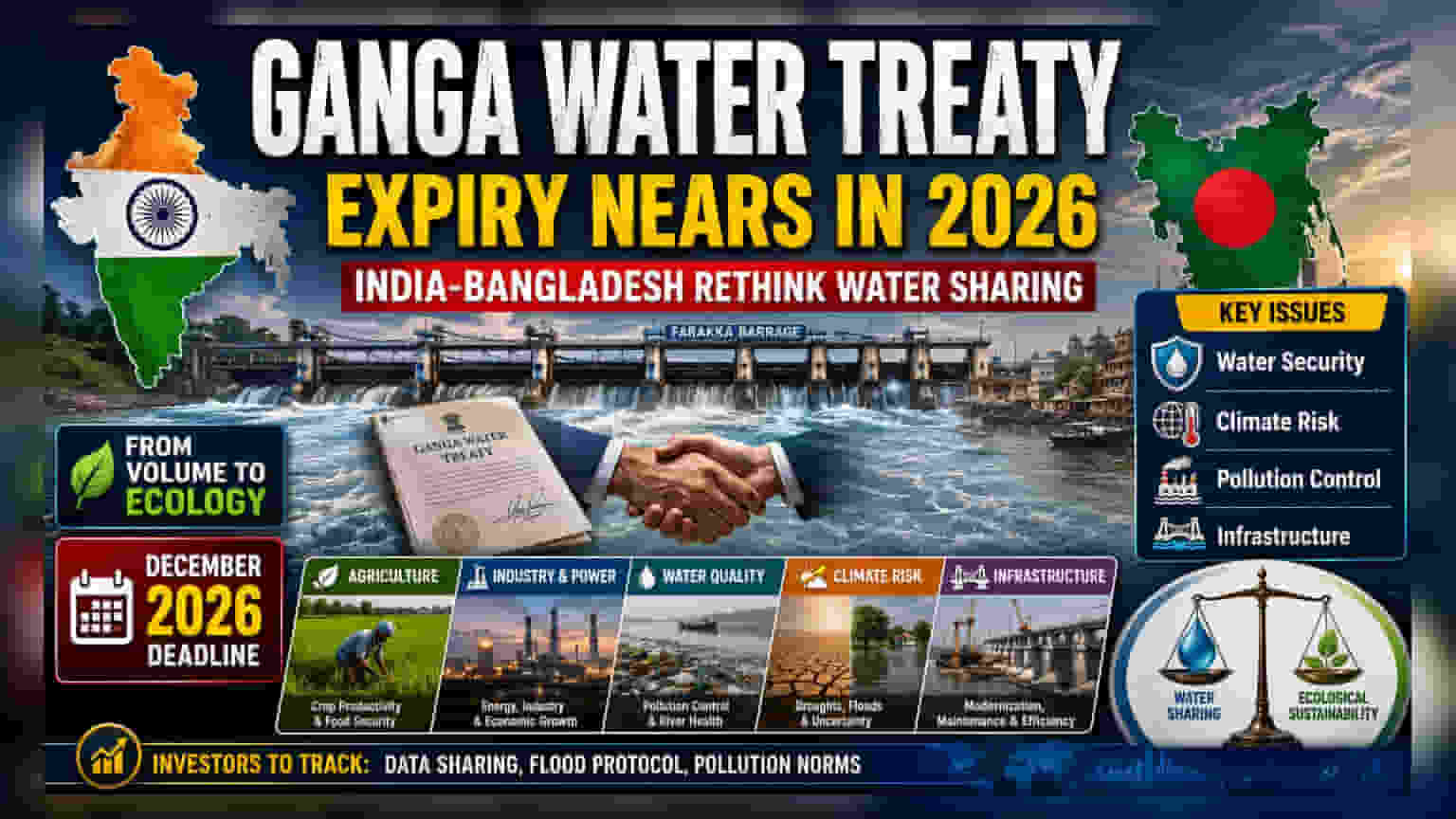
The 1996 Ganga Water Treaty between India and Bangladesh is set to expire in December 2026. As both nations prepare for renegotiations, the focus is shifting from simple volume-based water sharing to broader concerns like climate resilience, pollution control, and long-term water security for key industrial and agricultural regions.
What Happened
The Ganga Water Treaty, which has governed water sharing between India and Bangladesh since 1996, is approaching its expiration date in December 2026. The original agreement focused primarily on the volumetric sharing of water during the dry season, measured at the Farakka Barrage. With the end of the 30-year term nearing, the conversation has moved toward a more comprehensive framework. Both nations are signaling a need to move beyond simple flow metrics to address complex modern challenges, including climate-driven hydrological shifts, deteriorating water quality, and the rising demand for water in industrial and agricultural sectors.
The Economic Stakes of Water Security
For investors and businesses operating in the Indo-Gangetic plains, water security is a primary operational variable. Agriculture remains the dominant consumer of water in the region, supporting the livelihoods of millions. Any change in water availability directly affects crop yields in key agricultural belts, impacting commodity prices and supply chains. Furthermore, the region hosts various industrial hubs, including power plants and manufacturing units, which rely on the Ganga for cooling, processing, and transportation. Shifts in water management protocols could influence utility costs, operational continuity, and the viability of future infrastructure projects that depend on stable flow levels.
Shifting From Volume to Ecology
Experts note that the historical reliance on flow data from the 1990s no longer captures the reality of the basin today. Climate change has introduced significant volatility, including more frequent and intense droughts and unpredictable monsoon patterns. This variability means that rigid volume-based agreements may struggle to ensure equitable distribution during extreme weather events. The focus is shifting toward integrated basin management, which incorporates real-time telemetry, climate modeling, and shared responsibility for river health. This approach aims to protect the river's ecological integrity, which is essential for maintaining the long-term productivity of the entire basin.
Infrastructure and Pollution Management
The Farakka Barrage serves as a critical node in this dialogue. Discussions around its role, as well as the broader need for sedimentation management, are gaining traction. Additionally, water quality has become a major concern. Pollution from industrial effluents and agricultural runoff is increasingly limiting the usable water supply. A renewed treaty could potentially formalize cooperation on pollution control standards and data sharing, which would be a significant shift toward joint environmental stewardship rather than just water allocation.
What Investors and Stakeholders Should Track
As the December 2026 deadline approaches, the key monitorable is the framework of the upcoming negotiations. Investors should look for official updates regarding:
- Joint Protocols: Any formal agreements on flood management, drought mitigation, and real-time data sharing.
- Infrastructure Plans: Announcements regarding upgrades to barrage management or new water-sharing infrastructure that could impact industrial operational efficiency.
- Climate Adaptation: Policies focused on groundwater usage and river rejuvenation that may affect local industrial compliance and utility planning.
- Policy Stability: Bilateral statements that confirm long-term cooperation, providing certainty for cross-border trade and regional investments.