

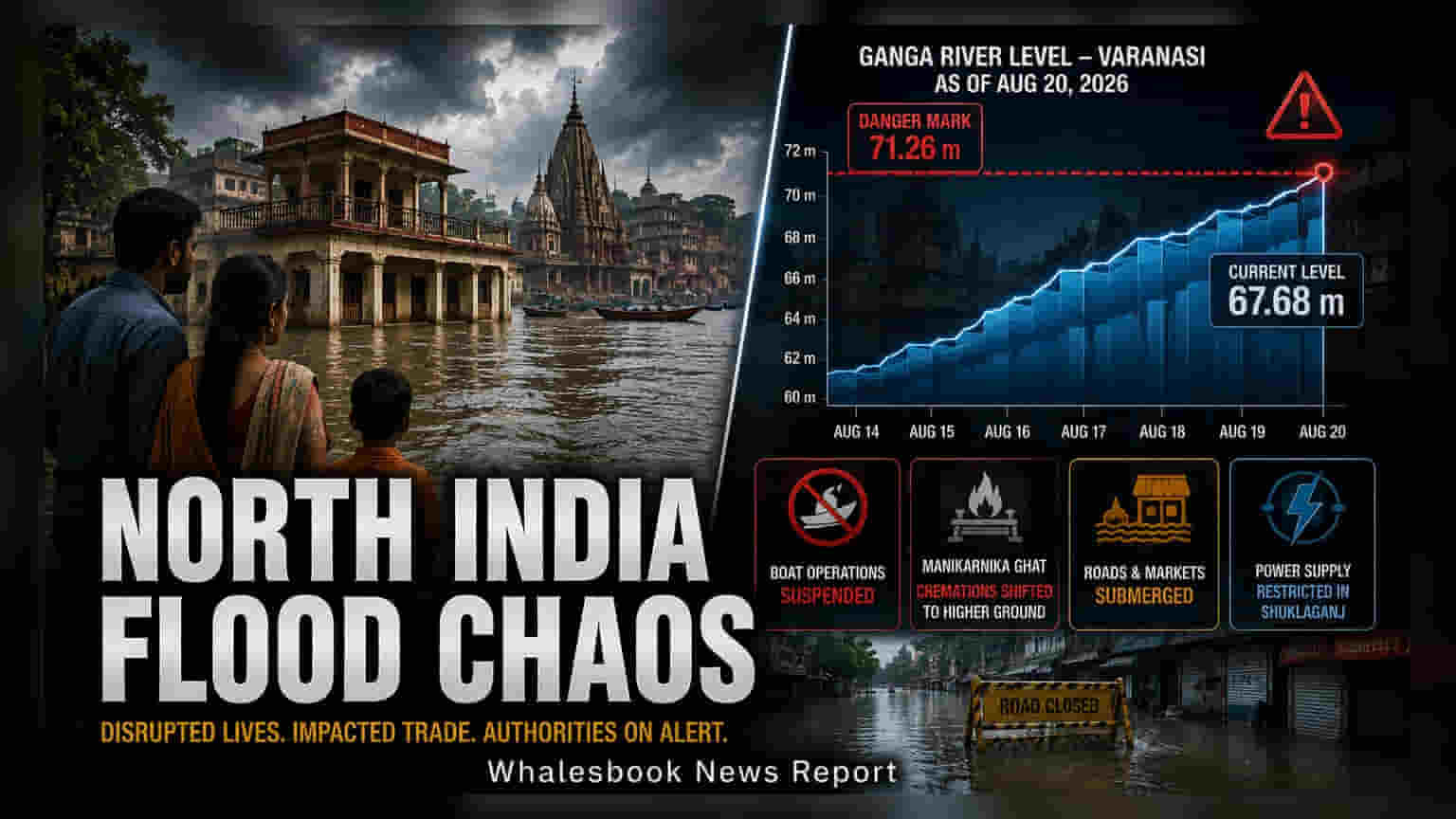
Severe monsoon rains have caused the Ganga and Yamuna rivers to rise, flooding key cities in Uttar Pradesh including Varanasi and Prayagraj. While life and local tourism face immediate disruption, there have been no reports of large-scale industrial or corporate distress, though logistical and local supply chain bottlenecks remain the primary concern for the near term.
Heavy monsoon rainfall across Uttar Pradesh has triggered a significant rise in the water levels of the Ganga and Yamuna rivers, leading to flooding in major commercial and religious hubs. As of August 20, 2026, the Ganga in Varanasi has reached a water level of 67.68 meters, nearing the danger mark of 71.26 meters. This rapid surge has forced authorities to suspend boat operations and shift cremation activities at the Manikarnika Ghat to higher ground, directly impacting the local tourism and religious services economy.
In Prayagraj and Unnao, the flooding has submerged critical infrastructure, including roads and local markets. The inundation has created challenges for daily logistics, as many residential and commercial areas have become inaccessible to land transport. This disruption affects small and medium-sized enterprises (SMEs) and retailers who rely on these routes for inventory movement and customer access. In Unnao’s Shuklaganj area, power supply has been restricted as a safety measure, which may temporarily affect small-scale local business operations.
From an investor and corporate perspective, the situation is primarily a regional civic and disaster management challenge. As of Thursday afternoon, there have been no exchange filings or reports from large listed entities indicating direct industrial or financial distress caused by this specific flood event. Unlike major industrial calamities that can halt production lines, this event is largely impacting retail, tourism, and local logistics. Investors monitoring the region may note that while the economic impact is concentrated on the local level, prolonged flooding could lead to localized inflationary pressure on perishable goods and delays in regional distribution channels.
State administration and emergency response teams, including the NDRF, are currently managing the situation with round-the-clock surveillance. The immediate focus remains on life safety and the restoration of essential services. For those tracking the economic footprint in these districts, the key monitorables over the coming days will be the stabilization of water levels and the restoration of road connectivity, which will determine how quickly local trade and supply chains can resume normal activity.