 Whalesbook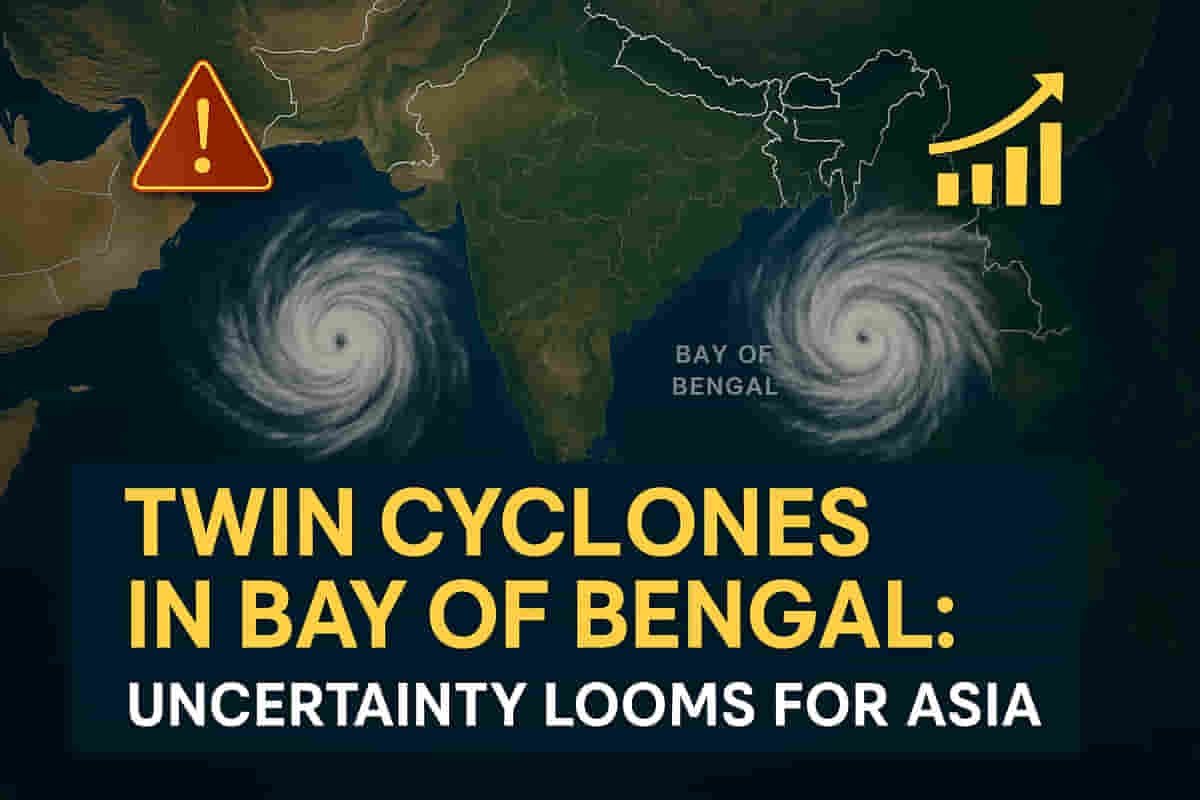


The Bay of Bengal is on alert for the potential development of two cyclonic storms within the next week, raising concerns about forecasting uncertainty due to a possible Fujiwhara-type interaction. The India Meteorological Department (IMD) is closely monitoring two developing systems.
The first system is a well-marked low-pressure area over Malaysia and the Straits of Malacca, predicted to move northwest and intensify into a depression over the South Andaman Sea by November 25, and further into a cyclone over the South Bay of Bengal within 48 hours.
The second system is an upper air cyclonic circulation over the Comorin area, which could induce another low-pressure area over the Southwest Bay of Bengal and Sri Lanka on November 25, with predictions for it to become a depression in a couple of days.
Divergent forecasts from global models like the United States' Global Forecasting System (GFS) and the European Centre for Medium-range Weather Forecasting (ECMWF), visualized on Windy, highlight the unpredictability. GFS data suggests both systems could interact by November 26, with one potentially moving towards the Myanmar coast. ECMWF data, however, indicates the storm from the Comorin area might gain strength and move along India's eastern coast.
Impact:
This news can significantly impact the Indian business landscape. Potential disruptions to agriculture, fisheries, coastal infrastructure, and supply chains due to severe weather could lead to economic losses. Insurance and logistics sectors may also face increased claims and operational challenges. Rating: 6/10
Terms Explained:
- Cyclonic Storm: A rapidly rotating storm system characterized by a low-pressure center, strong winds, and heavy precipitation.
- Low Pressure Area: A region where atmospheric pressure is lower than that of the surrounding area, often a precursor to storm development.
- Depression: A weather system characterized by a closed circulation of winds around a central area of low pressure, stronger than a low pressure area but weaker than a cyclone.
- Fujiwhara Effect: A phenomenon where two nearby cyclonic circulations interact with each other, influencing each other's track and intensity.
- Bay of Bengal: A large gulf in the northeastern part of the Indian Ocean, bounded by India, Bangladesh, Myanmar, and Sri Lanka.
- India Meteorological Department (IMD): The principal agency responsible for meteorological observations and forecasts in India.
- Global Forecasting System (GFS): A weather forecast model developed by the United States' National Oceanic and Atmospheric Administration (NOAA).
- European Centre for Medium-range Weather Forecasting (ECMWF): An independent intergovernmental organisation that provides meteorological forecasts.