

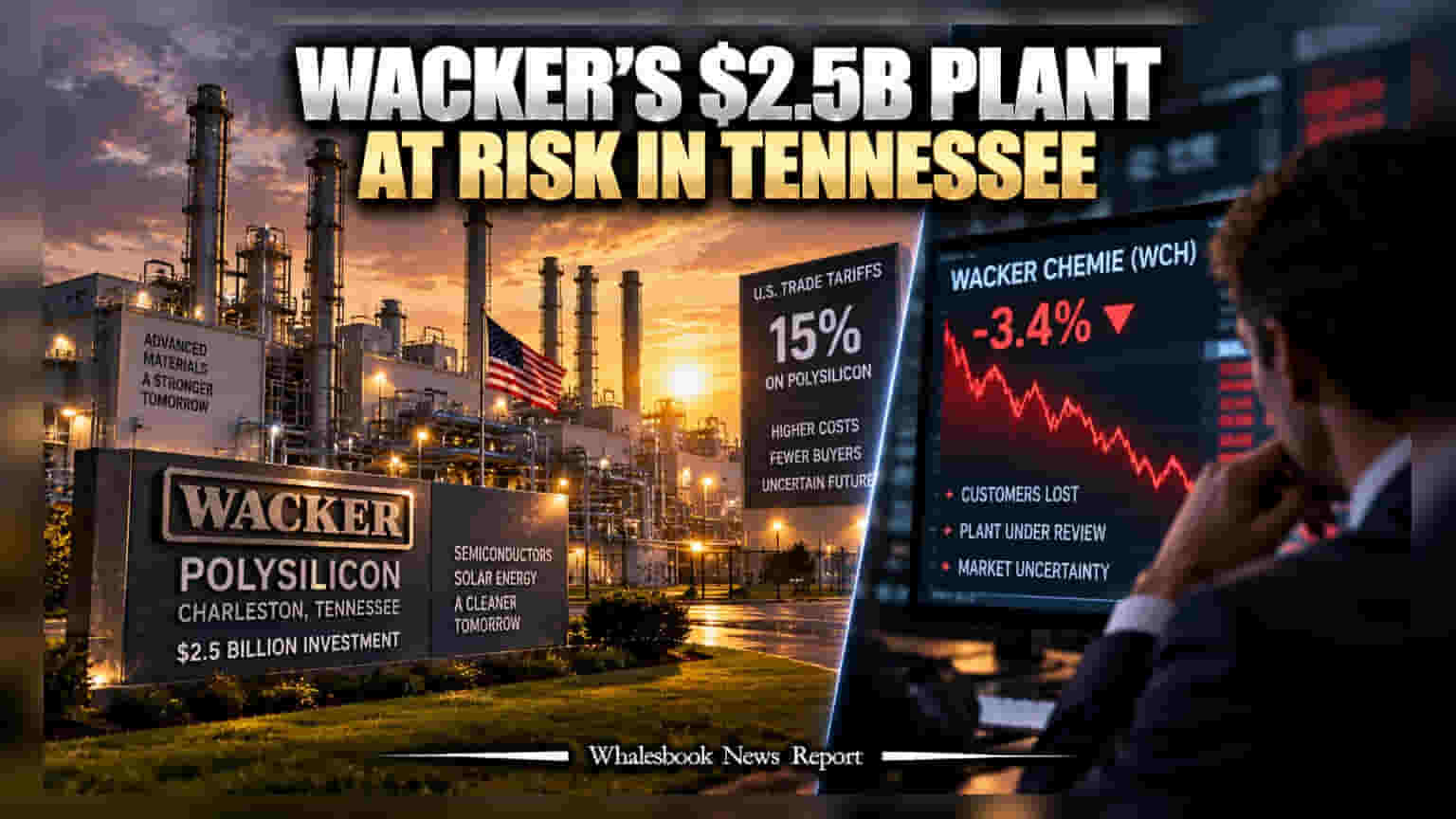
Wacker Chemie is considering closing its $2.5 billion polysilicon facility in Charleston, Tennessee, after recent U.S. trade policies rendered it uncompetitive. The stock fell 3.4% as investors assess the operational impact following the loss of two key customers. The company is expected to provide further clarity at its upcoming investor meeting on September 17.
Wacker Chemie is reviewing the future of its major polysilicon production site in Charleston, Tennessee, as the company faces unexpected fallout from recent U.S. trade measures. The facility, which represents a $2.5 billion investment, is under threat after the company lost its two remaining customers for the site’s output. The potential closure reflects a difficult environment for specialized manufacturers navigating complex changes in global trade rules.
The current crisis stems from an August 6, 2026, trade policy announcement by the Trump administration. While the measures were designed to protect domestic supply chains through a 15% duty on imported polysilicon and new price floors, the policy reportedly fails to distinguish between foreign and U.S.-made material. Wacker Chemie has indicated that U.S.-produced material is significantly more expensive to create than international alternatives, and without targeted subsidies, the Charleston site is struggling to compete for buyers.
Shares of Wacker Chemie (WCH) fell approximately 3.4% on September 4, 2026, as investors reacted to the potential shutdown news. This development creates uncertainty following a generally strong year for the company, which reported an 85% year-over-year increase in its second-quarter EBITDA, largely driven by previous cost-reduction efforts. However, this financial performance is now being challenged by persistent weaknesses in the global solar-grade polysilicon market and intense competition, particularly from Chinese manufacturers who maintain significant capacity advantages.
If the company decides to permanently close the Charleston plant, it would likely face significant financial costs, including restructuring charges and potential asset impairments. The situation highlights a broader risk for polysilicon producers operating in the U.S.: even with protective tariffs, if the cost of production remains substantially higher than global benchmarks without government support, the business model may struggle to remain viable in the long term.
Investors are now shifting their attention to Wacker Chemie’s upcoming Capital Markets Day in London, scheduled for September 17. The event is expected to be a crucial monitorable, as management provides more detail on the status of its North American operations and whether they see a path forward for the Charleston facility or if a permanent exit is the only option.