 Whalesbook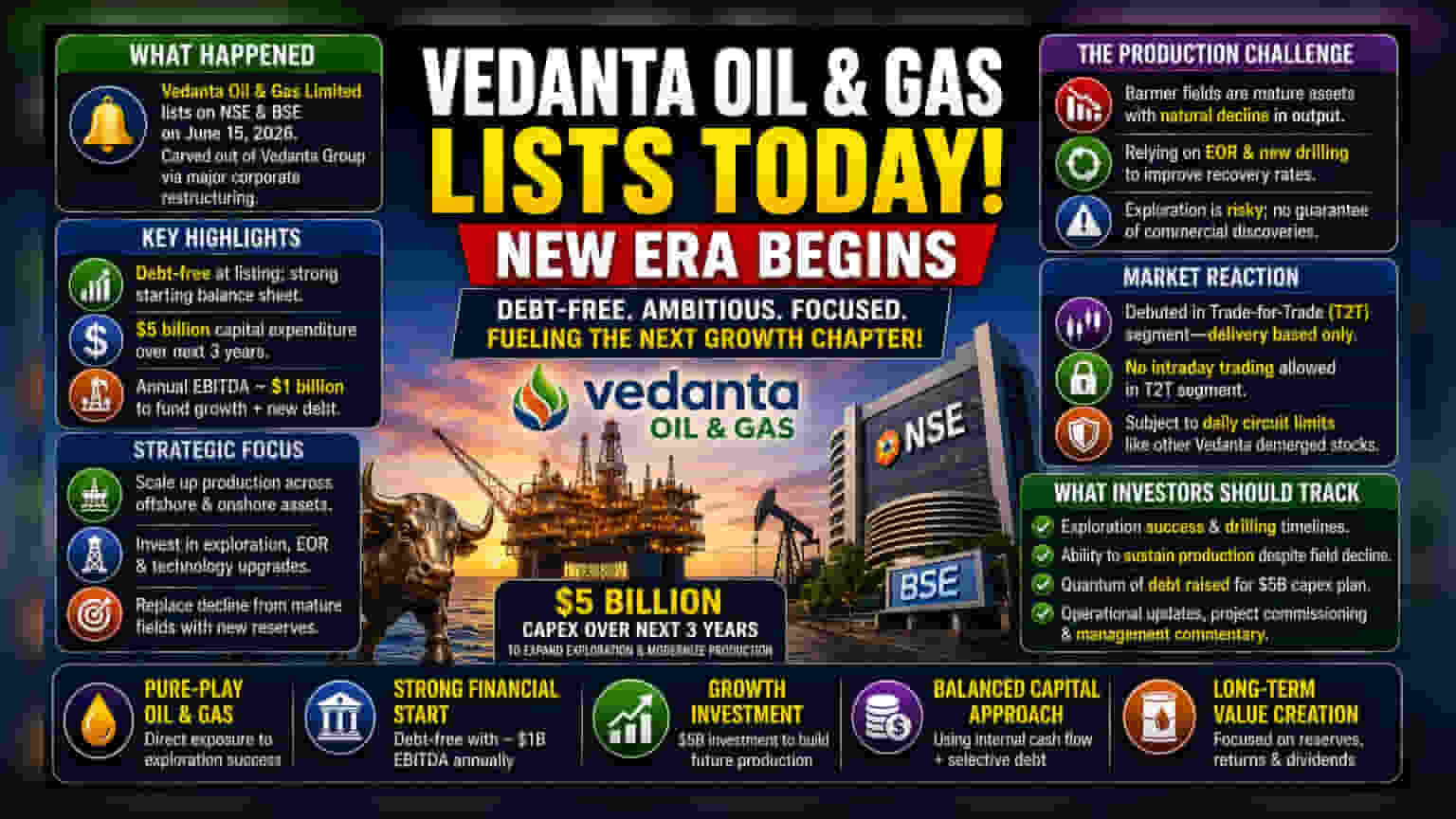


Following its demerger, Vedanta Oil & Gas has listed independently with a $5 billion expansion plan. While currently debt-free, the company faces the challenge of natural production declines at its mature Barmer fields, making execution of this exploration strategy a key monitorable for investors.
What Happened
Vedanta Oil & Gas Limited, a newly formed entity carved out of the Vedanta Group, officially began trading on the National Stock Exchange (NSE) and the Bombay Stock Exchange (BSE) on June 15, 2026. This independent listing is the result of a major corporate restructuring aimed at splitting the conglomerate into sector-focused businesses. Alongside this listing, management announced a capital spending program of $5 billion over the next three years, intended to boost exploration activities and modernize production capabilities. The company is currently operating as a debt-free entity, a status it intends to leverage to secure funding for these growth projects.
Strategic Shift and Expansion Plan
The primary goal behind this capital investment is to scale production across both offshore and onshore projects. For the newly independent entity, the move represents a shift in strategy. By operating as a pure-play oil and gas business, the company aims to provide investors with a direct way to participate in its exploration success. The $5 billion commitment is significant, as it addresses the need to replace output from older assets with new reserves. The company plans to fund this through a combination of its internal earnings—which reported an annual EBITDA of approximately $1 billion—and new debt. This marks a pivot for the business as it moves from being a cash-generating unit within a larger group to an independent entity that must actively manage its own balance sheet and future growth.
The Production Challenge
While the company has a strong financial starting point, investors should be aware of the operational context. Its key asset, the Barmer oil fields in Rajasthan, is a mature asset. Historically, such fields experience a natural decline in reservoir pressure, leading to reduced output over time. The management’s strategy relies heavily on technologies like Enhanced Oil Recovery (EOR) and new exploration drilling to offset this decline and improve recovery rates. The success of this $5 billion investment will depend on the company's ability to successfully find and develop new reserves. Exploration is inherently risky, and there is no guarantee that drilling will always lead to commercial discoveries.
How The Stock Reacted
The shares made their debut in the "Trade-for-Trade" (T2T) segment, a standard measure for newly listed securities to prevent speculative trading. In this segment, all transactions must result in delivery, meaning intraday trading is not permitted. Upon listing, the stock experienced volatility, reflecting the market’s initial price discovery process for the newly independent business. As with other entities formed during the Vedanta demerger, the stock is also subject to daily circuit limits, which restrict how much the price can move in a single session.
How Investors May Read This
The demerger was designed to eliminate the "conglomerate discount" often applied to diversified companies, allowing the market to value the oil and gas business on its own merits. However, the investment case now hinges on two factors: the transition from a debt-free status to one that will use debt for expansion, and the ability to reverse production trends. Investors will likely look for clarity on how the company manages the cost of its expansion relative to global crude oil prices, which directly impact revenue. The company’s ability to pay dividends, as hinted by management, while simultaneously funding a large capital program, will also be an important point of interest for long-term shareholders.
What Investors Should Track
Moving forward, the primary monitorables for shareholders include updates on exploration success and drilling timelines. Investors should track whether the company can maintain its production levels despite the natural decline of its mature fields. Additionally, any updates regarding the quantum of debt raised to fund the $5 billion project will be critical, as it will change the company's currently debt-free financial profile. Regular operational updates from the company regarding field performance, project commissioning dates, and management commentary on capital allocation will provide a clearer picture of the business’s long-term sustainability.