

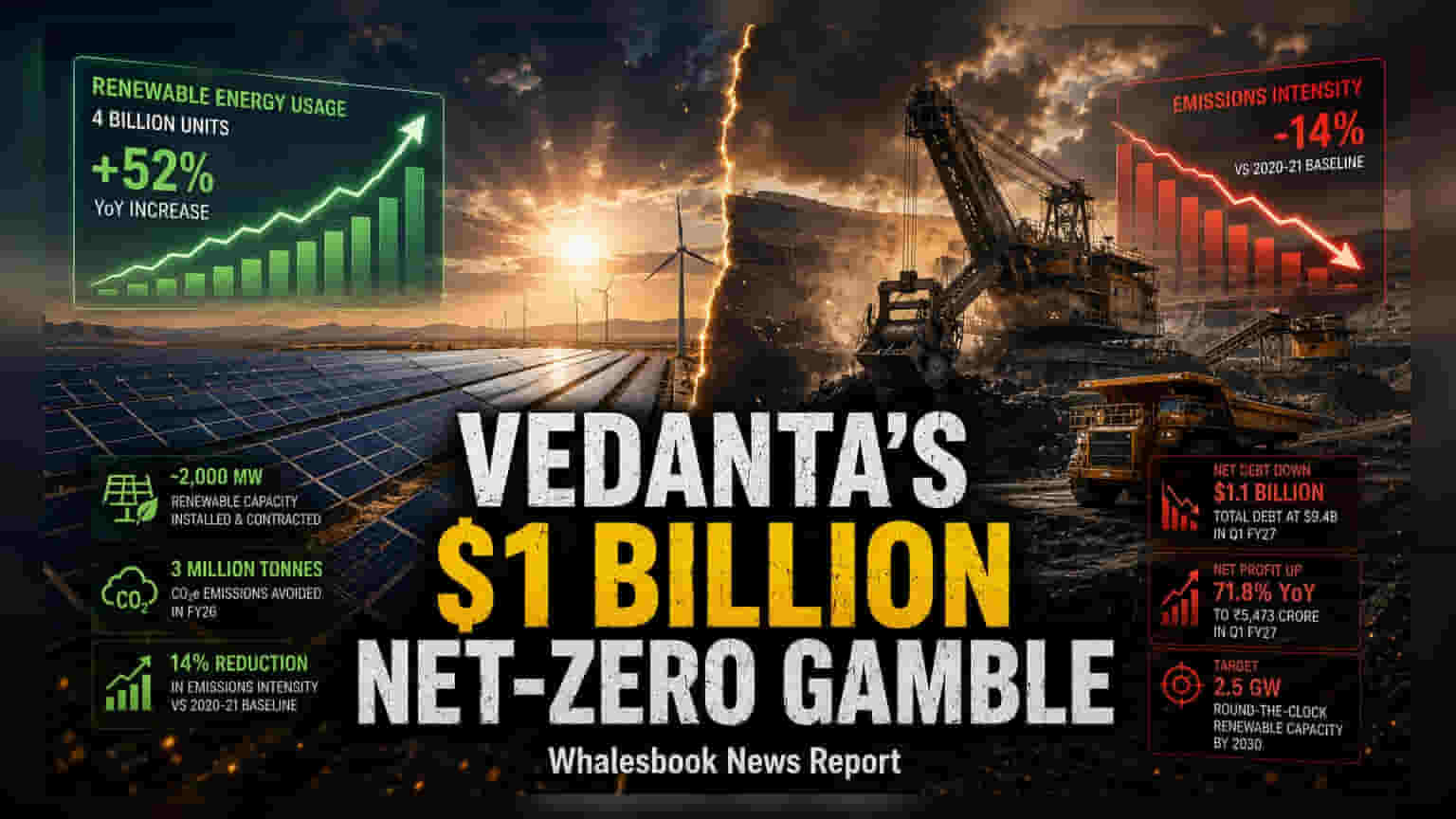
Vedanta has deployed over $1 billion for its net-zero goals in FY26, as renewable energy use jumped 52%. The mining major is balancing these green investments with a strong 71.8% profit growth in the latest quarter, though the capital-heavy nature of its business remains a factor for investors to track.
Vedanta, the diversified mining and metals conglomerate, has invested over $1 billion into its net-zero transition initiatives during the fiscal year 2025-26. This spending is part of the company's broader strategy to lower its carbon footprint and shift toward cleaner energy sources across its global operations.
Scaling Renewable Energy
The company’s investment has yielded tangible results in energy usage. In FY26, Vedanta reported a 52% year-on-year increase in renewable energy consumption, reaching 4 billion units. This shift has been supported by an installed and contracted renewable capacity of nearly 2,000 MW. These efforts, combined with technology-driven improvements, allowed the company to avoid 3 million tonnes of carbon dioxide equivalent emissions in the last fiscal year. Furthermore, the company has successfully reduced the emissions intensity of its metals and mining operations by approximately 14% against its 2020-21 baseline.
Balancing Green Spending with Financial Growth
For investors, understanding how these environmental investments impact the balance sheet is crucial. While the company is spending significantly on its energy transition, it has also focused on improving its financial health. In the first quarter of fiscal year 2027 (Q1 FY27), the Vedanta Group successfully reduced its net debt by $1.1 billion, bringing the total debt down to $9.4 billion. During the same period, the company reported a strong financial performance, with consolidated net profit rising by 71.8% year-on-year to ₹5,473 crore. This combination of profit growth and active debt reduction suggests that the company is aiming to fund its transition initiatives without over-leveraging its balance sheet.
Risks and Market Realities
Despite the positive progress in both decarbonisation and financial results, the mining and metals sector carries inherent risks. The industry is highly capital-intensive, requiring constant investment to maintain or expand capacity, which can periodically put pressure on cash flows. Investors should also note that the commodities market is subject to volatility, which can influence profit margins regardless of energy efficiency gains. Additionally, the success of long-term climate goals relies heavily on the scalability of new technologies and future government policies regarding energy transition.
Looking ahead, the next monitorable for the market will be the company’s progress toward its target of reaching 2.5 GW of round-the-clock renewable energy capacity by 2030. Management’s ability to maintain a balance between aggressive environmental goals and debt management will remain a key focus for shareholders in the coming quarters.