 Whalesbook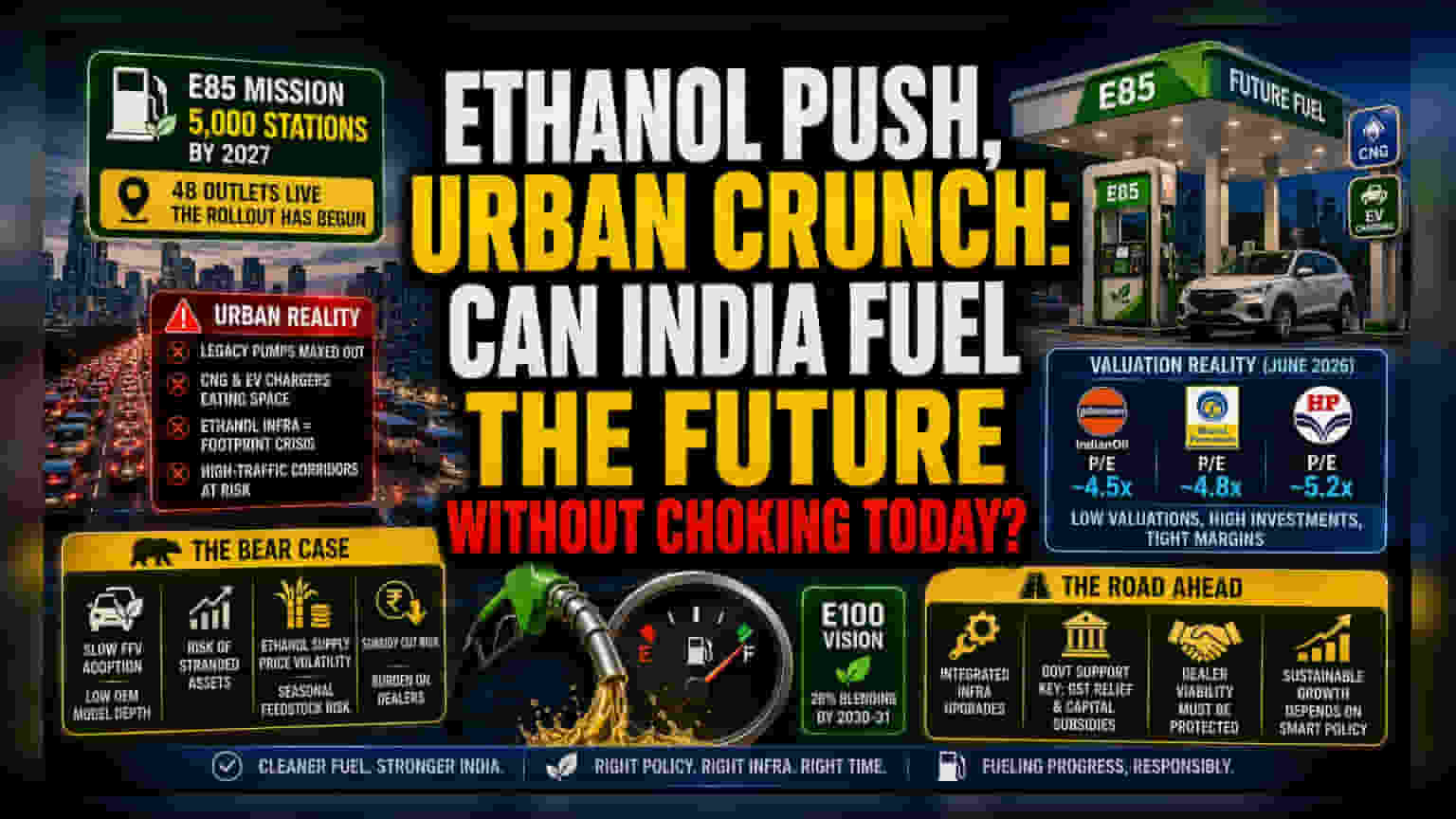


The Infrastructure Paradox
The government’s aggressive transition toward high-ethanol fuel grades—with plans for 5,000 dispensing stations by 2027—is hitting a wall in India’s densest metropolitan areas. While the rollout of E85 across 48 initial outlets marks a significant policy milestone, the move exposes a structural fragility in the retail network. Unlike greenfield highway stations, legacy urban pumps in cities like Delhi and Mumbai are effectively maxed out. These sites were engineered for traditional petroleum products; the layering of CNG and EV charging hardware has already eroded their operational efficiency. Introducing the specialized storage, pipelines, and dispensing units required to prevent ethanol contamination creates a footprint crisis that threatens to bottleneck fuel supply in high-traffic corridors.
Valuation and Market Reality
For major Oil Marketing Companies (OMCs) like Indian Oil (IOC), Bharat Petroleum (BPCL), and Hindustan Petroleum (HPCL), the push toward E100 involves heavy capital expenditure at a time when retail margins remain constrained by global crude volatility. As of June 2026, these stocks are trading at relatively low P/E multiples—ranging from approximately 4.5x to 5.2x—reflecting market skepticism regarding the immediate profitability of these mandates. While the government claims E85 will be priced roughly ₹20 per liter below conventional petrol, the burden of funding the required infrastructure—and managing the potential under-utilization of these assets until flex-fuel vehicle (FFV) penetration reaches scale—falls heavily on the OMCs and individual dealers.
The Forensic Bear Case
Institutional analysts remain wary of the 'Brazil-style' roadmap, noting that India’s retail sector lacks the footprint flexibility of its global peers. Beyond the immediate spatial constraints, the financial viability of these retail upgrades is contingent upon FFV sales, which have been historically sluggish. Unlike the rapid adoption of electric two-wheelers, flex-fuel vehicle market penetration faces significant inertia, exacerbated by the lack of model diversity from OEMs. There is a tangible risk that current capital investments in ethanol-compatible infrastructure may result in stranded assets if consumers do not migrate to FFVs at the pace required by the Ministry’s 2027 targets. Furthermore, the reliance on seasonal agricultural feedstocks for ethanol production introduces supply-side price risks that the retail network may eventually have to absorb if subsidies are curtailed.
Future Outlook
Moving forward, the industry expects a move toward more integrated planning, where traditional petrol infrastructure is gradually converted rather than merely augmented. The current policy focus on increasing the nationwide blending average to 26% by 2030-31 implies that OMCs will continue to prioritize ethanol-compatible upgrades. However, successful scaling will likely depend on whether the government can provide consistent GST relief or capital subsidies that offset the mounting infrastructure and operational costs currently weighing on the retail fuel dealer network.