

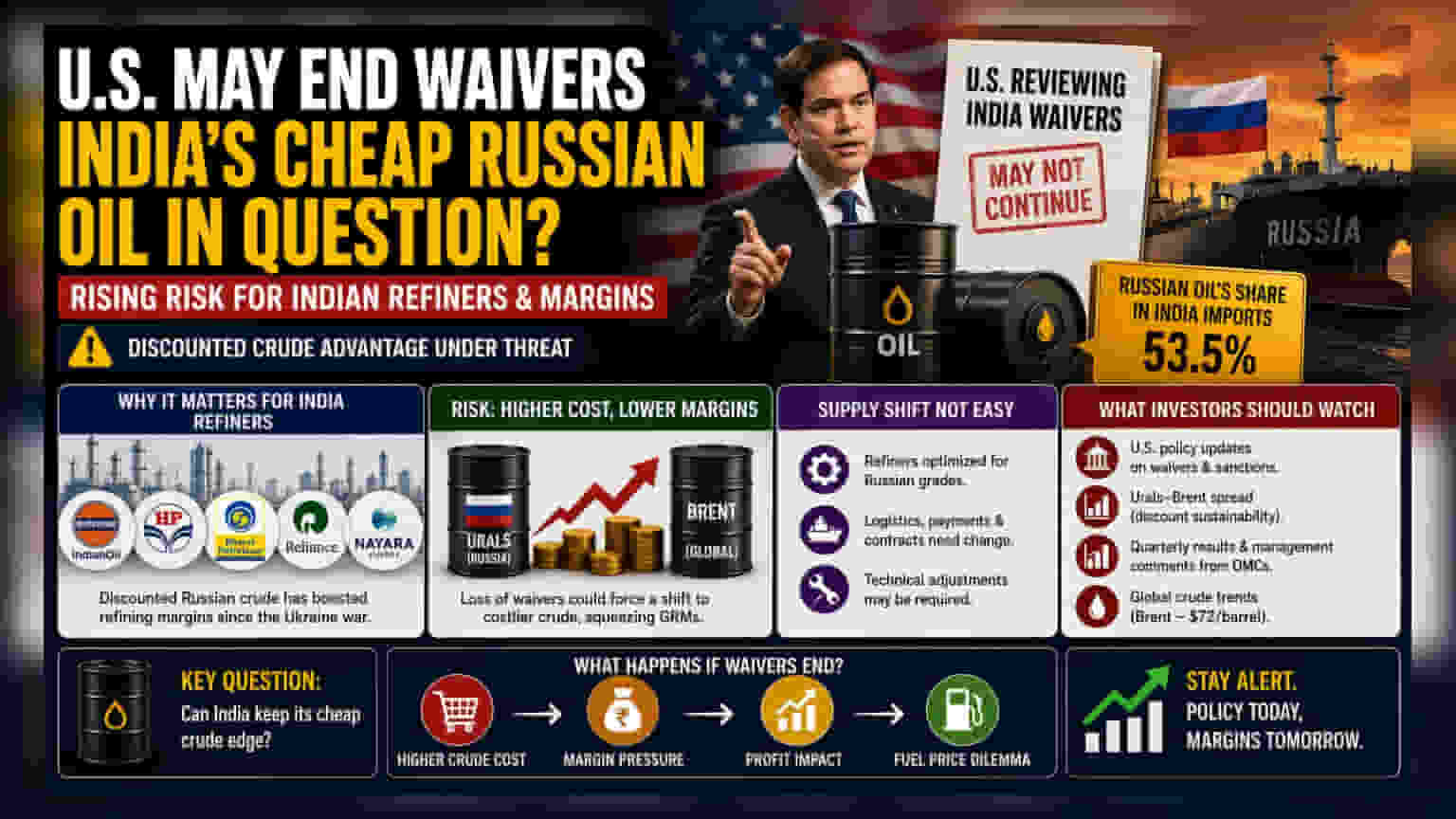
US officials have hinted that waivers allowing India to import discounted Russian crude may be reviewed as global oil prices stabilize. With Russia accounting for over 53% of India's crude intake, any potential restriction could force domestic refiners to switch to costlier markets, which may pressure refining margins and overall profitability.
What Happened
The US administration has signaled a potential review of the waivers that have allowed India to import discounted Russian crude oil. US Secretary of State Marco Rubio indicated that these waivers may not continue indefinitely, especially as global crude oil prices have shown signs of stabilizing. With Brent crude trading near $72 a barrel, the US government reportedly believes it has more flexibility to enforce stricter measures without triggering extreme volatility in global energy markets. India has significantly increased its intake of Russian oil, which currently makes up approximately 53.5% of the country's total crude imports, according to recent data.
Why This Matters For Indian Refiners
For Indian oil companies, the heavy reliance on Russian crude has been a key factor in protecting and expanding profit margins. Since the conflict in Eastern Europe began, Russian oil (specifically the Urals grade) has often been available at a discount compared to global benchmarks like Brent. This price differential has allowed Indian refiners—including state-owned giants like Indian Oil Corporation (IOCL), Bharat Petroleum (BPCL), and Hindustan Petroleum (HPCL), as well as private players like Reliance Industries and Nayara Energy—to maintain healthier Gross Refining Margins (GRMs).
If the US were to end import waivers or apply stricter enforcement, these companies might be forced to shift their purchasing back to traditional suppliers in the Middle East and other regions. These sources often operate on different pricing models, and any move away from discounted Russian crude could lead to a higher raw material cost for Indian refiners.
The Margin And Cost Risk
The financial impact on refiners would depend on the price difference between Russian crude and the alternatives available in the spot market. Refining is a high-volume, low-margin business where raw material costs represent the vast majority of operating expenses. A sudden increase in procurement costs without a corresponding rise in retail fuel prices in India could squeeze margins. While the Indian government has historically adjusted fuel pricing, any persistent rise in crude costs creates a difficult balance between maintaining refinery profitability and managing domestic inflation.
Furthermore, shifting supply chains is not an overnight process. Refiners have made capital investments and operational adjustments to process specific grades of Russian crude. Moving away from these suppliers could require technical adjustments in refineries and changes to logistics and payment settlements, which may increase operational complexity.
What To Watch Next
Investors should focus on diplomatic developments and any official policy updates from the US administration regarding the waivers. The critical data point to track is the 'Urals-Brent spread'—a measure of how much cheaper Russian oil is compared to the global standard. If this discount narrows, the economic incentive to source Russian crude diminishes, reducing the impact of potential sanctions.
Additionally, market participants will monitor the upcoming quarterly results of Indian Oil marketing companies to see how management commentary addresses raw material sourcing risks and any potential changes in refining strategies. The stability of global crude prices, currently near $72, remains the primary factor influencing US policy, so monitoring energy market trends will be essential.