

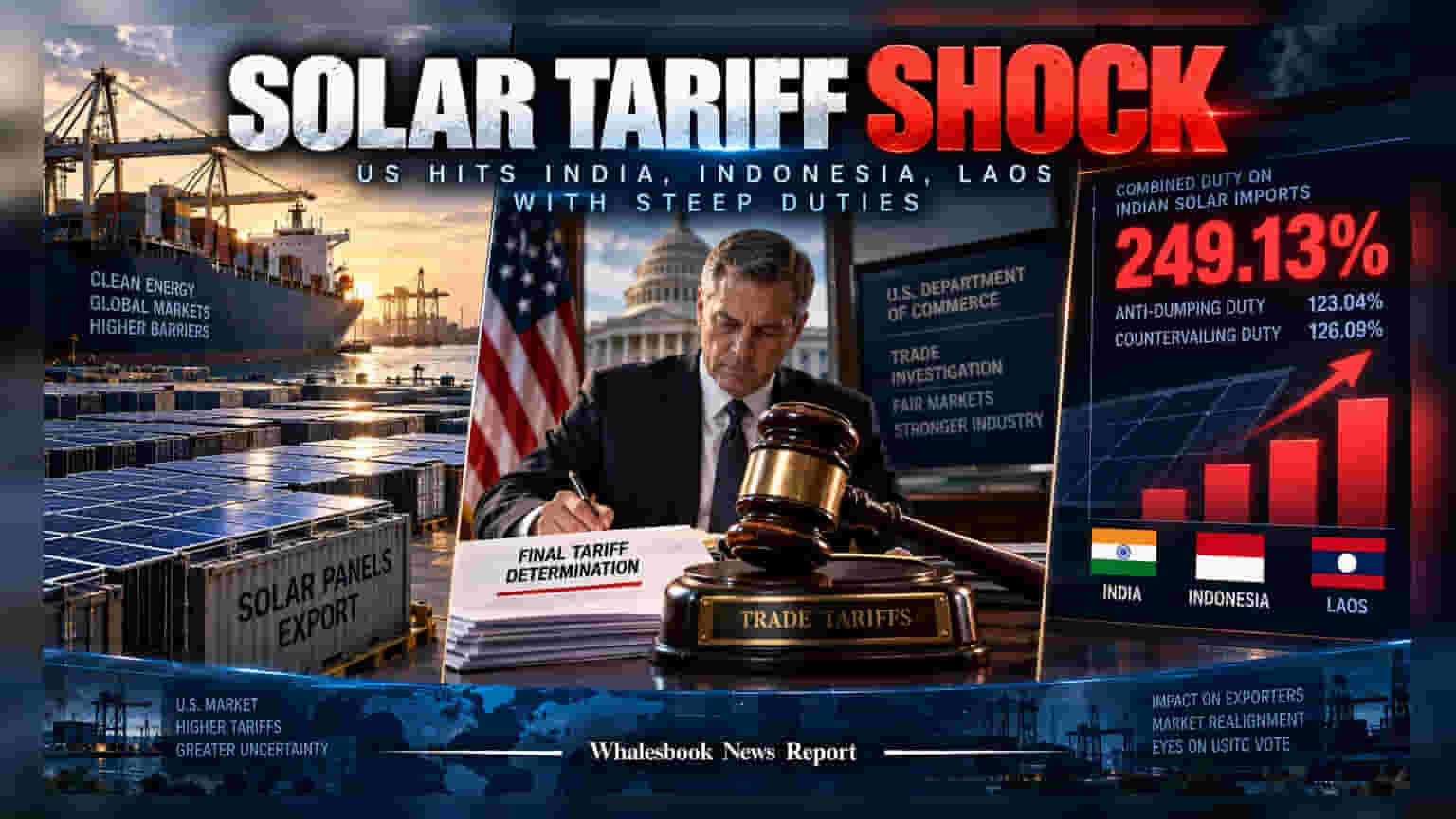
The US Department of Commerce has finalized combined anti-dumping and countervailing duties of approximately 249% on solar cell imports from India. The move addresses allegations of unfair government subsidies, creating significant pressure on Indian manufacturers' export competitiveness. Investors should monitor the upcoming final injury determination by the US International Trade Commission (USITC) set for October 14, 2026.
The United States Department of Commerce has officially finalized steep trade barriers on crystalline silicon photovoltaic cells imported from India, Indonesia, and Laos. For Indian exporters, the decision imposes a combined duty structure of approximately 249.13%, which includes an anti-dumping margin of 123.04% and a countervailing duty (CVD) rate of 126.09%. This aggressive tariff regime follows an investigation initiated by the Alliance for American Solar Manufacturing and Trade, which alleged that manufacturers in these regions were benefiting from unfair state subsidies and flooding the American market with underpriced goods.
Financial Impact on Exporters
For Indian companies that rely heavily on the American solar market, these findings represent a significant business challenge. The primary risk for manufacturers is that these tariff levels are effectively prohibitive, making it difficult for products to be sold at competitive prices in the US. If firms cannot pass these added costs to their customers, their operating margins will face intense pressure. Furthermore, companies with high export exposure to the US may need to quickly pivot toward other international markets or refocus on domestic demand to protect their revenue streams. The ability of these firms to absorb such costs or reconfigure their supply chains without compromising profitability will be a key factor for investors to observe in coming quarterly results.
The Final Hurdle: The USITC Decision
While the Department of Commerce has concluded its investigation and set these duty rates, the process is not yet fully closed. The final authority on whether these duties become permanent lies with the US International Trade Commission (USITC). The commission is responsible for determining whether the import levels from India, Indonesia, and Laos have caused material injury to the domestic US solar manufacturing industry.
This is a critical checkpoint for the sector. The USITC is scheduled to deliver its final injury vote on October 14, 2026. If the commission votes in favor of the domestic industry, the Department of Commerce will issue final duty orders by November 2026, making the tariffs effective. Conversely, if the USITC delivers a negative finding, the investigation would be terminated, and the proposed duties would not be imposed.
What Investors Should Monitor
Investors should track management commentary from major Indian renewable energy and solar manufacturing firms regarding their exposure to the US market. The central monitorable is the USITC vote on October 14. A positive injury finding by the USITC would likely force a strategic shift for affected companies, requiring them to manage potential revenue loss and adjust their sales strategies. Market participants may also watch for any official filings or updates from these companies regarding their plans to navigate this new trade environment, including any potential legal responses or shifts in production focus.