

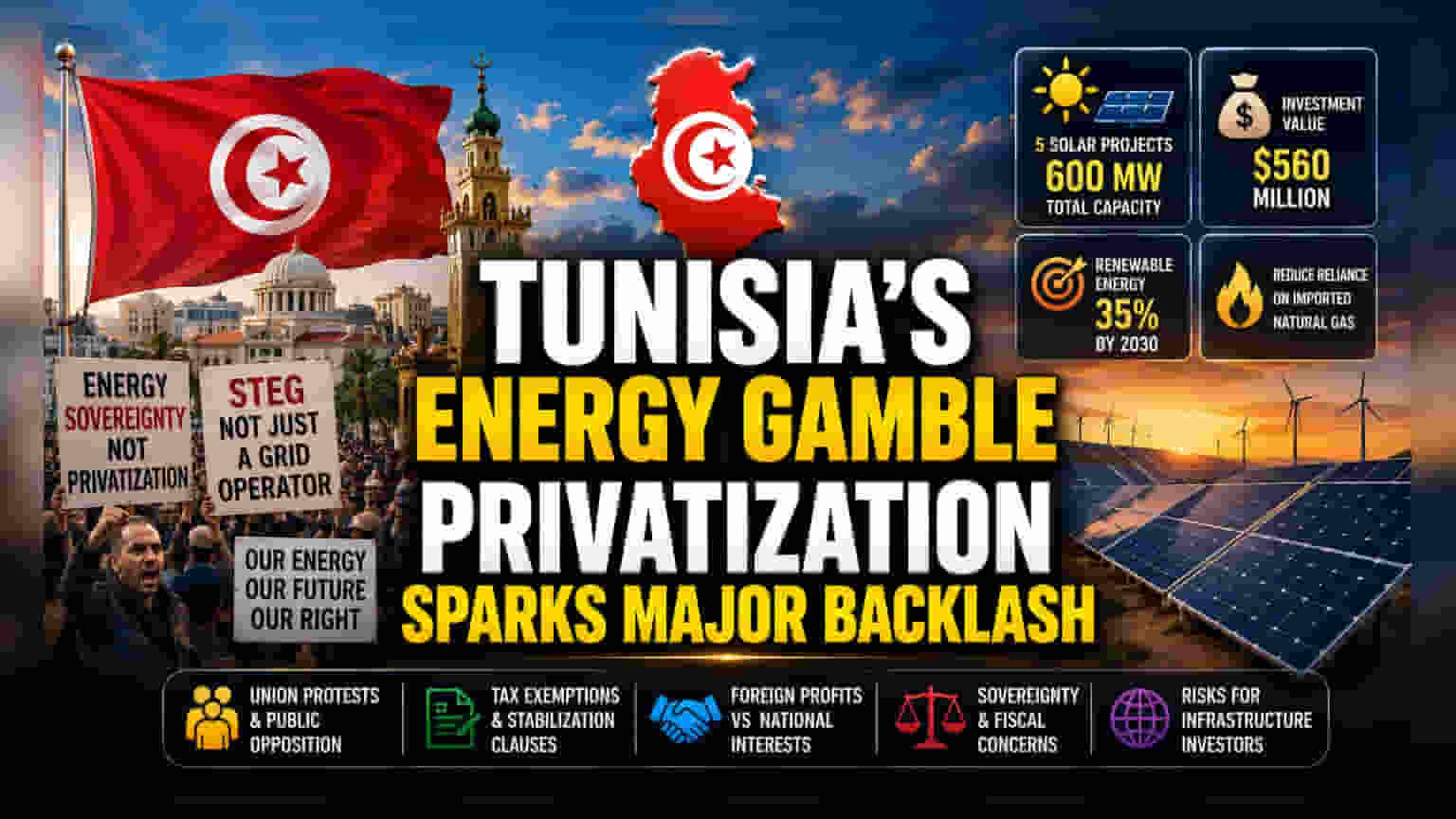
Tunisia is moving ahead with plans to award 600-megawatt solar projects worth $560 million to foreign firms. The move is facing strong resistance from trade unions and local observers who argue it could undermine energy sovereignty and fiscal stability. Investors in emerging market infrastructure are keeping a close eye on how the government navigates these local socio-political risks.
What Happened
Tunisia is advancing a strategy to privatize electricity production, aiming to reduce its national energy deficit, which currently stands at approximately $3.8 billion. In January, the government submitted five new renewable energy concession contracts for approval by parliament. These solar projects, expected to total 600 megawatts in capacity, carry an estimated investment value of $560 million. The planned sites include locations in Sidi Bouzid, Gafsa, and Gabes. The government argues that these foreign-led investments are necessary to reach its target of 35% renewable energy by 2030 and to lower reliance on imported Algerian natural gas.
The Conflict Over Privatization
The initiative has triggered significant domestic opposition. The Electricity and Gas Federation, a major trade union, has criticized the model, arguing that it reduces the national utility, STEG, to a mere grid operator. Critics contend that under this structure, foreign multinationals would profit from electricity production while local citizens might be left to bear the burden of infrastructure costs. The concerns center on the long-term impact on Tunisia’s economic autonomy, with some labeling the plan as a repeat of earlier economic adjustment policies that prioritize foreign capital over national development.
Fiscal and Sovereignty Concerns
The Tunisian Economic Observatory has raised questions regarding the terms of these concession agreements. Specifically, the observatory pointed to tax exemptions and stabilization clauses as factors that could limit Tunisia’s fiscal control. There are also concerns about the limited transfer of technology and the potential for carbon credits generated within the country to be transferred to foreign entities rather than remaining a public asset. These issues have created a complex environment for these infrastructure projects, as the government attempts to balance international investment with domestic demands for energy sovereignty.
Risks for Infrastructure Investors
For global investors in the renewable energy sector, this situation highlights the operational risks inherent in emerging market infrastructure projects. When large-scale projects rely on privatization, the social license to operate can become a significant hurdle. Union resistance, public sentiment, and potential changes in government policy regarding fiscal sovereignty can lead to delays, cost overruns, or contractual renegotiations. Investors in similar regions often watch how governments manage the trade-off between attracting foreign capital and maintaining domestic political stability.
What Investors Should Track
The immediate monitorable is the outcome of the parliamentary review for these five concessions. Investors will also look for further clarity on how the government plans to address concerns regarding local job creation and technology transfer. The broader energy strategy remains a point of contention, and any shift in the government’s approach—such as focusing more on public transport efficiency or local refining capacity—could impact the future of these private energy contracts.