

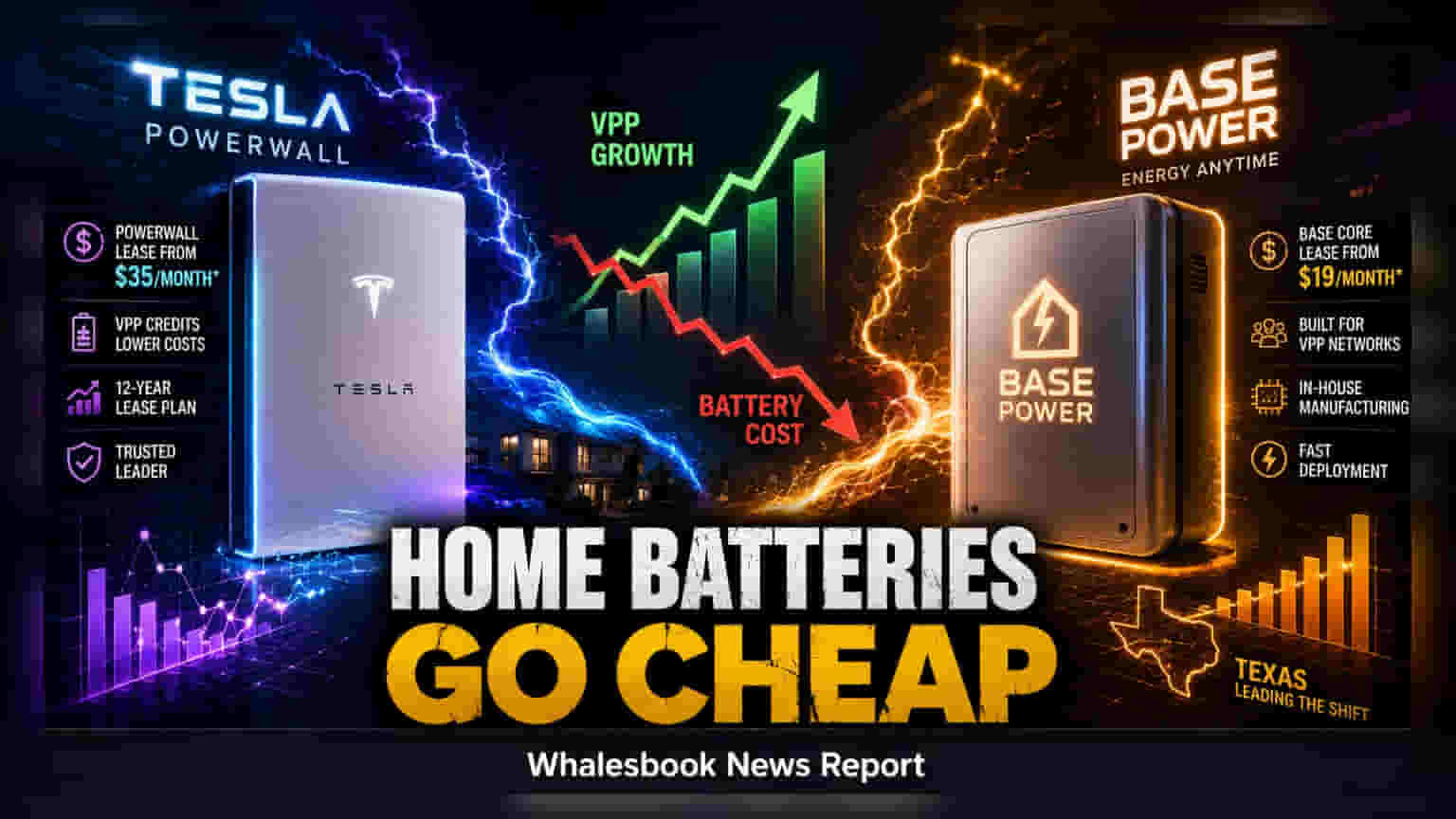
Home energy storage prices are dropping rapidly as Tesla and startup Base Power use aggressive leasing to grow their virtual power plant networks. By offering low-cost battery access, these companies are turning residential homes into grid-scale power resources. Investors are now watching whether this rapid expansion can overcome the risks of long-term contracts and complex regulatory scaling.
The home energy storage market is undergoing a major shift as prices for battery systems fall, fueled by intense competition and the rise of Virtual Power Plants (VPPs). Tesla, a long-time leader in this space, is now facing direct competition from newer companies like Texas-based startup Base Power. This rivalry has triggered an aggressive push to lower costs for homeowners, with some lease options now costing as little as $19 to $35 per month.
Competition Drives New Leasing Models
Historically, installing a home battery system could cost homeowners more than $10,000. To disrupt this model, companies are shifting toward monthly leasing. In Texas, for instance, Tesla has introduced a Powerwall lease plan that can cost around $35 per month after factoring in credits from VPP participation. Meanwhile, Base Power, which recently secured $1 billion in Series D funding at a $13 billion valuation, is offering its 'Base Core' battery system for approximately $19 monthly.
The strategy is simple: by lowering the entry barrier, these companies can deploy thousands of batteries quickly. This allows them to build a large fleet of decentralized energy assets that can be controlled as a single unit.
The Virtual Power Plant Model
Virtual Power Plants allow utility companies to use these home batteries during times of high electricity demand. Instead of building expensive new power plants or paying industrial users to stop operations, utilities can simply draw power from the network of home batteries when needed. The battery operators earn money by charging the units when electricity prices are low and selling stored power back to the grid during peak hours.
This system is gaining traction because it is much faster to deploy than a traditional power plant, which can take years to permit and build. As the demand for electricity grows due to the rise of AI data centers and broader economic electrification, the need for these flexible grid solutions is expected to increase.
Risks and Investor Monitorables
While the business model of monetizing distributed batteries sounds promising, there are clear risks for investors to track. Tesla’s lease programs often involve 12-year contracts, which create long-term financial commitments for the company. If customers leave or properties are sold, managing these contracts can become complex.
For startups like Base Power, the risk is execution. Successfully scaling in-house manufacturing to meet the demand of a growing VPP network is a difficult task. Additionally, the industry faces regulatory hurdles. VPPs rely on specific utility partnerships and state-level energy rules. If these regulations change or if utility partnerships do not scale as expected, the financial returns on these battery fleets could fall short of projections. Investors may monitor how quickly these companies can sign up new subscribers and secure the necessary regulatory approvals to keep their battery networks growing.