 Whalesbook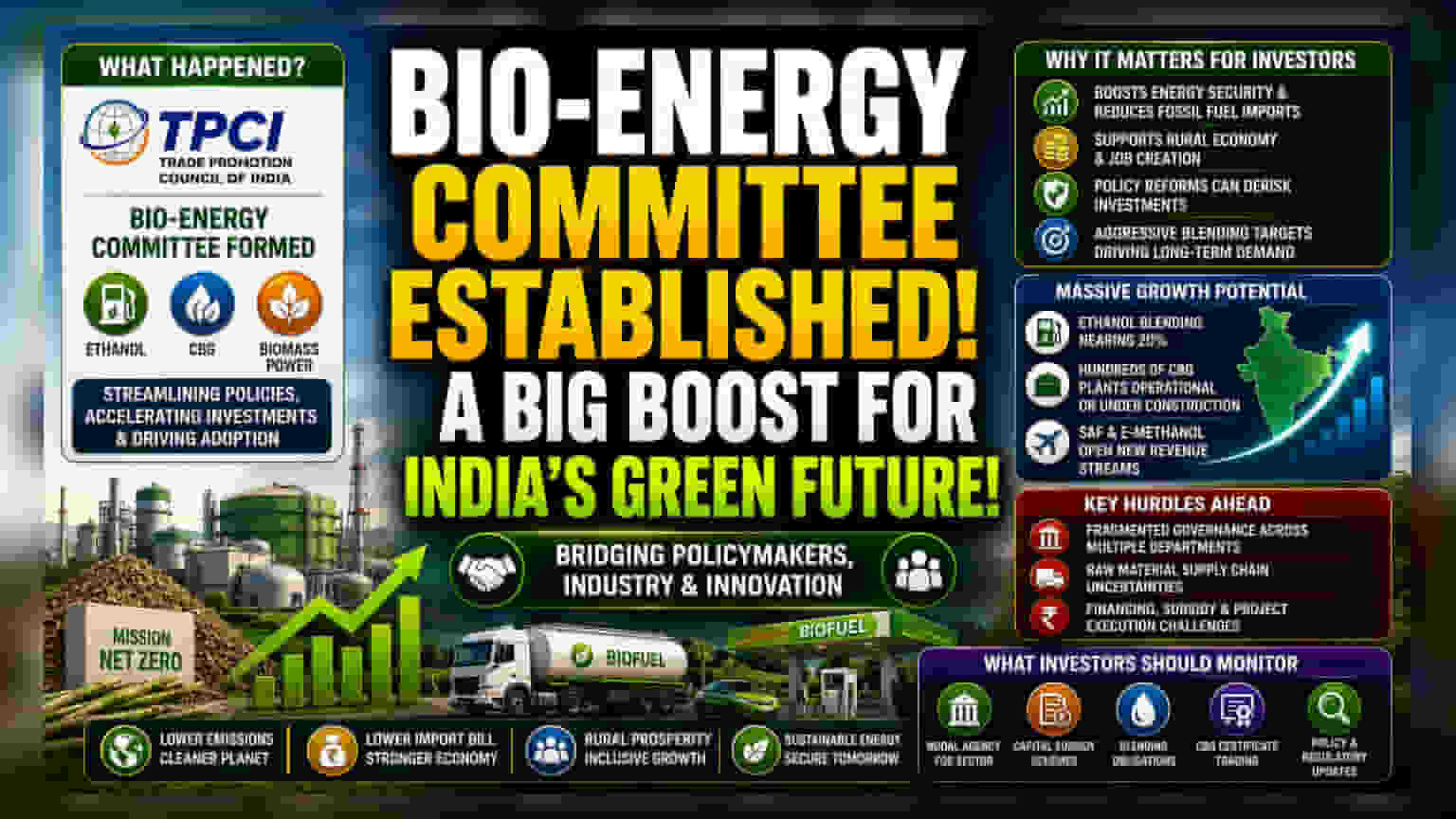


The Trade Promotion Council of India has launched a dedicated Bio-Energy Committee to streamline policy and boost investment in the sector. With India accelerating ethanol blending and Compressed Bio-Gas (CBG) capacity, this move aims to bridge the gap between policy and implementation. Investors are tracking this shift toward green fuels, though hurdles like fragmented governance and supply chain stability remain key areas to watch.
What Happened
The Trade Promotion Council of India (TPCI) has officially established a dedicated Bio-Energy Committee. This new body aims to act as a bridge between policymakers, industry leaders, and innovators. The primary objective is to streamline the bio-energy sector, which includes segments like ethanol, Compressed Bio-Gas (CBG), and biomass power. The committee will work on formulating recommendations for policy and regulatory reforms to help accelerate the adoption of these technologies and attract more investment into the country's green energy ecosystem.
Why This Matters for Investors
Bio-energy is becoming a central pillar of India's energy security and net-zero emissions strategy. By reducing reliance on imported fossil fuels, the sector offers a way to lower the national import bill while creating new economic opportunities in rural areas. For investors, this development signals a push to resolve the "implementation gap" that has often slowed down projects in this space. As the government moves toward more aggressive blending targets and capacity additions, a structured dialogue between the industry and the government could lead to clearer rules, faster project approvals, and better financial support mechanisms, potentially de-risking investments in this sector.
The Sector's Growth Potential
India is currently one of the fastest-growing bioenergy markets globally. The government has already set ambitious targets for ethanol blending—nearing the 20% mark—and is rapidly scaling up CBG production. Current data indicates that hundreds of CBG plants are either operational or under construction. Beyond transportation fuel, there is rising interest in Sustainable Aviation Fuel (SAF) and e-methanol for shipping, which could open up entirely new revenue streams for companies involved in the bioenergy value chain. Major players, from traditional oil companies to specialized bioenergy firms, are already positioning themselves to capture this demand by converting agricultural and organic waste into value-added energy products.
The Hurdles Ahead
Despite the positive outlook, the sector faces significant operational and structural challenges. Industry leaders have frequently pointed out that governance is currently fragmented. A single project often requires coordination across multiple government departments, including agriculture, petroleum, rural development, and finance. This complexity can cause delays in project execution and complicate the path to securing financial incentives or subsidies. Additionally, maintaining a stable supply chain for raw materials—such as agricultural residue or organic waste—remains a persistent risk. Seasonal variations in crop production and the logistics of collecting and transporting biomass mean that project viability often depends heavily on local supply chain efficiency rather than just the production technology itself.
What Investors Should Monitor
Moving forward, the key factor for investors will be whether this new committee can successfully advocate for a single "nodal agency" or a more unified point of contact for the bio-energy sector. This would significantly reduce the bureaucratic burden for companies. Other critical areas to track include updates on capital subsidy schemes, clarity on blending obligations for bio-products, and the development of new market mechanisms, such as certificate trading for CBG. Any progress in these areas could be a strong signal of the sector's maturity and its ability to scale sustainably beyond the current project pipeline.