

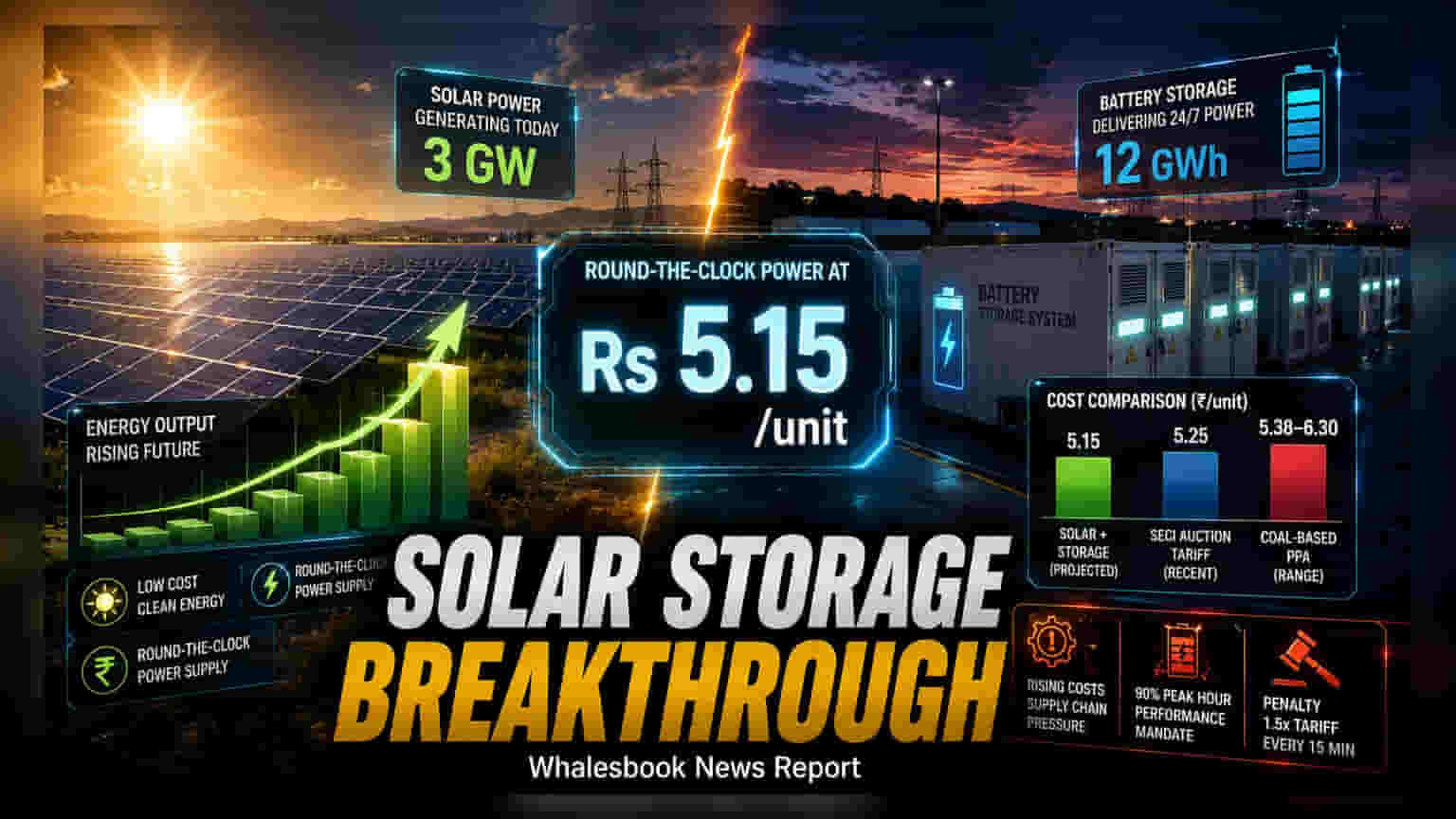
New research from the India Energy and Climate Centre suggests solar-plus-storage projects could deliver 24/7 power at ₹5.15 per unit, outperforming recent SECI auction rates of ₹5.25. While this efficiency signals potential for cheaper clean energy, investors should watch for risks like rising solar component costs and profit pressure from aggressive bidding.
A new study by the India Energy and Climate Centre (IECC) at UC Berkeley suggests that integrating solar power with battery storage technology can deliver consistent, round-the-clock electricity at approximately ₹5.15 per kilowatt-hour (kWh). This potential price point is lower than the ₹5.25 per unit tariff discovered in a recent 1,000 MW auction conducted by the Solar Energy Corporation of India (SECI).
The analysis modeled configurations using 3 GW of solar capacity paired with 12 GWh of battery storage. Unlike traditional solar farms that produce electricity only when the sun is out, these systems aim to supply firm power throughout the day and night. To meet tender requirements, developers must provide higher output during evening and morning peak hours, while scaling back during the mid-day solar peak. The study notes that strong solar resources in regions like northwestern India make this transition from daytime generation to storage-backed supply increasingly feasible.
While the lower projected cost is a positive development for renewable energy adoption, the sector faces several operational and financial challenges. The competitive landscape for these tenders is intense, with 16 companies bidding for capacity in the recent SECI auction and winning tariffs clustering tightly between ₹5.25 and ₹5.26 per unit. Analysts suggest this narrow bidding range indicates high confidence, but it also leaves little room for error if project costs rise unexpectedly.
Investors should monitor the impact of rising costs on these projects. Domestic solar manufacturing mandates, specifically the Approved List of Models and Manufacturers (ALMM), have created supply chain bottlenecks. Industry reports indicate that a shortage of domestically manufactured solar cells could increase utility-scale system prices by nearly 20% by the end of 2026. If component costs continue to rise, developers who locked in fixed, low tariffs may see their profit margins come under significant pressure.
Operational reliability is another key risk. The current tenders include strict performance mandates, requiring suppliers to meet at least 90% of contracted capacity during six selected peak hours. Failure to deliver results in penalties calculated at 1.5 times the contract tariff, assessed every 15 minutes. This creates a high stakes environment where project execution and the quality of battery management systems become critical for financial stability.
While solar-plus-storage remains cheaper than traditional coal-based power purchase agreements, which range from ₹5.38 to ₹6.30 per unit, the long-term success of these projects will depend on developers managing these rising costs while avoiding penalties. Moving forward, shareholders may track how companies manage the balance between aggressive capacity expansion, which is essential to meet India's 50 GW target for 2026, and maintaining sustainable margins in a cost-sensitive market.