

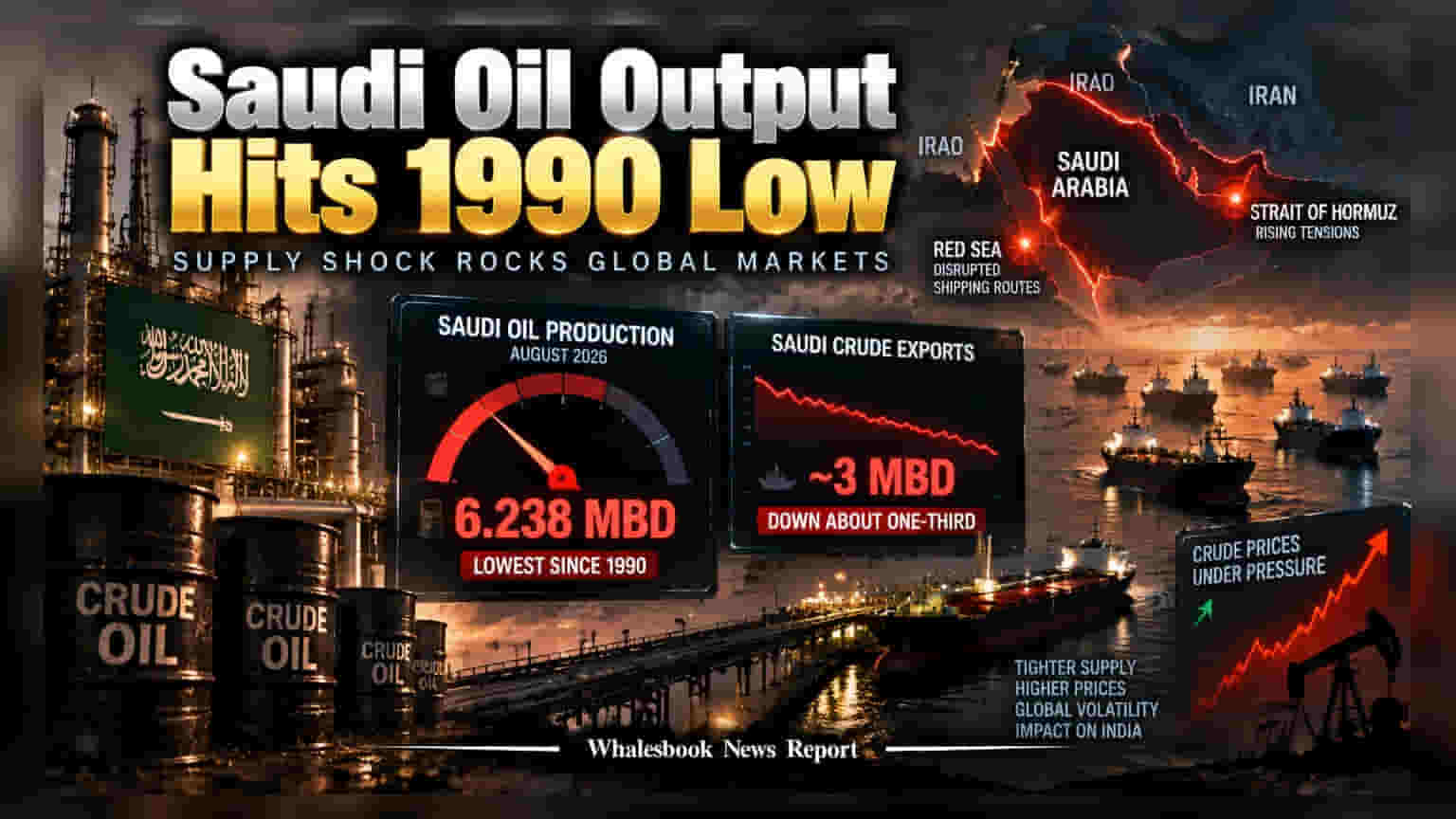
Saudi crude production fell to 6.238 million barrels per day in August 2026, the lowest level since 1990, as regional conflicts disrupted maritime export routes. This one-third drop in exports has tightened global supply, fueling concerns over rising crude prices and their impact on India’s import bill and inflation.
Saudi Arabia’s crude oil production dropped to 6.238 million barrels per day in August 2026, marking the country's lowest reported output level since 1990. This decline, a sharp reduction of 1.9 million barrels per day, comes as intensifying geopolitical hostilities between the United States and Iran continue to threaten energy shipping routes in the Middle East, particularly around the Red Sea and the Strait of Hormuz.
The supply shock is further confirmed by tanker-tracking data, which shows Saudi crude exports falling by approximately one-third to roughly 3 million barrels per day. While Saudi Arabia, as OPEC's largest producer, typically serves as a key stabiliser for global oil markets, this sustained disruption limits the world's spare capacity to handle potential outages elsewhere.
To manage the immediate shortfall, Saudi Arabia reportedly utilised oil inventories to maintain supply levels at 7.122 million barrels per day, bridging the gap between actual production and market demand. While this drawdown provides a temporary buffer for global markets, it is not a long-term solution. Continued reliance on stored oil without a recovery in production leaves the global market vulnerable if shipping disruptions persist.
For Indian investors, the situation poses significant macroeconomic risks. India imports a large portion of its crude oil requirements, and sustained supply constraints pushing global prices higher can increase the country's import bill. This puts pressure on the Indian rupee and can fuel domestic inflation, affecting both the fiscal deficit and interest rate expectations.
The impact on the Indian stock market is typically bifurcated by sector. Upstream oil producers like Oil and Natural Gas Corporation (ONGC) and Oil India, which sell crude at market-linked prices, may see improved revenue when crude prices remain elevated. Conversely, oil marketing companies such as Indian Oil Corporation (IOCL), Bharat Petroleum (BPCL), and Hindustan Petroleum (HPCL) often face margin pressure if they are unable to fully pass on rising costs to consumers at the fuel pump. Additionally, transport-heavy industries, aviation, and chemical manufacturers, which rely heavily on crude-derived feedstock, may experience rising operational costs.
The key monitorable for the market in the coming weeks will be the duration of these regional disruptions. Investors will be tracking whether Saudi Arabia can resume normal export volumes and if OPEC+ continues its policy of maintaining production levels. Any sign of a prolonged energy supply bottleneck is likely to remain a central driver of volatility in global oil prices and, by extension, the performance of energy-sensitive sectors in the Indian equity market.