

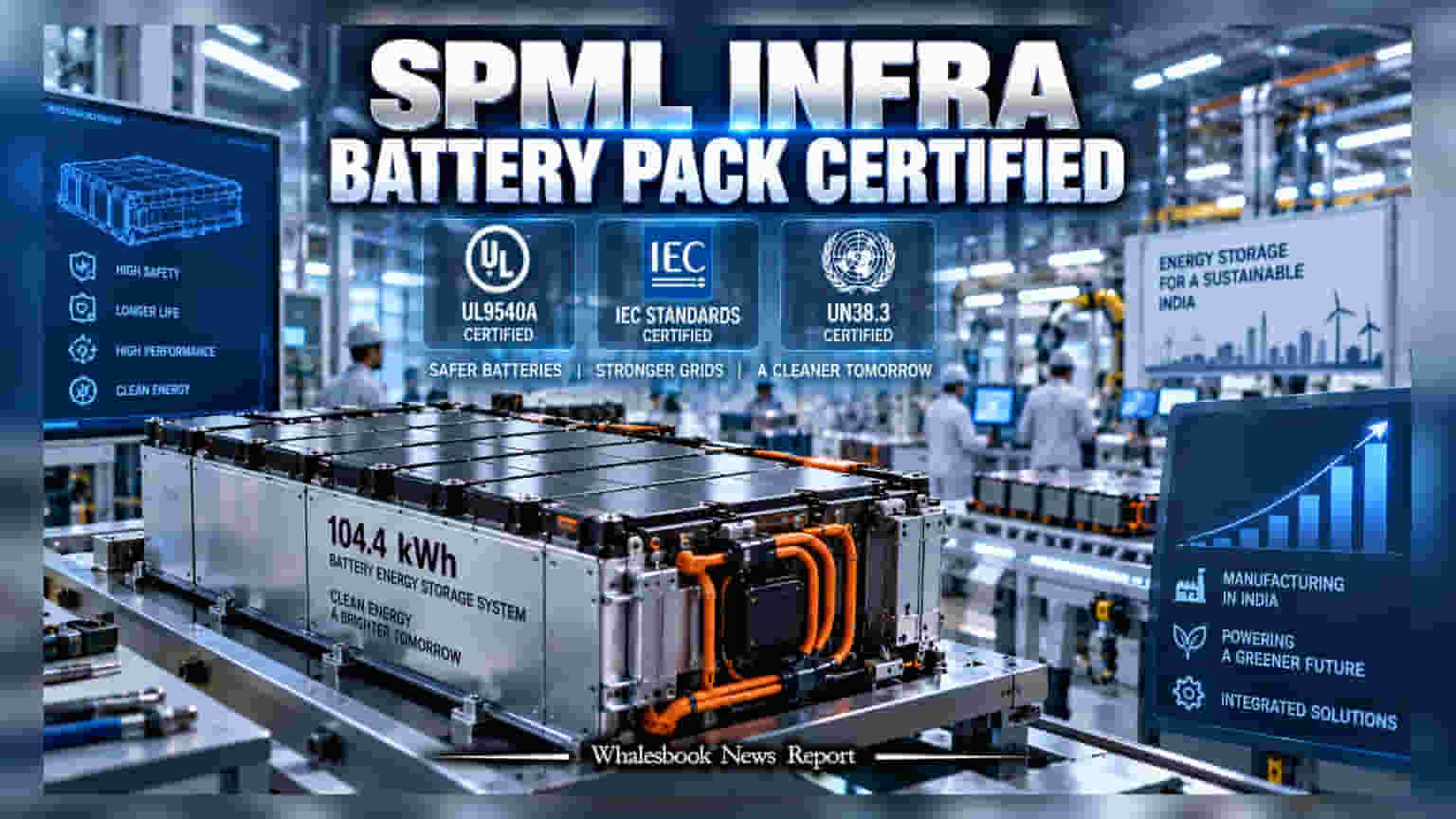
SPML Infra’s 104.4 kWh battery pack secured international safety certifications, marking its shift into energy storage manufacturing. The stock rose 5% following the announcement. Investors should watch for the successful execution of its NTPC order and potential margin impact from higher manufacturing capital requirements.
Shares of SPML Infra rose 5% on Friday following the company's announcement that its proprietary 104.4 kWh Battery Energy Storage System (BESS) pack has cleared critical international safety and performance certifications. These include the UL9540A, various IEC standards, and UN38.3, which validate the product's safety in areas such as thermal runaway protection, electromagnetic compatibility, and transportation safety. This move marks a strategic shift for the company, which has traditionally operated as an engineering, procurement, and construction (EPC) contractor, toward becoming an integrated technology and manufacturing provider.
Strategic Manufacturing Pivot
The company is currently developing battery manufacturing and integration capabilities at its facility in Pune, Maharashtra. By transitioning from a pure-play infrastructure contractor to a technology manufacturer, the firm aims to reduce its reliance on third-party battery providers. This integration is intended to support the company's long-term growth strategy by allowing it to provide end-to-end solutions for grid-scale energy storage projects.
Order Book and Financial Context
This certification is key to supporting the company’s current portfolio, specifically its major ₹1,128 crore order from NTPC for a 1 GWh energy storage project in Barauni, Bihar. As of June 2026, SPML Infra reported a total order book of ₹5,094 crore, which provides clear revenue visibility for its operations. Financially, the company showed growth in the fiscal year 2026, with a 55% increase in profit after tax to ₹76.25 crore.
Risks and Monitoring
While the expansion into battery manufacturing could potentially create a competitive advantage, it also introduces new risks for shareholders to consider. Transitioning from a project-based service model to a hardware manufacturing business involves significant execution risks, including the challenge of ramping up production effectively. Additionally, hardware manufacturing is generally more capital-intensive than a pure service-based EPC model. Investors may monitor whether this capital spending results in margin compression due to higher financing costs and increased working capital requirements.
The company’s future performance will depend on its ability to execute the NTPC project on schedule and the successful scaling of its Pune manufacturing facility. Monitoring the company’s profit margins and cash flow in coming quarters will be essential to understand if this new business vertical is generating sustainable returns.