

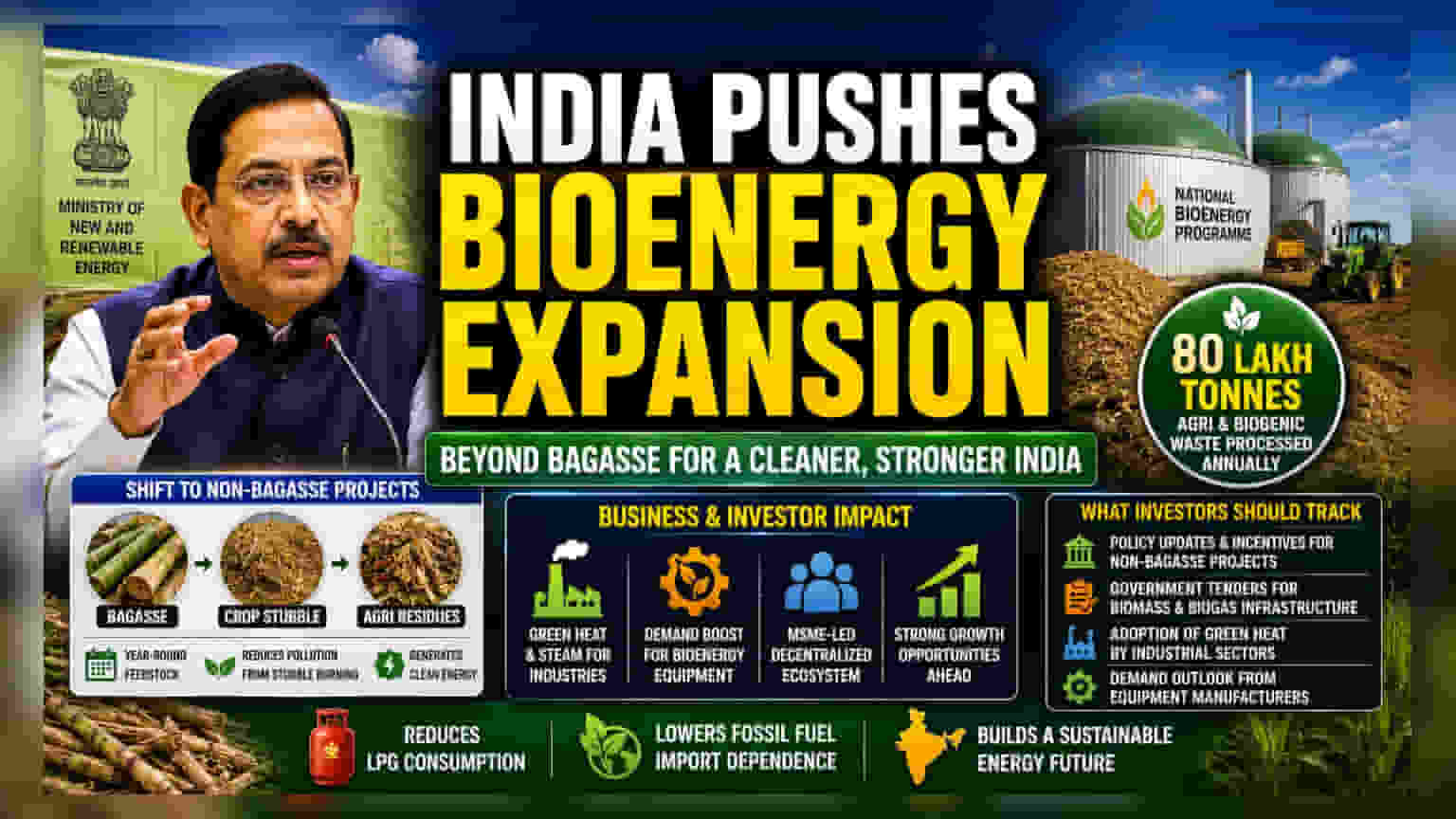
Union Minister Pralhad Joshi has ordered an acceleration of the National Bioenergy Programme, shifting focus toward non-bagasse projects and green heat applications. This initiative aims to reduce energy import dependence and improve waste management. For investors, this policy priority points to potential growth in companies providing waste-to-energy technology and project development services.
What Happened
Union Minister for New and Renewable Energy, Pralhad Joshi, has directed officials to expedite the implementation of the National Bioenergy Programme. In a recent review meeting, the minister emphasized the need to expand beyond traditional bagasse-based projects. The government reported that the program has already achieved a capacity to process approximately 80 lakh tonnes of agricultural and biogenic waste annually. The goal is to further scale these operations to reduce LPG consumption and lower India's reliance on imported fossil fuels.
The Shift To Non-Bagasse Projects
For years, much of India's bioenergy generation has relied on bagasse, which is the fibrous residue left after crushing sugarcane. While bagasse is a reliable energy source, it is inherently tied to the seasonal nature of the sugar industry. By pushing for non-bagasse projects, the government is targeting the utilization of diverse agricultural residues, such as crop stubble and other farm waste.
This shift is strategically important because it expands the potential feedstock for bioenergy plants. Instead of relying solely on sugar mills, projects can now be set up in regions where agricultural waste is abundant, potentially creating a year-round supply chain. This approach addresses the dual challenge of managing farm waste—which is often burned, causing pollution—and generating clean energy.
Direct Business And Investor Impact
This policy directive is relevant for companies operating in the renewable energy, waste management, and industrial boiler sectors. The focus on green heat and steam applications implies that industrial clusters may increasingly adopt bioenergy solutions to meet their thermal energy needs.
Companies that manufacture equipment for biomass processing, biogas plants, or biochar production could see increased demand as the government incentivizes these projects. Furthermore, the emphasis on involving Micro, Small, and Medium Enterprises (MSMEs) suggests that the government is looking to build a decentralized ecosystem for waste collection and energy production, which could open opportunities for smaller technology providers and local project developers.
Execution And Operational Risks
While the push for non-bagasse projects is significant, investors should be aware of the operational complexities. Unlike sugar mills where the waste is concentrated in one location, non-bagasse agricultural waste is widely dispersed. The logistics of collecting, transporting, and storing this waste at a centralized processing facility involves high costs and supply chain risks.
Additionally, the moisture content and chemical composition of diverse agricultural waste vary significantly, requiring robust technology to ensure consistent energy output. If the infrastructure for waste aggregation is not efficient, project viability could face pressure from fluctuating raw material availability.
What Investors Should Track
Investors may monitor the following to understand the progress of this sector:
- Updates on the National Bioenergy Programme, particularly regarding subsidies or financial incentives for non-bagasse project developers.
- Growth in government tenders related to biomass-to-energy or biogas infrastructure.
- The adoption rate of green heat and steam solutions by industrial players in manufacturing sectors.
- Management commentary from equipment manufacturers regarding the demand for biomass-processing machinery.