 Whalesbook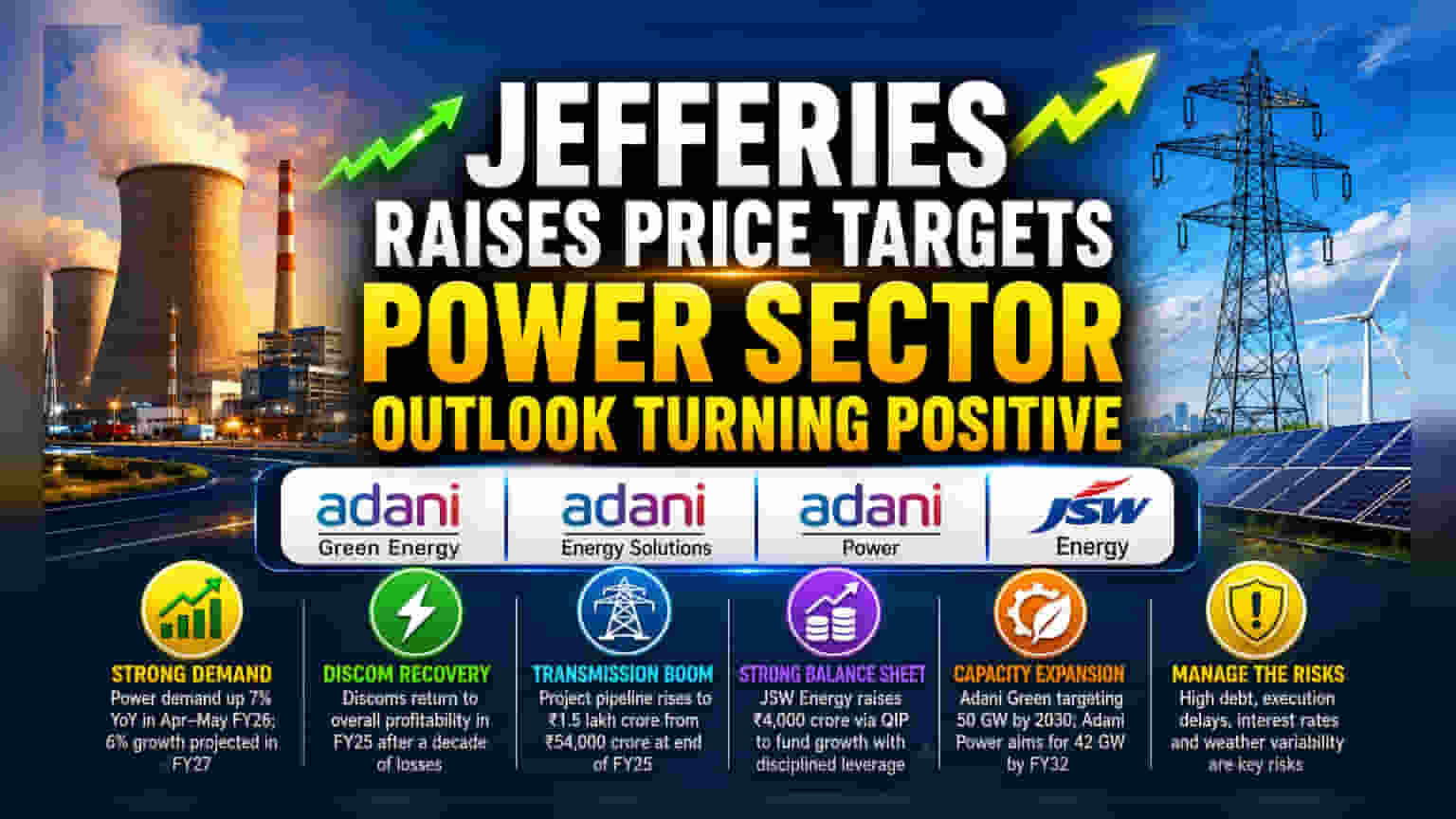


What Happened
Brokerage firm Jefferies has released an updated outlook on the Indian power sector, reaffirming a positive view on several key companies. The firm increased its price targets for Adani Green Energy Ltd., Adani Energy Solutions Ltd., Adani Power Ltd., and JSW Energy Ltd. This adjustment follows observations of strong power demand in recent months, a significant jump in the transmission project pipeline, and improvements in the financial health of power distribution companies (discoms).
Why The Power Sector Is In Focus
The Indian power sector is undergoing a transition driven by both demand and infrastructure needs. After a relatively muted FY26 due to weather patterns like extended monsoons, electricity demand is showing signs of a strong recovery. Recent data for April and May 2026 showed a year-on-year growth of 7% in power demand. Projections for FY27 suggest a growth rate of 6%, assuming normal weather conditions.
Equally important is the structural change in discoms. These companies, which are responsible for distributing electricity to end-consumers, have returned to overall profitability in FY25. This marks a major shift from a decade of losses. The stability of discoms is vital because they are the primary customers for power generators. When they are financially healthy, they are more likely to pay their bills on time, which improves the cash flow for power companies.
Additionally, the government's focus on integrating renewable energy has opened up massive opportunities in the transmission sector. The potential for new transmission projects has increased to Rs 1.5 lakh crore, a sharp rise from Rs 54,000 crore at the end of FY25. This infrastructure is essential to carry electricity from renewable energy plants to consumers across the country.
Company-Specific Context
Each company mentioned in the update has a unique growth strategy. JSW Energy has recently strengthened its balance sheet through a qualified institutional placement (QIP) of Rs 4,000 crore. This capital raising is intended to support its capacity expansion while keeping debt levels in check. The company is focusing on accelerating project execution to drive earnings growth.
Within the Adani Group, the entities have distinct roles. Adani Green Energy is targeting a significant capacity expansion to 50 GW by 2030. Adani Energy Solutions is focusing on the growing transmission opportunity and the expansion of its smart meter business, which provides a steady, regulated stream of revenue. Adani Power is pursuing its own capacity growth, with a goal to reach 42 GW by FY32.
Understanding The Risks
While the outlook for these companies is positive, the power sector is highly capital-intensive. Projects require significant upfront investment, which often means high debt. Changes in interest rates can impact the cost of borrowing, potentially affecting profitability.
Execution risk is another major factor. Building power plants or transmission lines involves complex logistics, land acquisition, and regulatory clearances. Delays in these areas can lead to cost increases and lower returns than originally planned. Furthermore, renewable energy companies are sensitive to weather conditions. If wind or solar patterns deviate significantly from historical averages, it can impact the amount of electricity generated, directly affecting revenue.
Investors should also note that while public sector giants like NTPC and Power Grid Corporation continue to lead in scale, private players are aggressively competing for market share in both generation and transmission. This competition can sometimes lead to lower margins in bidding for new projects.
What Investors Should Monitor
The most important factors to track will be the actual pace of project commissioning. Announcements are only the first step; shareholders should watch for updates on when projects actually start generating revenue. Debt management is another key area, especially if interest rates remain volatile. Finally, ongoing updates on electricity demand and discom payment patterns will provide clues on whether the sector's financial improvement is sustainable.