

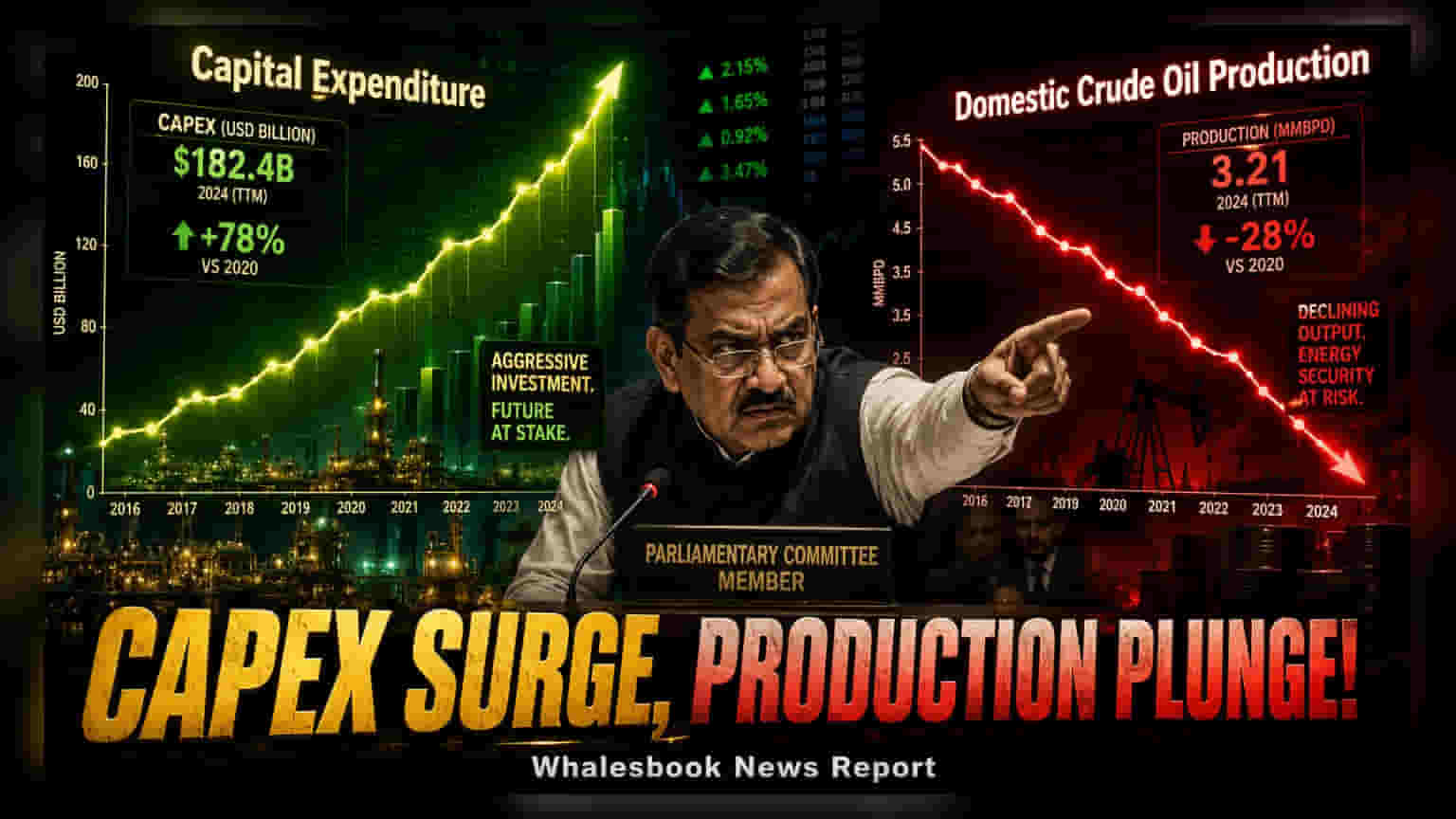
A parliamentary committee has questioned the effectiveness of rising capital spending in India's oil and gas sector. Despite investments reaching over ₹1.7 lakh crore, domestic production continues to decline. The panel has demanded a report on how new government initiatives will improve output, highlighting the need for better accountability given India's high reliance on energy imports.
A parliamentary committee on public undertakings has raised serious concerns regarding the performance of India's oil and gas public sector undertakings (PSUs). The committee has highlighted a growing disconnect where massive investments are not leading to the expected increase in domestic crude oil production.
The Gap Between Spending and Production
Recent data presented to the committee shows that the sector has been aggressively spending money on new assets and exploration. Capital spending by petroleum and natural gas PSUs has grown from ₹1.33 lakh crore in the 2020-21 financial year to a projected ₹1.70 lakh crore for 2024-25. Despite this increase in spending, crude oil output is trending downward. Production is projected to fall to 28.7 million metric tonnes (MMT) in 2024-25, compared to 34.2 MMT in 2018-19.
This trend is significant for investors and the broader economy because India relies on imports for nearly 90% of its crude oil needs. The committee has pointed out that while the government has introduced various reforms, such as the ₹84,000 crore Samudra Manthan scheme for offshore exploration and new licensing rounds, the results on the ground have not yet matched the financial outlays. The panel has labeled the ministry's earlier explanations as insufficient and is now seeking a detailed account of how these efforts will lead to concrete production gains.
Challenges Facing the Sector
The oil exploration business involves unique risks that investors often monitor. Many of India's oil fields are mature, meaning they have been producing for a long time and naturally yield less oil over the years. Additionally, oil exploration is a long-term game. It takes years—sometimes a decade or more—from the time money is spent on exploration to the time oil is actually extracted. These long gestation periods often create a lag between investment and output, which can make financial performance look weaker in the short term.
However, the committee’s demand for accountability suggests that the government wants better performance benchmarks. There is pressure to ensure that the massive capital spending does not just sit in budgets but effectively reverses the decline in domestic resources. For investors, this adds a layer of regulatory and performance scrutiny to the sector.
What Investors Should Monitor
Moving forward, the primary focus for the market will be how these PSUs demonstrate tangible results from their exploration activities. The key monitorable will be the outcome-linked reports that the ministry is expected to provide to the parliamentary panel. Investors may track progress on new offshore blocks and the implementation of the Samudra Manthan scheme to see if they eventually lead to production growth. Furthermore, the ability of these companies to manage the balance between high spending and the natural decline of mature fields will remain crucial for long-term financial health and shareholder value.