 Whalesbook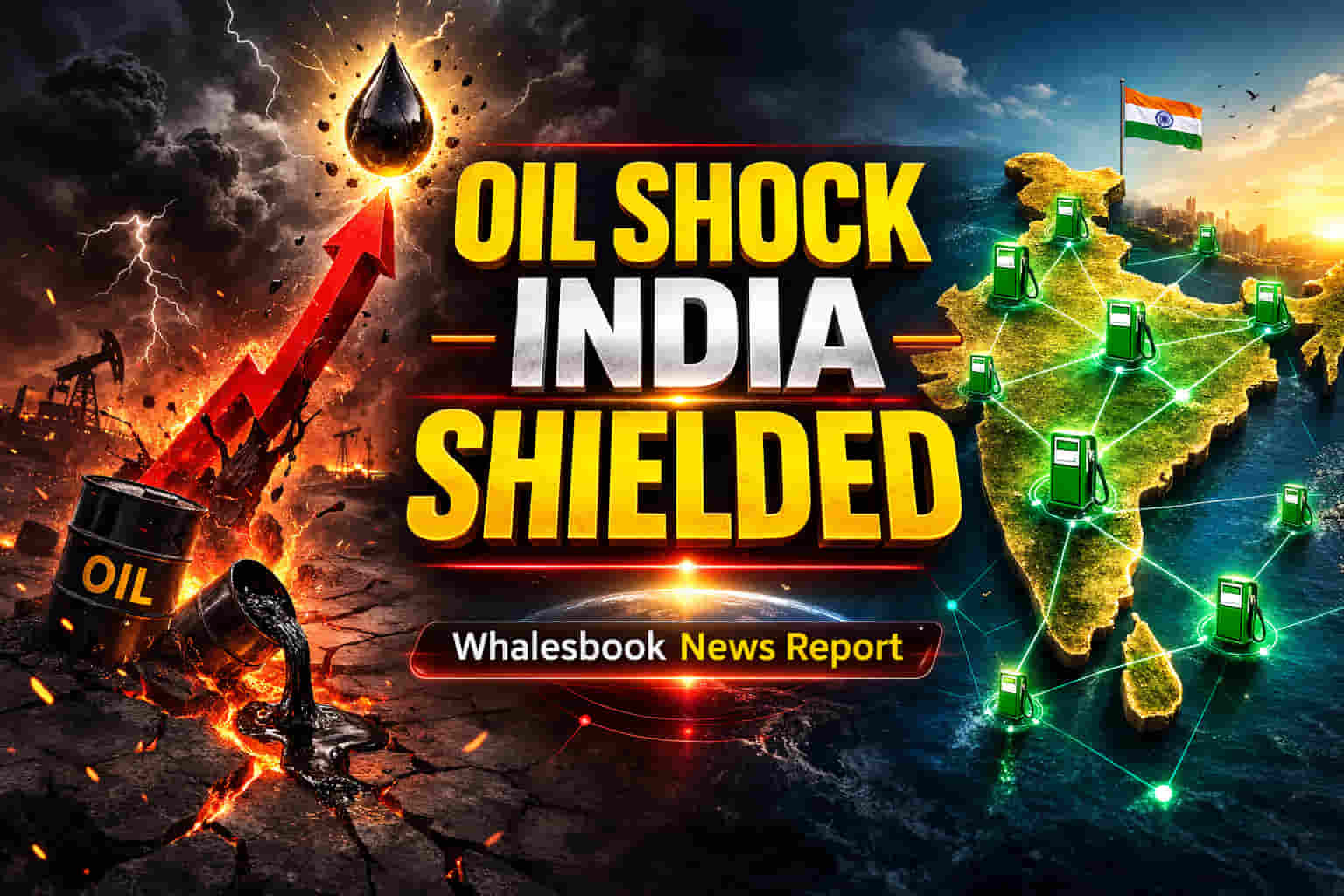
THE SEAMLESS LINK
Escalating US-Iran hostilities have pushed Brent crude near $80 per barrel, but Indian fuel prices remain stable for now. State-owned fuel retailers have built profit buffers to absorb this spike. However, India's critical 88% crude import dependency and potential Strait of Hormuz disruptions pose significant energy security risks, threatening sustained price shocks that could strain company margins and the broader economy. Recent record profits offer a temporary cushion against these underlying vulnerabilities.
The Core Catalyst: Geopolitical Shockwaves Ripple Through Energy Markets
Escalating geopolitical tensions in the Middle East have sent international oil prices surging, with Brent crude breaching the $78 per barrel mark on March 2, 2026. This sharp ascent followed US and Israeli strikes on Iran, met with retaliatory actions, immediately impacting global energy supply concerns. The market reacted swiftly, creating a clear divergence within India's energy sector. Shares of major Oil Marketing Companies (OMCs) – Indian Oil Corporation (IOC), Hindustan Petroleum Corporation Ltd (HPCL), and Bharat Petroleum Corporation Ltd (BPCL) – collectively declined by up to 6% as investors anticipated pressure on their marketing margins. In contrast, upstream oil producers like ONGC and OIL India saw their stock prices rally, directly benefiting from the higher crude price environment. This immediate market response underscores how sensitive the Indian energy stock market is to global crude price fluctuations and the prevailing geopolitical climate.
The Analytical Deep Dive: Vulnerability Amidst Profitability
Indian OMCs, including IOC (Market Cap ~₹2.53 trillion, P/E ~7.73x), BPCL (Market Cap ~₹1.62 trillion, P/E ~6.80x), and HPCL (Market Cap ~₹90,000 Cr, P/E ~6.36x), currently trade at historically low price-to-earnings multiples, suggesting they may be undervalued given their earnings power. These state-owned enterprises have demonstrated significant financial strength, reporting record combined profits of approximately ₹81,000 crore in fiscal year 2024 and ₹23,743 crore in the December 2025 quarter, providing a substantial profit buffer. [cite: Original News] However, the nation's energy security remains a paramount concern, with India importing 88% of its crude oil requirements. [cite: Original News] The potential disruption of the Strait of Hormuz, a critical chokepoint responsible for approximately 20% of global oil transit, heightens this vulnerability, particularly as India routes a significant portion of its oil and LNG imports through this waterway. Historical precedents, such as the crude price surge to $119 per barrel in June 2022 following the Ukraine conflict, illustrate the potential for extreme price volatility driven by geopolitical events. [cite: Original News] These past episodes have shown that sustained higher crude prices place earnings pressure on OMCs, as their marketing margins shrink if retail prices cannot be adjusted proportionally, a situation exacerbated by India's fuel price freeze since April 2022.
⚠️ THE FORENSIC BEAR CASE
Structural Margin Erosion: Despite robust recent earnings, the fundamental business model of Indian OMCs remains highly susceptible to crude oil price volatility. A hypothetical $10 per barrel spike in crude prices could potentially reduce marketing margins by as much as Rs 4.5 per litre, a significant impact that current profit levels may not indefinitely absorb, especially with retail fuel prices frozen since early 2022. [cite: 36, Original News] This structural weakness means that while producers directly benefit from higher prices, retailers face a squeeze, turning geopolitical risk into a direct threat to profitability.
Energy Security Bottleneck: India's profound reliance on imported energy, with roughly 40-50% of its oil and gas transiting the Strait of Hormuz, creates an acute chokepoint risk. Sustained disruptions could propel Brent crude prices beyond $100 per barrel, possibly reaching $120, far exceeding the current financial resilience of the OMCs. Such a scenario would not only jeopardize fuel availability but also inflate India's annual import bill by approximately $2 billion for every $1 increase in crude prices, directly fueling inflation and posing a threat to broader economic stability.
Limited Pricing Power: The government's policy of shielding consumers from immediate price hikes, especially with state assembly elections approaching, curtails the OMCs' ability to pass on escalating input costs. [cite: Original News] While this strategy offers short-term relief, it amplifies the financial pressure on fuel retailers during periods of intense global energy market volatility, creating a policy-driven vulnerability.
The Future Outlook
While immediate retail fuel price increases in India are improbable due to existing profit margins and government policy directives, the underlying vulnerability of the nation's energy security is starkly exposed. [cite: Original News] Projections from various analysts indicate that sustained geopolitical conflict in the Middle East could drive Brent crude prices well above $100 per barrel, posing a significant challenge to the current pricing framework and potentially overwhelming the financial resilience of the OMCs. Although the EIA forecasts a long-term average Brent price of around $55 per barrel for 2026, this outlook likely does not fully account for the immediate risk premiums associated with current geopolitical escalations. The government's balancing act between consumer protection and national energy security will face critical tests if disruptions in key shipping lanes persist, potentially necessitating a reassessment of existing policies.