 Whalesbook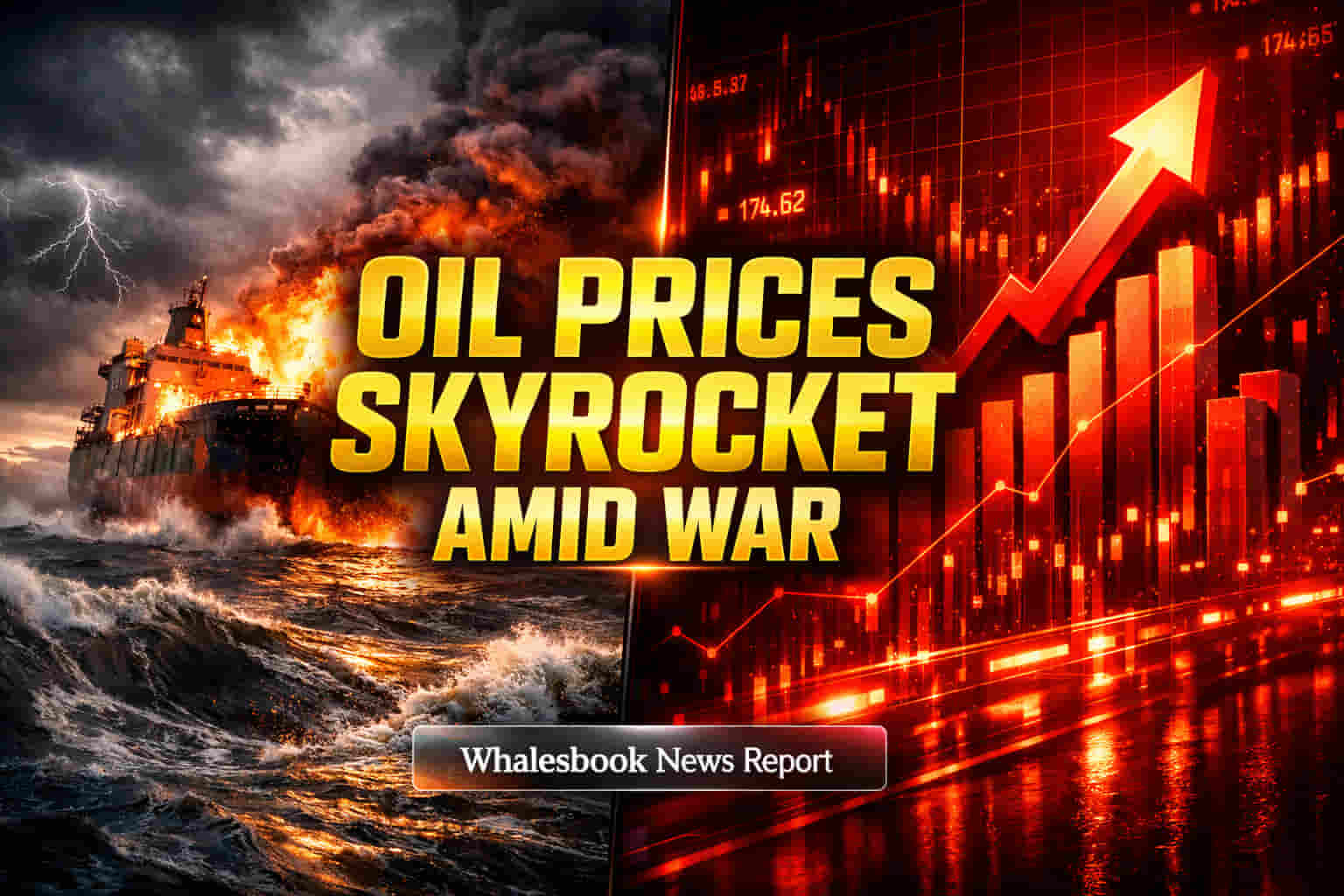


The Geopolitical Catalyst
Missile strikes on two tankers off the coast of Oman on Sunday, March 1, 2026, have dramatically escalated regional tensions, sending crude oil prices skyrocketing. Brent crude briefly traded around $82.37 per barrel on March 2, marking a significant jump from earlier in the month and nearing historical highs. West Texas Intermediate (WTI) also saw substantial gains, trading near $72.52 per barrel. The attacks, targeting vessels near the critical Strait of Hormuz—a waterway responsible for approximately 20% of global oil shipments—have triggered immediate concerns over supply chain integrity. Major shipping lines, including Maersk, Hapag-Lloyd, and CMA CGM, have already suspended transits through the Strait, rerouting vessels and warning of significant delays. War risk insurance premiums have reportedly surged by 50%, adding further costs to maritime operations.
Market Resilience vs. Historical Parallels
Despite the sharp price increase, the market's reaction appears more contained than in previous crises. Current price levels, while elevated, remain below the peaks of nearly $147 per barrel seen in July 2008 or the $139 per barrel reached in March 2022 following Russia's invasion of Ukraine. Several factors are contributing to this relative resilience. The substantial growth in US shale oil production over the past decade, which saw output climb from 8.8 million barrels per day (bpd) in 2016 to a record 13.6 million bpd in 2025, has increased global supply and lessened dependence on Middle Eastern sources. Additionally, analysts note that global oil supply has recently outpaced demand, leading to gradually building inventories, a trend projected by the International Energy Agency (IEA) to potentially continue, creating a supply glut in 2026. China's expanded strategic petroleum reserves also offer a buffer against short-term disruptions. [cite: original text]
India's Critical Energy Artery
For India, the geopolitical shock carries disproportionately high stakes. The nation imports roughly 90% of its crude oil requirements, with approximately 50% of these imports, translating to about 2.5 to 2.7 million bpd, transiting through the Strait of Hormuz. The vulnerability extends critically to other energy sources: nearly 60% of India's liquefied natural gas (LNG) imports and a staggering 80-85% of its liquefied petroleum gas (LPG) pass through this vital waterway. Unlike crude oil, India lacks comparable strategic LPG reserves, making its supply chain exceptionally sensitive to any disruption. A sustained $10-$15 per barrel increase in oil prices could inflate India's annual import bill by over $20 billion, widening its current account deficit and pressuring the rupee, complicating the central bank's disinflation efforts.
OPEC+ Response and Spare Capacity Constraints
In response to the escalating tensions, the eight-member OPEC+ group announced a modest increase in production quotas, agreeing to add 206,000 bpd from April. This planned increase, however, represents less than 0.2% of global demand and was reportedly decided before the latest conflict escalation. While Saudi Arabia and the UAE hold significant spare production capacity, much of their export infrastructure remains reliant on passage through the Strait of Hormuz, limiting the immediate effectiveness of their output capabilities in mitigating transit disruptions.
The Bear Case: Structural Weaknesses and Risks
While market fundamentals offer some buffer, the immediate conflict presents considerable risks. The closure or severe restriction of the Strait of Hormuz would create a critical bottleneck, irrespective of global supply-demand balances. The threat of Iran targeting the waterway, though not officially declared closed, has practical implications with shipping companies halting operations. The IEA's forecasts of a potential supply glut in 2026 are predicated on a stable geopolitical environment; prolonged conflict could rapidly shift the market balance. Furthermore, while Iran's own oil production is relatively small compared to global output, its direct involvement in targeting shipping introduces significant uncertainty and could lead to further retaliatory actions. The modest OPEC+ increase is insufficient to offset a full-scale disruption, and the market is sensitive to the geopolitical risk premium.
Future Outlook
Analysts are divided on the duration and ultimate price impact, with forecasts ranging from $100 to over $150 per barrel in severe disruption scenarios. Public Investment Bank Bhd anticipates prices could temporarily trade in the $100-$110 range if transit is sustainedly interfered with, while warning that a $15-$20 surge is possible from current levels. The situation remains fluid, heavily dependent on Iran's actions and the de-escalation of regional tensions. The continued flow through the Strait of Hormuz is the paramount determinant for global oil prices and market stability. Traders emphasize that the market is highly sensitive to further developments, especially whether energy infrastructure or major shipping routes face direct targeting. [cite: original text]