

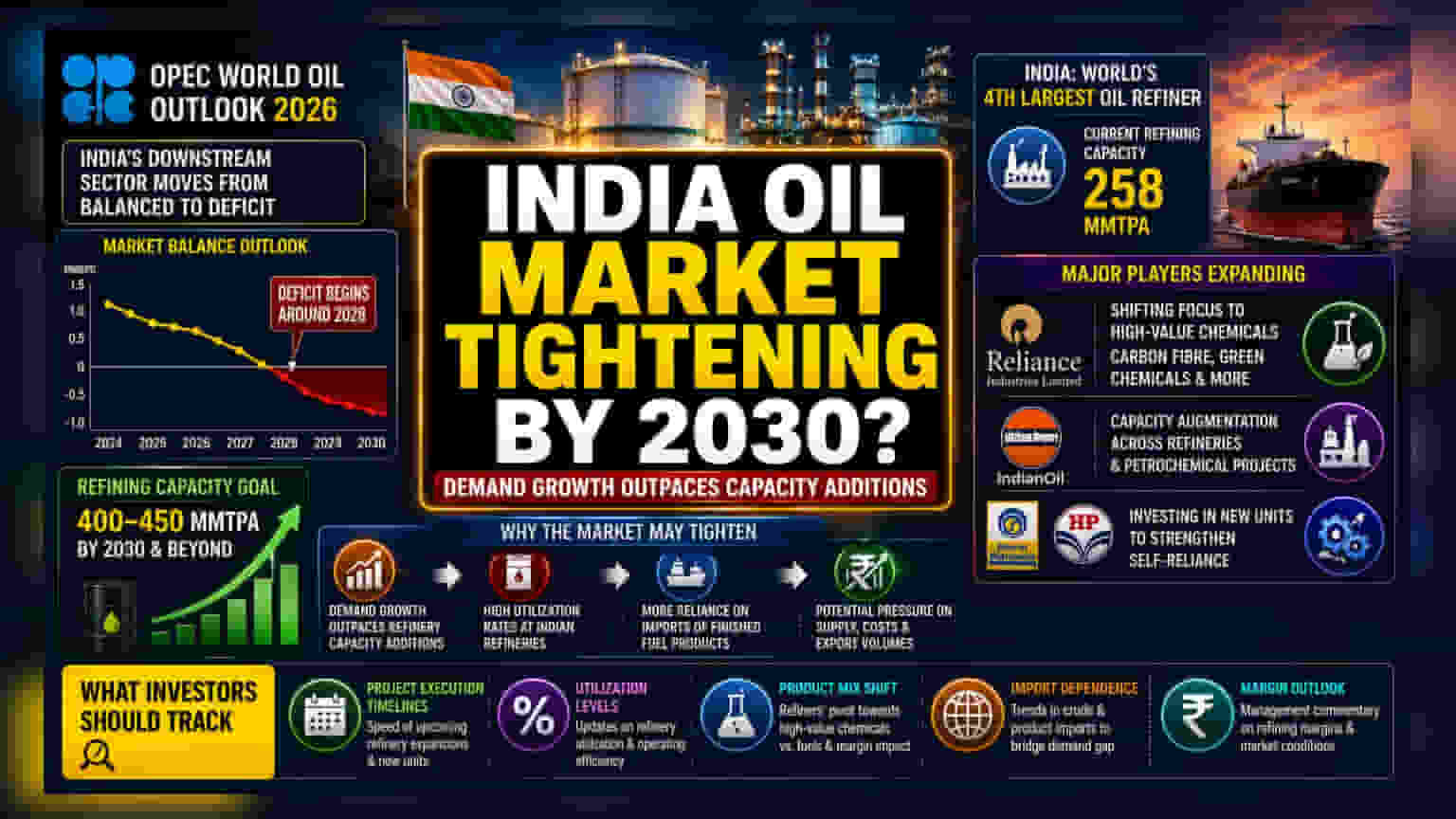
OPEC’s latest World Oil Outlook warns that India's growing oil demand may outpace domestic refinery capacity by 2030. This shift is expected to transition the market from a balanced state to a tighter supply environment, potentially increasing petroleum product imports. Investors are monitoring how major domestic refiners like Reliance Industries, Indian Oil, and others ramp up expansion to meet these needs.
What Happened
India is expected to face a tightening petroleum market by 2030, as oil demand growth is likely to outstrip the pace of refinery capacity additions. According to the recently released OPEC World Oil Outlook 2026, India's downstream sector—the part of the industry that refines crude oil into products like petrol and diesel—is moving from a balanced state to a deficit. While India remains one of the world's largest refining hubs, the sheer scale of rising energy demand is creating a challenge for domestic refiners to keep pace, potentially forcing the country to rely more on imports of finished petroleum products.
Why The Market May Tighten
India is the world's fourth-largest oil refiner, with a current capacity of approximately 258 million metric tonnes per annum (MMTPA). The OPEC report estimates that while India will continue to add refining capacity, the volume of crude oil processing needed will grow faster than the new capacity coming online. The report predicts a deficit that could start to emerge around 2028. For investors, this shift is meaningful because it suggests that even as major companies expand their operations, domestic supply may struggle to meet the full needs of the country's economy, leading to a higher dependence on global markets to bridge the gap.
Expansion Plans and Company Context
India’s major players, including Indian Oil Corporation (IOCL), Reliance Industries (RIL), Bharat Petroleum (BPCL), and Hindustan Petroleum (HPCL), have been actively expanding their footprint. India has set long-term goals to push its refining capacity toward 400–450 MMTPA by 2030 and beyond.
Reliance Industries, which operates the world’s largest single-location refinery complex in Jamnagar, has been shifting its strategy. During its 2026 Annual General Meeting, the company emphasized a move toward converting crude oil into high-value chemicals, such as carbon fibre and green chemicals, rather than just conventional fuels. Meanwhile, state-run firms like IOCL are investing heavily in capacity augmentation across existing refineries and petrochemical projects to strengthen self-reliance.
The Balancing Act for Refiners
Refining is a business of margins, and Indian refiners currently operate at high utilization rates. The industry often balances domestic fuel needs with export opportunities. If the domestic market becomes 'tight' due to capacity constraints, refiners may prioritize supplying the local market, which could reduce the volume of petroleum products available for export. While this helps meet domestic demand, it could influence the export revenue streams that have historically supported these companies.
What Investors Should Track
For investors, the key monitorable is the execution timeline of upcoming refinery projects across both public and private sectors. With significant capital already allocated toward infrastructure, the speed at which these new units are commissioned will determine whether India can keep imports in check. Additionally, investors should watch for management commentary on utilization levels and whether refiners continue to pivot toward high-value petrochemicals, which offer different margin profiles than standard petrol and diesel production. The broader sector trend will depend on whether domestic expansion can effectively match the pace of India’s growing appetite for energy.