

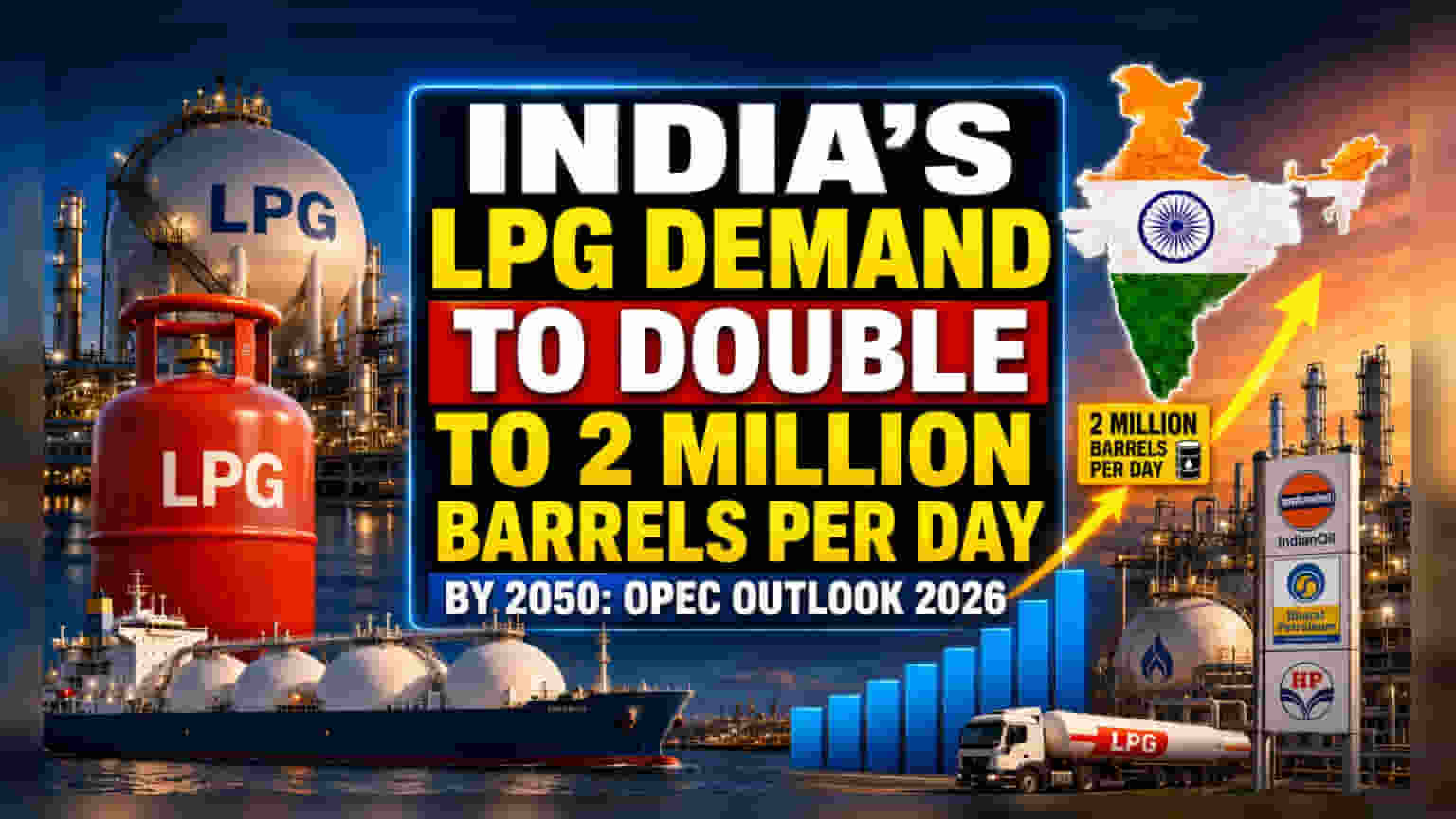
The Organization of the Petroleum Exporting Countries (OPEC) projects India's LPG demand will double to 2 million barrels per day by 2050. This growth, driven by residential cooking and the petrochemical industry, has significant implications for oil marketing companies, government energy policies, and import reliance. Investors should watch how this trend impacts subsidy budgets and energy infrastructure investment.
What Happened
The Organization of the Petroleum Exporting Countries (OPEC) released its World Oil Outlook 2026, forecasting a major rise in India's Liquefied Petroleum Gas (LPG) consumption. The report estimates that India’s demand will reach 2 million barrels per day (mb/d) by 2050, effectively doubling from current levels. This long-term projection places India as a central engine for global oil demand, with the country expected to contribute significantly to the increase in global energy consumption over the next 25 years.
Impact on Energy Companies
For Indian investors, this trend is directly relevant to Oil Marketing Companies (OMCs) like Indian Oil Corporation (IOCL), Bharat Petroleum (BPCL), and Hindustan Petroleum (HPCL). These companies manage the vast network of LPG distribution, including bottling plants and supply chains across the country. A doubling of demand implies a need for sustained infrastructure expansion, such as increased storage capacity, transport logistics, and bottling plants, which may require ongoing capital spending by these state-owned energy firms.
The Petrochemical Connection
Beyond household use, the report highlights the petrochemical industry as a key growth pillar. Companies such as Reliance Industries and other major petrochemical players increasingly use LPG and ethane as feedstocks to produce ethylene and other derivatives. As India continues to build its manufacturing and industrial base, the demand for LPG as a chemical building block is expected to rise, creating a dual-demand environment alongside residential needs.
Policy Drivers and Risks
The residential demand growth is heavily tied to government initiatives like the Pradhan Mantri Ujjwala Yojana (PMUY), which has expanded LPG access to millions of households. While this policy supports volume growth, it also brings financial considerations. India relies heavily on imported LPG to meet local demand. Consequently, OMCs face risks related to international price volatility and the financial burden of subsidies when global oil prices rise. If government subsidy support fluctuates, it can directly impact the profit margins of these marketing companies.
Potential Challenges
While the demand outlook is strong, several factors could influence the business reality. The energy transition poses a long-term risk if household cooking habits shift toward electricity, such as the adoption of induction stoves, or if natural gas (PNG) gains significant market share in urban areas. Additionally, India’s heavy dependence on imports means that geopolitical tensions or currency depreciation can inflate the cost of servicing this demand, putting pressure on the government's fiscal balance and the operational costs of energy firms.
What Investors Should Track
Moving forward, investors may want to track government policy on LPG subsidies, which remains a primary variable for OMC profitability. Additionally, updates on petrochemical capacity expansion by major industrial players will indicate how quickly industrial demand is catching up to residential usage. Finally, monitoring the pace of infrastructure commissioning, such as new import terminals and pipeline networks, will provide insight into how energy companies are preparing to meet this projected 2050 target.