 Whalesbook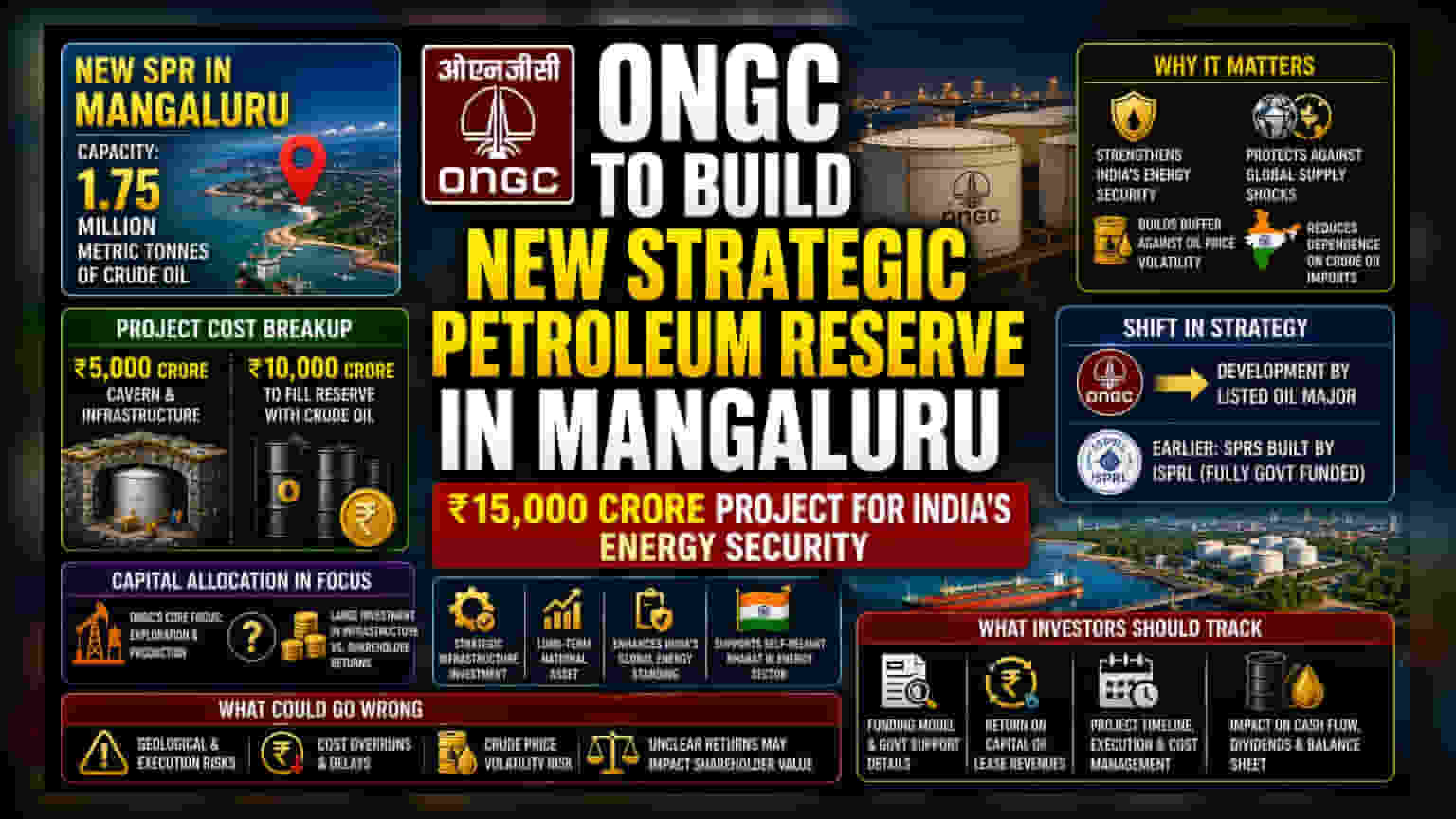
India has tasked ONGC with developing a 1.75 million metric tonne strategic petroleum reserve in Mangaluru at an estimated cost of ₹15,000 crore. As the company takes on this national infrastructure project, investors are focusing on how this heavy capital allocation will impact cash flow and returns, especially compared to its core oil and gas exploration business.
What Happened
State-run Oil and Natural Gas Corporation (ONGC) has been directed to build a new strategic petroleum reserve (SPR) in Mangaluru. This project aims to store 1.75 million metric tonnes of crude oil. The total estimated cost for the facility is ₹15,000 crore. This development is a response to the need for better energy security, particularly in light of recent global supply shocks caused by geopolitical tensions in the Middle East.
The Financial Breakup
The estimated ₹15,000 crore investment is split into two parts. Approximately ₹5,000 crore is earmarked for building the underground cavern and necessary infrastructure. The remaining ₹10,000 crore will be used to fill the reserve with crude oil. This distinction is important for investors because the cost of the crude oil effectively becomes an inventory asset, while the construction cost is a long-term infrastructure investment. The company has not yet provided full details on how it plans to recover this capital or whether it will operate the facility on a commercial lease model, as seen in other newer SPR projects.
Shift in Infrastructure Strategy
Historically, India’s strategic oil reserves were developed and managed by Indian Strategic Petroleum Reserves Ltd (ISPRL), a special-purpose vehicle fully funded by the government. The decision to involve ONGC, a listed entity with its own public shareholders, marks a change in how the country funds and builds such energy infrastructure. While the company has the land and technical experience in the energy sector, taking on a project of this scale represents a significant commitment of funds that would otherwise be available for oil and gas exploration or dividends.
Capital Allocation Questions
For investors, the key monitorable is capital allocation. ONGC is primarily an exploration and production company. Its core business involves finding and extracting oil and gas, which typically offers different risk and return profiles compared to managing storage infrastructure. When a large company diverts significant cash to a government-mandated infrastructure project, investors often look for clarity on the expected return on capital. If this project is treated as a strategic asset with no clear path to commercial returns, it may impact the company's free cash flow and dividend-paying capacity.
Sector And Peer Context
Global energy consumers like the United States, China, and Japan maintain massive strategic reserves to insulate their economies from supply disruptions. India currently lags in this capacity. While the government has recently allowed private sector involvement in SPR development, such as the contract awarded to Megha Engineering & Infrastructures Ltd for the Padur facility, this is the first time a state-run oil major like ONGC has been tasked with the full development of a new site. This sets a precedent for how future energy security projects might be funded.
What Could Go Wrong
Large infrastructure projects, especially underground caverns for oil storage, carry execution risks. Geological challenges can lead to delays or cost overruns. Furthermore, because a large portion of the budget is for the crude oil itself, the value of the inventory will fluctuate with global oil prices. If the company is forced to fill the reserve when oil prices are high, it may face pressure if prices drop significantly later, depending on the accounting model used for the reserve.
What Investors Should Track
Investors should look for management commentary on the funding structure of this project in future quarterly filings. Specifically, it is worth tracking whether the government provides a direct subsidy, guarantees a return, or allows ONGC to lease the storage space to third parties to generate revenue. These details will determine whether the project is value-accretive for shareholders or a drag on the balance sheet. Tracking the project timeline and any potential updates on the operational model will be essential.

