

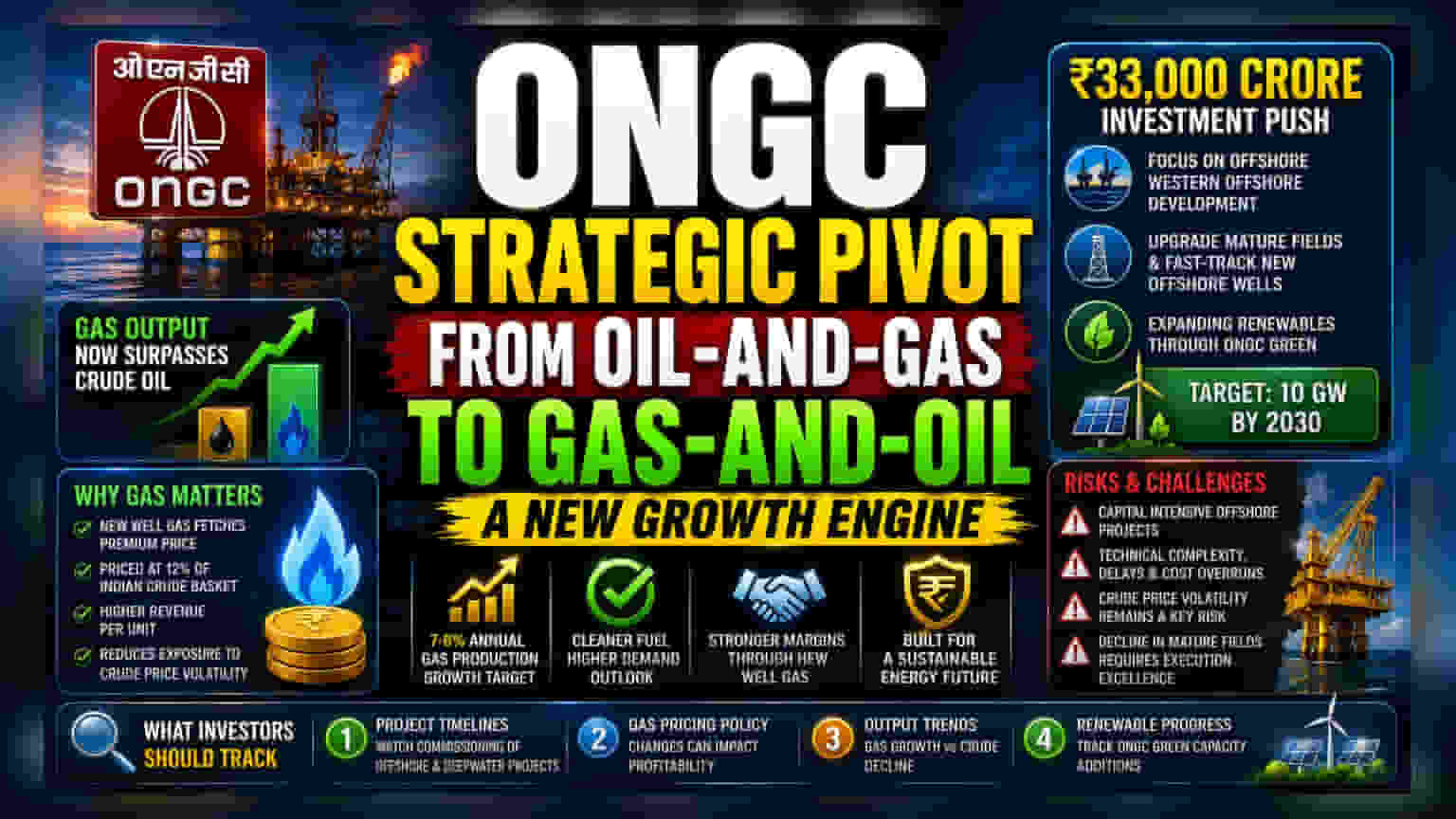
State-owned ONGC is repositioning as a 'gas-and-oil' company after its natural gas production crossed crude oil output. The explorer is deploying ₹33,000 crore into offshore projects to boost higher-margin gas production and hedge against crude price volatility.
What Happened
Oil and Natural Gas Corporation (ONGC) has officially signaled a strategic pivot in its business model. Chairman Arun Kumar Singh announced that the company is moving away from its traditional 'oil-and-gas' identity to become a 'gas-and-oil' producer. This shift is not just branding; it reflects a material change in the company's production portfolio, where natural gas output has now surpassed crude oil volumes.
The company is realigning its long-term growth strategy to prioritize natural gas, anticipating that this cleaner fuel will be the primary driver of expansion as crude oil production remains relatively stable without major new discoveries.
Why the Shift to Gas Matters
For investors, this transition is about more than just volume; it is about profit margins. ONGC’s move is driven by the economics of 'new well gas.' Gas produced from newly drilled wells fetches a premium price compared to older, legacy fields. While legacy gas is sold under an administered price mechanism, new well gas is priced at 12% of the Indian crude basket, allowing for better earnings.
Management highlighted that this new well gas is already delivering higher revenue per unit. By expanding its gas footprint, ONGC aims to reduce its sensitivity to global crude oil price swings and capitalize on India’s rising demand for cleaner industrial and domestic fuel.
The ₹33,000 Crore Investment Push
To support this target of 7–8% annual gas production growth, ONGC is investing approximately ₹33,000 crore into offshore projects. The primary focus is the Western Offshore region, which currently accounts for a significant portion of the company’s total hydrocarbon output.
These funds are being deployed to upgrade mature fields and fast-track the development of new offshore wells. Beyond fossil fuels, the company is also expanding its renewable energy capacity through its subsidiary, ONGC Green, with an ambitious target of reaching 10 GW of capacity by 2030, which includes solar, wind, and green hydrogen projects.
Risks and Execution Challenges
While the pivot to gas offers potential margin benefits, it is not without hurdles. The energy sector is inherently capital-intensive and subject to complex operational risks. Developing deepwater and ultra-deepwater fields involves significant technical difficulty and carries a risk of cost overruns and delays.
Additionally, despite the move toward gas, the company’s financial health remains heavily linked to global crude oil prices. As long as a large portion of its revenue is tied to oil, the company remains vulnerable to geopolitical tensions and crude price volatility. Furthermore, older, mature fields are naturally seeing a decline in production, meaning ONGC must successfully execute these new projects just to maintain current output levels before it can achieve net growth.
What Investors Should Track Next
Investors may monitor several key triggers in the coming quarters:
- Project Timelines: Watch for regular updates on the commissioning dates of the Western Offshore and deepwater projects.
- Gas Pricing Policy: Any change in government policy regarding gas pricing could materially impact the profitability of the 'new well gas' strategy.
- Output Trends: Compare the growth rate of gas production against the decline rate of the legacy crude fields to assess the net impact on overall volumes.
- Renewable Progress: Track the capacity addition of ONGC Green to see how quickly it transitions from a traditional explorer to an integrated energy provider.