

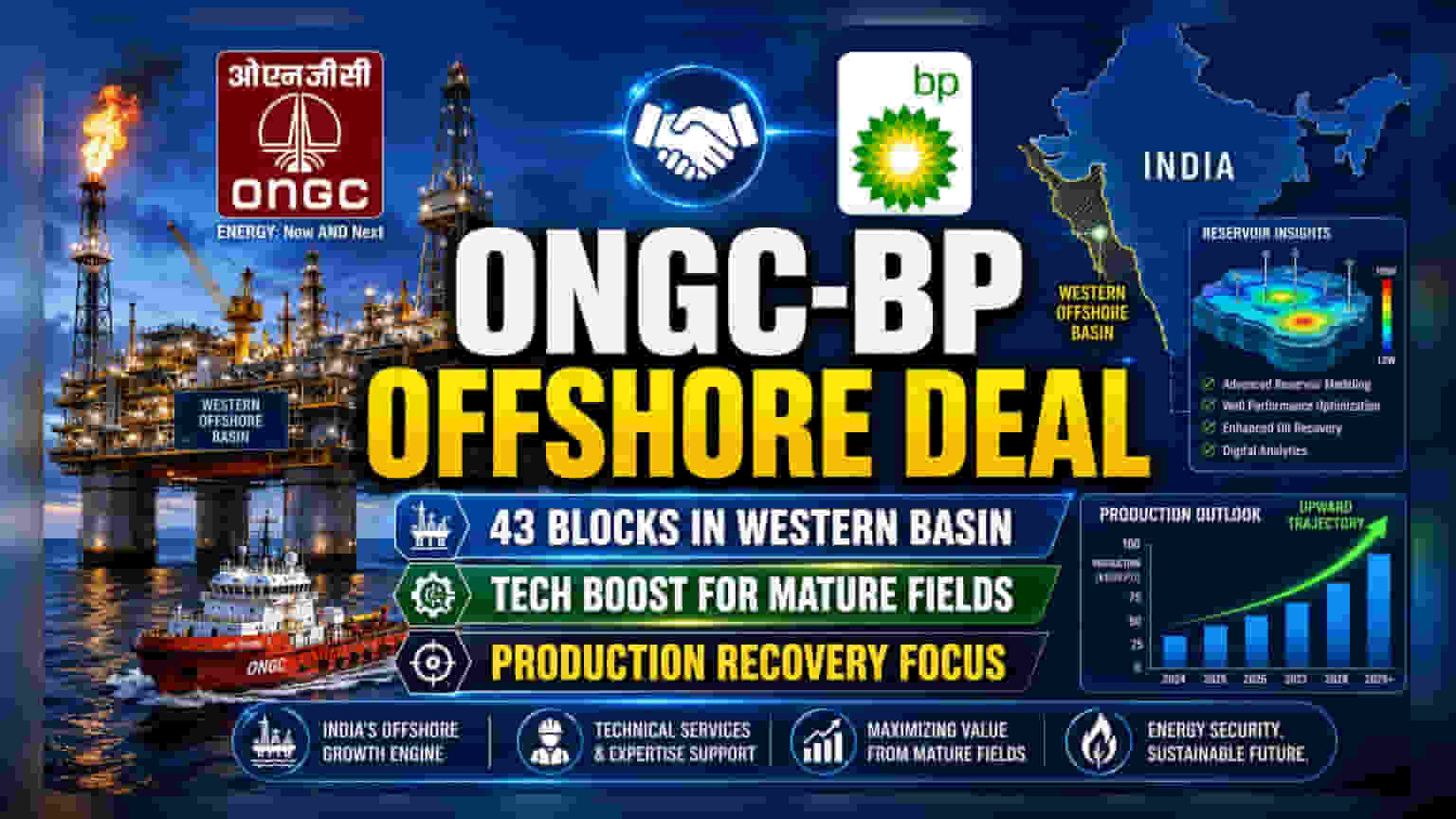
ONGC has signed a technical services contract with bp to improve oil and gas production across its 43 Western Offshore blocks. This deal builds on their previous Mumbai High cooperation to tackle falling output in mature fields. Investors will watch if this tech-driven approach helps reverse production decline and improves efficiency for India's largest oil producer.
What Happened
State-owned Oil and Natural Gas Corporation (ONGC) has entered into a new technical services contract with global energy major bp, effective June 25, 2026. The agreement focuses on the Western Offshore Basin, which is ONGC’s primary hydrocarbon region and accounts for a significant portion of its total domestic output. Under this deal, bp will serve as the technical advisor for 43 blocks, bringing advanced reservoir management and production techniques to these assets. This expands upon an earlier pilot agreement involving the Mumbai High field that was initiated in February 2025.
The Strategy Behind The Deal
For years, ONGC has faced the challenge of managing mature oil and gas fields where natural production rates have historically declined. By partnering with bp, the company aims to apply modern global technologies to squeeze more output from these older assets. The goal is to stabilize production and improve the recovery factor—the percentage of oil and gas that can be extracted from a reservoir. This is a strategic move, as ONGC contributes roughly 64% of India’s domestic crude oil and natural gas. With India heavily dependent on energy imports, increasing domestic supply is a national priority.
How The Payment Works
The financial structure of this contract is designed to align the interests of both companies. For the first two years, the agreement includes a fixed fee structure. Following this period, the contract transitions to a performance-linked model. This means that a portion of the payment to bp will be tied directly to the incremental production achieved through their technical interventions. This incentive-based model protects ONGC from paying for services that do not deliver tangible improvements in output.
The Challenge Of Mature Fields
While the partnership aims to boost efficiency, investors should understand the operational realities. The Western Offshore Basin consists of aging fields that have been in production for decades. Reversing or even moderating the decline in these mature fields is technically complex and carries no guarantee of success. While bp’s global experience is a positive factor, the actual impact on production will depend on the specific geological conditions of each block and the successful execution of the proposed technical interventions. The company still retains full operational control and ownership, meaning it carries the final responsibility for project outcomes.
What Investors Should Track
Moving forward, investors and analysts will focus on whether this technical intervention successfully alters the production curve in the Western Offshore region. Key monitorables include management commentary on production volumes from these 43 blocks in future quarterly results, and the cost-benefit analysis of the performance-linked fees. If the project helps stabilize output, it could support operational margins. However, if production continues to decline despite the tech-driven efforts, it may raise questions about the efficacy of such partnerships on aging assets. Market participants will also look for updates on the commissioning of specific recovery projects within these blocks.